Tag: competency based assessment

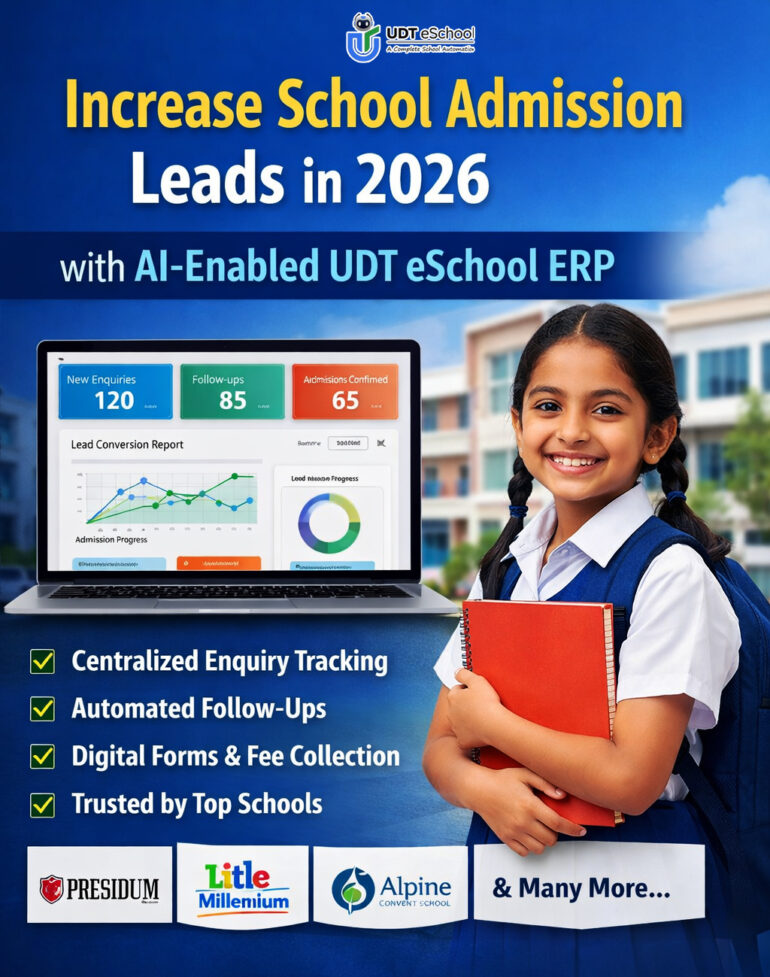
  • Increase School Admission Leads in 2026 | With AI Enabled UDT eSchool ERP

    Increase School Admission Leads in 2026 | With AI Enabled UDT eSchool ERP

    Increase School Admission Leads
    Increase School Admission Leads in 2026 with UDT eSchool AI Enabled ERP

    How to Increase School Admission Leads in 2026 | UDT eSchool ERP

    In 2026, schools are facing a new admission reality. Parents are more informed, comparisons are instant, and response time often decides where a child finally enrolls.

    While many schools receive enquiries, very few convert them efficiently into confirmed admissions. The gap is not marketing โ€” it is process, speed, and experience.

    This guide explains how to increase school admission leads and get conversions in 2026, and how an AI-enabled ERP like UDT eSchool ERP plays a crucial role in improving admission outcomes.

    Related: CBSE guidelines for school admissions


    Why Schools Are Losing Admission Leads (Without Realizing It)

    Why Schools Are Losing Admission Leads
    Why Schools Are Losing Admission Leads

    Most schools struggle with admissions due to:

    As a result, high-intent parents quietly choose another school that appears more organized and responsive.


    How to Increase School Admission Leads in 2026

    School Admission Lead Conversion Funnel

    1. Build a Clear and Transparent Admission Process

    Parents want clarity. Schools that clearly explain:


    Admission steps


    Required documents


    Timelines


    Fee structure


    create immediate trust.

    A documented and digital process significantly improves enquiry confidence.

    ๐Ÿ”— Related: School Admission Process Reference


    2. Respond Faster to Every Enquiry

    Speed is a conversion multiplier.

    Schools that respond within 24 hours see significantly better engagement compared to delayed responses. Manual handling often fails here.

    Automation ensures no enquiry is ignored.


    3. Track Every Admission Lead Centrally

    Without centralized tracking, schools cannot:


    Identify quality leads


    Measure campaign performance


    Improve conversion ratios


    A structured system is essential for growth.

    Related:


    How UDT eSchool ERP Helps Increase School Admission Leads

    Streamlining Admission Processes

    Centralized Enquiry & Lead Management

    UDT eSchool ERP captures and manages:

    All data is stored in one centralized dashboard, eliminating missed opportunities.

    Automated Follow-Ups and Notifications

    The ERP enables:

    This ensures every enquiry is followed up professionally.

    Digital Admission Forms and Document Collection

    Parents can:

    This reduces friction and increases form completion rates.

    Seamless Fee Collection and Confirmation

    Once a parent decides:

    ๐Ÿ”— Related: School Fee Management System


    The Role of AI-Enabled ERP in Admission Growth

    AI Enabled ERP in Admission Growth

    Schools adopting AI-enabled ERP systems gain a strong operational advantage.

    AI-driven features help by:

    Several large school groups and progressive institutions such as Presidium, Little Millennium, Alpine, and others rely on technology-driven admission workflows to manage high enquiry volumes efficiently.

    While admission growth depends on multiple factors, schools using AI-powered ERP systems are better equipped to handle, nurture, and convert leads consistently.

    Related: National Education Policy 2020


    Why ERP-Driven Schools Convert More Admissions

    ERP Driven Admission Funnel

    Schools using ERP-based admission systems:

    ๐Ÿ”— Related: School ERP Software Guide


    โœ… Frequently Asked Questions (FAQs)

    How can schools increase admission leads in 2026?

    Schools can increase admission leads in 2026 by adopting digital admission processes, responding faster to enquiries, tracking leads centrally, and improving parent communication using ERP systems.


    Why is lead management important for school admissions?

    Lead management ensures that no enquiry is missed, follow-ups are timely, and schools can track which channels generate quality admission leads, improving overall conversion rates.


    How does ERP software help increase school admissions?

    ERP software helps increase school admissions by centralizing enquiries, automating follow-ups, enabling digital forms, and improving transparency throughout the admission process.


    Is UDT eSchool ERP suitable for both small and large schools?

    Yes, UDT eSchool ERP is scalable and suitable for schools of all sizes, from emerging institutions to large school groups managing high admission volumes.


    Can ERP really improve admission conversion rates?

    ERP improves admission conversion rates by reducing response delays, organizing follow-ups, enhancing parent experience, and providing data insights to optimize the admission process.


    Conclusion

    Increase School Admission Leads In 2026
    Increase School Admission Leads In 2026

    Increasing admission leads in 2026 is not just about visibility โ€” it is about experience, responsiveness, and structure.Schools that adopt digital, AI-enabled admission processes consistently outperform others in enquiry handling and conversions.

    UDT eSchool ERP empowers schools to increase school admission leads and streamline admissions, improve parent trust, and build a scalable system for long-term growth.


    Related Articles

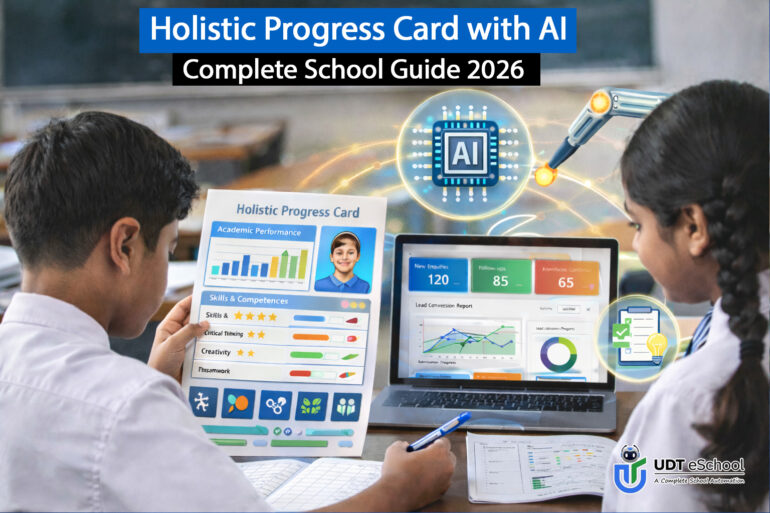
  • Holistic Progress Card with AI in Schools | 2026 Guide

    Holistic Progress Card with AI in Schools | 2026 Guide

    Holistic Progress Card with AI
    Holistic Progress Card with AI

    Holistic Progress Card with AI in Schools – A 2026 Implementation Guide

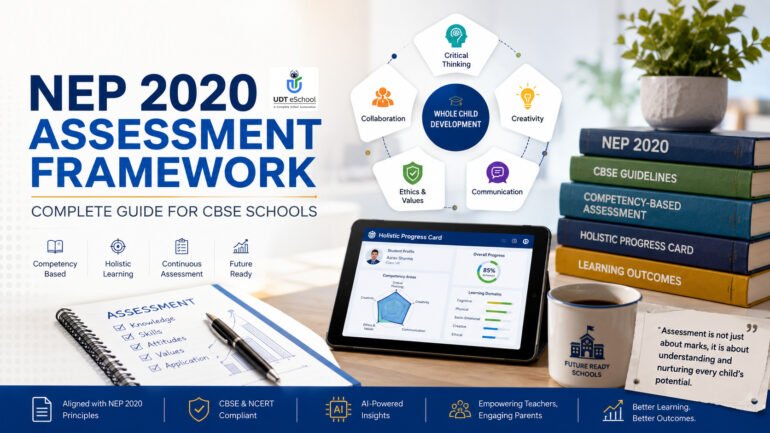
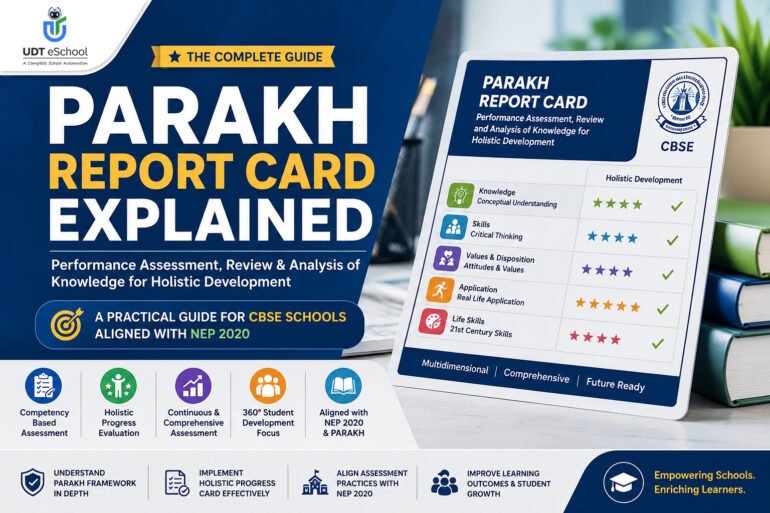
    Holistic progress card with AI is transforming how schools assess students in 2026. Moving beyond marks and grades, schools are now adopting competency-based, multi-dimensional evaluation models aligned with CBSE (Central Board of Secondary Education), NEP 2020 (National Education Policy 2020), and PARAKH guidelines.

    In 2026, schools across India are shifting from traditional marks-based evaluation to Holistic Progress Cards (HPC)โ€”structured, multi-dimensional reports that capture a studentโ€™s complete learning journey. This transition is driven by NEP 2020 and national frameworks, making HPC essential for compliance and modern education standards. With AI-enabled platforms like your school ERP, schools can implement these systems efficiently, accurately, and at scale.

    What Is a Holistic Progress Card?

    What Is A Holistic Progress Card
    What Is A Holistic Progress Card

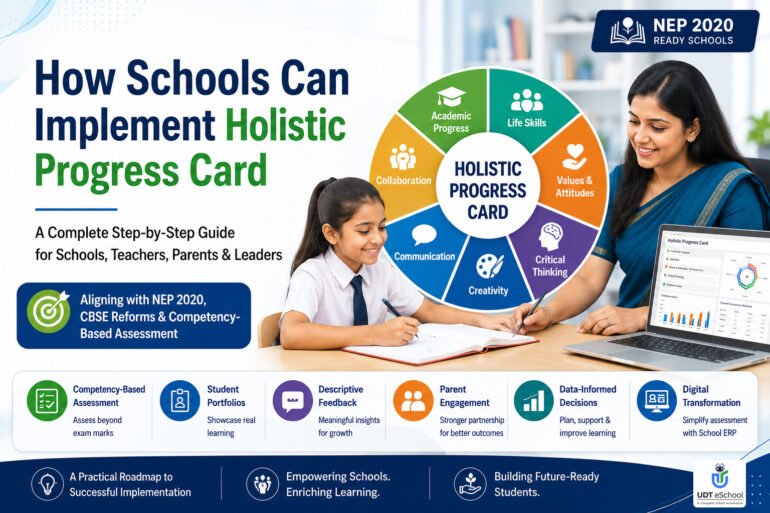
    The holistic progress card with AI enables schools to assess both academic and non-academic development in a unified and structured format.

    A Holistic Progress Card (HPC) provides a 360-degree evaluation of student performance. Instead of focusing only on exam marks, it includes:

    Traditional To Holistic Progress
    Traditional To Holistic Progress
    • Cognitive skills
    • Emotional and social development
    • Physical growth
    • Creativity and problem-solving
    • Self-assessment and peer feedback

    This model reflects the learner-centric vision of NEP 2020 and is widely adopted by CBSE schools moving toward competency-based assessment systems.

    ๐Ÿ‘‰ Common searches this section answers:

    • โ€œwhat is holistic progress card in CBSEโ€
    • โ€œ360 degree assessment NEP meaningโ€

    This approach mirrors the learner-centric philosophy of the National Education Policy (NEP) 2020.


    Why Schools Must Adopt HPC in 2026

    HPC Assesment Transformation
    HPC Assesment Transformation

    ๐Ÿ“Š Moves Beyond Marks

    HPC shifts evaluation from memorization-based exams to competency-based learning, improving conceptual understanding and critical thinking.

    ๐Ÿ‘จโ€๐Ÿ‘ฉโ€๐Ÿ‘ง Integrates Teacher, Parent & Peer Feedback

    HPC incorporates multiple perspectives, making assessment more collaborative, transparent, and accurate.

    ๐Ÿ“… Ongoing Development Mapping

    Instead of year-end results, HPC tracks student progress continuously, helping schools improve long-term learning outcomes.


    Core Features Of Holistic Progress Cards

    Core Features Of Holistic Progress Cards
    Core Features Of Holistic Progress Cards

    Holistic Progress Cards are designed to provide a detailed and meaningful understanding of student development.

    They typically include:

    • Self-assessment and reflection
    • Teacher observations and qualitative feedback
    • Peer and parent inputs
    • Academic performance indicators
    • Skill and competency tracking
    • Co-curricular and activity records

    These elements ensure that student evaluation goes beyond marks and reflects real learning progress.


    Role of AI in Holistic Progress Cards

    Role of AI in Holistic Progress Cards
    Role of AI in Holistic Progress Cards

    An AI-enabled holistic progress card allows schools to move from manual evaluation to intelligent, data-driven assessment systems.

    Artificial Intelligence enhances accuracy, efficiency, and insights in HPC implementation:

    ๐Ÿ” Automated Analysis

    AI processes large volumes of academic and behavioral data to identify patterns, strengths, and learning gaps.

    ๐Ÿง  Adaptive Feedback

    AI provides personalized insights and recommendations based on student performance, supporting continuous improvement.

    ๐Ÿ“Š Smart Reporting

    AI generates structured progress reports instantly, supported by real-time dashboards for teachers and parents.

    According to UNESCO, digital assessment tools significantly improve learning outcomes when applied effectively.


    Benefits of AI-Enabled HPC Implementation

    Benefits of AI-Enabled HPC Implementation
    AI-Enabled HPC Benefits

    AI-powered HPC systems offer clear advantages for schools, teachers, and parents.

    ๐Ÿš€ Faster, Better Assessment

    Automates evaluation tasks, reducing manual workload and saving time.

    ๐Ÿ“ˆ Insightful Parent Engagement

    Provides structured, easy-to-understand progress reports for parents.

    ๐Ÿ“Œ Early Intervention

    Helps identify learning gaps early, enabling timely corrective actions.

    ๐Ÿง  Competency-Driven Learning

    Supports skill-based education aligned with NEP 2020 goals.


    Challenges Schools Face Without AI

    Challenges Schools Face Without AI HPC
    Challenges Schools Face Without AI HPC

    Without AI and digital systems, implementing HPC becomes complex and inefficient.

    Common challenges include:

    • Manual data collection and consolidation
    • Delayed feedback cycles
    • Increased teacher workload
    • Inconsistent evaluation standards

    Schools searching for โ€œproblems in implementing NEP 2020โ€ often encounter these exact issues. AI-based systems help eliminate these bottlenecks and improve accuracy.


    How UDT eSchool ERP Supports AI-Driven Holistic Progress Cards

    UDT eSchool ERP provides an integrated solution for implementing AI-powered Holistic Progress Cards effectively.

    ๐Ÿ“‹ Unified Student Data

    Centralizes academic, behavioral, and activity records in one platform.

    ๐Ÿค– AI-Assisted Evaluation

    Automates competency mapping and performance analysis.

    ๐Ÿ“Š Intelligent Dashboards

    Offers real-time insights for teachers and school leaders.

    ๐Ÿ‘ช Parent Portal

    Enhances communication through transparent and accessible progress tracking.

    ๐Ÿ”— Related read:
    SAFAL Exam Updated Guide

    ๐Ÿ‘‰ Also explore:


    Why Choose UDT eSchool for Holistic Progress Card?

    UDT eSchool offers a complete AI-powered solution designed specifically for modern schools.

    It simplifies Holistic Progress Card implementation by automating evaluation, data collection, and report generation.

    The platform ensures compliance with CBSE and NEP 2020 while reducing administrative workload.

    ๐Ÿ‘‰ Schools using UDT eSchoolโ€™s school ERP system can seamlessly manage assessments, attendance, and even fee management systemsย  from a single platform.

    This integrated approach allows schools to focus more on student growth rather than administrative challenges.


    HPC and NEP 2020 Alignment

    The Holistic Progress Card framework aligns directly with key national initiatives:

    • NEP 2020 learner-centric evaluation
    • PARAKH competency-based standards
    • NIPUN Bharat foundational goals

    This ensures that schools adopting HPC remain compliant with Indiaโ€™s evolving education policies.


    Practical Steps to Implement HPC with AI

    Schools can implement HPC effectively by following these steps:

    1. Define competency-based evaluation frameworks
    2. Configure ERP systems for structured data collection
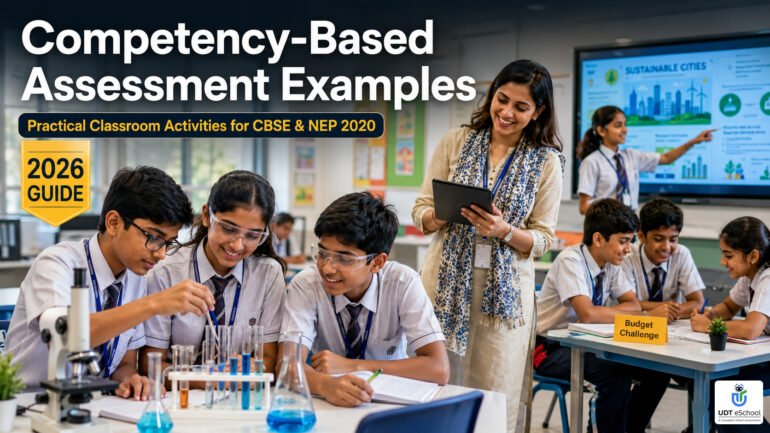
    3. Train teachers on observational and skill-based assessment
    4. Integrate AI-driven analytics tools
    5. Generate and review progress cards regularly
    6. Engage parents through digital reporting systems

    ๐Ÿง  People Also Search For

    When exploring Holistic Progress Cards and AI-based assessment systems, users also search for related topics to better understand implementation, compliance, and tools. These queries reflect real concerns of schools adapting to NEP 2020 and CBSE guidelines.

    • What is CBSE holistic progress card format 2026?
    • How to implement holistic progress card in schools step by step?
    • What is competency-based assessment in NEP 2020?
    • AI in student assessment tools for schools in India
    • Best school ERP software for CBSE schools
    • Difference between report card and holistic progress card
    • PARAKH assessment framework explained
    • How AI helps teachers in student evaluation
    • Digital progress card system for schools India
    • Continuous and comprehensive evaluation vs HPC

    ๐Ÿ‘‰ These topics are closely aligned with frameworks from Central Board of Secondary Education and National Education Policy 2020, making them essential for schools aiming to stay compliant and future-ready.


    ๐Ÿ“‹ Frequently Asked Questions

    What is a Holistic Progress Card?

    A Holistic Progress Card is a 360-degree evaluation system that tracks academic, social, emotional, and skill-based development of students.

    What is a Holistic Progress Card in CBSE?

    A Holistic Progress Card is a comprehensive student evaluation system introduced under NEP 2020 that measures academic performance, skills, and overall development.

    Why do schools need AI for HPC?

    AI automates analysis, ensures consistency, and provides insights that are difficult to generate manually.

    Is Holistic Progress Card mandatory for CBSE schools in 2026?

    CBSE is gradually implementing HPC, making it essential for schools to adopt structured and digital assessment systems.

    Does HPC replace traditional report cards?

    HPC enhances traditional report cards by adding multiple assessment dimensions; many schools use both during transition.

    How can schools implement Holistic Progress Cards effectively?

    Schools can use AI-powered ERP platforms to manage evaluation, automate reporting, and ensure compliance with NEP guidelines.

    How does AI help in creating Holistic Progress Cards?

    AI automates data collection, ensures consistent evaluation, and generates reports instantly, saving time and improving accuracy.

    How does AI improve parent-school communication?

    AI-powered systems provide real-time updates, structured reports, and better transparency for parents.

    What is the difference between a report card and a Holistic Progress Card?

    A traditional report card focuses on marks, while a Holistic Progress Card evaluates complete student development, including skills and behavior.


    Conclusion

    The Holistic Progress Card with AI represents the future of student assessment in India. As education moves toward competency-based and learner-centric models, schools adopting AI-powered HPC systems gain efficiency, accuracy, and deeper engagement.

    Implementing a holistic progress card with AI is no longer optional for CBSE-aligned schoolsโ€”it is essential for compliance and long-term success.

    UDT eSchool ERP provides the tools needed to implement this transformation effectively and position schools as leaders in modern education.


    Related Articles