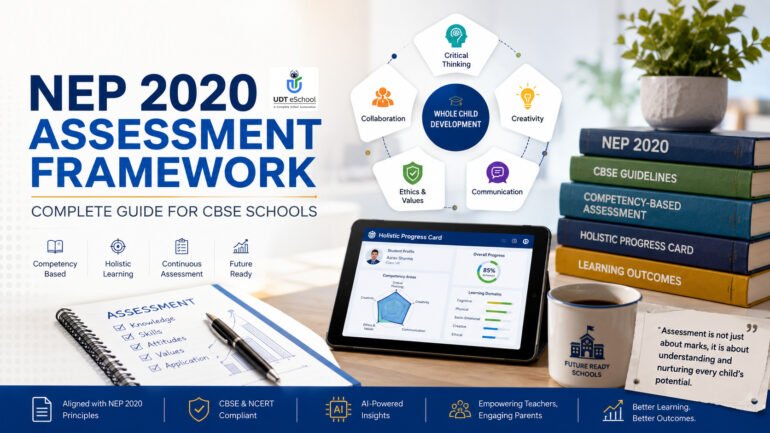
Complete NEP 2020 Assessment Framework for Future-Ready Schools
NEP 2020 Assessment Framework represents one of the most significant shifts in Indian education, redefining how schools measure student learning and success. Instead of focusing primarily on marks and examinations, it encourages schools to assess how well students apply knowledge, solve problems, collaborate with others, and develop essential life skills.
For school leaders, this transformation extends beyond changing question papers or report cards. It requires rethinking classroom practices, teacher feedback, assessment design, and the overall learning experience. Initiatives such as PARAKH, competency-based assessment, and the Holistic Progress Card are all interconnected elements of this broader vision.
In this comprehensive guide, you’ll gain a clear understanding of the NEP 2020 Assessment Framework, explore its core principles, learn how it differs from traditional assessment methods, and discover practical strategies that schools can adopt to implement these reforms successfully. Whether you’re a principal, teacher, academic coordinator, or school administrator, this article provides a roadmap for building a future-ready assessment ecosystem that supports meaningful student growth.
The Evolution of Assessment Under NEP 2020
The traditional education system in India has long relied on examinations, marks, and grades as the primary indicators of student achievement. While this approach established common academic standards, it often measured how much students could remember rather than how effectively they could understand, apply, and use their knowledge in real-life situations.
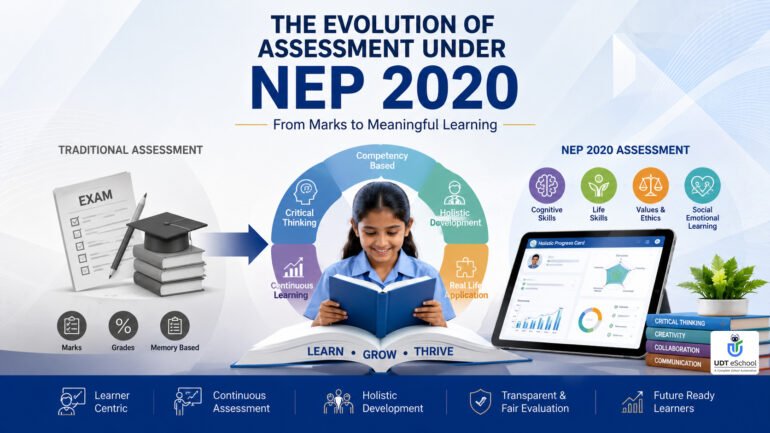
As education evolved and the demands of the 21st-century workforce changed, it became increasingly evident that academic success alone was no longer sufficient. Today’s learners require critical thinking, communication, creativity, collaboration, adaptability, digital literacy, and problem-solving skills to thrive in higher education, careers, and everyday life.
Recognising this shift, the National Education Policy (NEP) 2020 introduced a new vision for assessment—one that treats assessment as an integral part of the learning journey rather than merely a mechanism for awarding marks.
Instead of evaluating students only at the end of a chapter, term, or academic year, the NEP encourages schools to continuously observe, guide, and support learner progress throughout the academic session. This enables teachers to identify learning gaps early, personalise instruction, and help every child achieve meaningful academic growth.
The policy also places equal importance on cognitive development, practical application, social-emotional learning, ethical values, and life skills, ensuring that assessment reflects the overall development of the learner rather than only examination performance.
This learner-centric philosophy forms the foundation for other major reforms such as competency-based assessment, the Holistic Progress Card, and the establishment of PARAKH, all of which work together to create a more balanced, transparent, and future-ready assessment ecosystem for Indian schools.
Understanding the Evolution of Assessment Under NEP 2020
The National Education Policy (NEP) 2020 marks a fundamental shift in how schools understand, measure, and support student learning. Rather than viewing assessment as a periodic exercise conducted only to assign marks or grades, the policy positions assessment as a continuous process that improves teaching, guides learning, and helps every student reach their full potential.
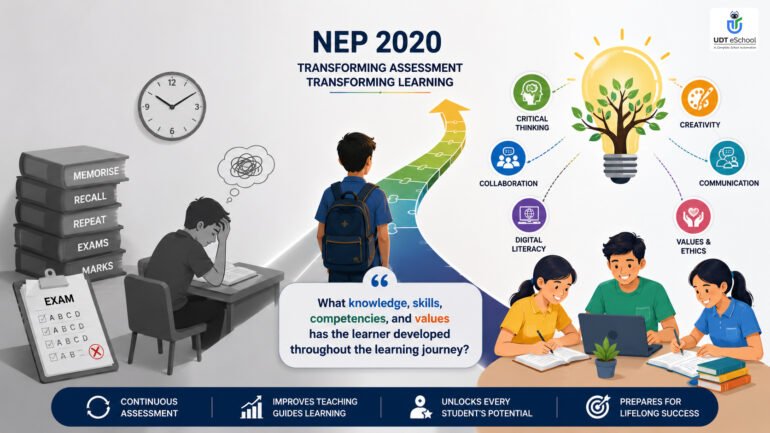
For decades, India’s school education system primarily relied on examinations that rewarded memorisation and textbook recall. While these assessments provided a standardised way to evaluate academic performance, they often overlooked whether students could apply their knowledge, think critically, solve real-world problems, or collaborate effectively with others.
As the world rapidly evolves, employers and higher education institutions increasingly value competencies such as creativity, communication, analytical thinking, adaptability, teamwork, and digital literacy. Recognising this transformation, NEP 2020’s vision for assessment to move beyond examination-centric learning and adopt an assessment culture that prepares students for lifelong success.
Instead of asking “How many marks did a student score?”, schools are encouraged to ask a much more meaningful question:
“What knowledge, skills, competencies, and values has the learner developed throughout the learning journey?”
This change in perspective forms the foundation of every assessment reform introduced under NEP 2020, including competency-based assessments, the Holistic Progress Card, and PARAKH.
What Is the NEP 2020 Assessment Framework?
The NEP 2020 Assessment Framework is a learner-centred approach to school assessment that moves beyond rote memorisation and one-time examination scores towards competency-based, continuous and holistic evaluation. It encourages schools to assess conceptual understanding, application of knowledge, critical thinking, problem-solving, creativity, collaboration and overall learner development.
The framework does not mean eliminating examinations. Instead, it calls for a broader assessment ecosystem in which examinations are complemented by formative assessment, classroom observation, projects, portfolios, practical activities, feedback and other evidence of learning.
For schools, the practical shift is from asking only “How much did the student score?” to also asking “What can the student understand, apply and demonstrate?”
How NEP 2020, PARAKH and the Holistic Progress Card Are Connected
NEP 2020 provides the broader policy vision for transforming school education and assessment. PARAKH was established within NCERT as the National Assessment Centre to support assessment standards, guidelines and related activities. The Holistic Progress Card (HPC) is one of the major assessment initiatives developed by PARAKH to support more comprehensive and competency-based assessment.
The relationship can therefore be understood simply:
NEP 2020 → Policy vision for assessment reform
PARAKH → National assessment framework and implementation support
HPC → A holistic, stage-wise assessment tool supporting competency-based learning
PARAKH has developed HPCs for the Foundational, Preparatory, Middle and Secondary stages, reflecting the different assessment needs of learners at each stage.
For schools, these are not three unrelated reforms. They are interconnected parts of India’s broader shift towards competency-based, learner-centred assessment.
How Does NEP 2020 Assessment Apply to CBSE Schools?
For CBSE schools, the assessment direction under NEP 2020 is reflected through an increasing emphasis on competency, application, conceptual understanding and higher-order thinking. CBSE has developed competency-based learning frameworks and assessment resources that provide guidance on learning outcomes, assessment objectives, question types and rubrics.
This does not mean that CBSE schools should abandon examinations. Rather, schools can progressively broaden assessment practices so that written examinations work alongside classroom activities, projects, practical work, portfolios, formative assessment and other evidence of learning.
The practical goal is not to conduct more assessments, but to make assessment more meaningful.
Why India Needed a New Assessment Framework
For many years, success in schools was largely determined by examination marks. Students often focused on completing the syllabus, memorising answers, and performing well in final examinations because these scores influenced academic progression and future opportunities.
Although this system created uniformity, it also introduced several long-standing challenges.
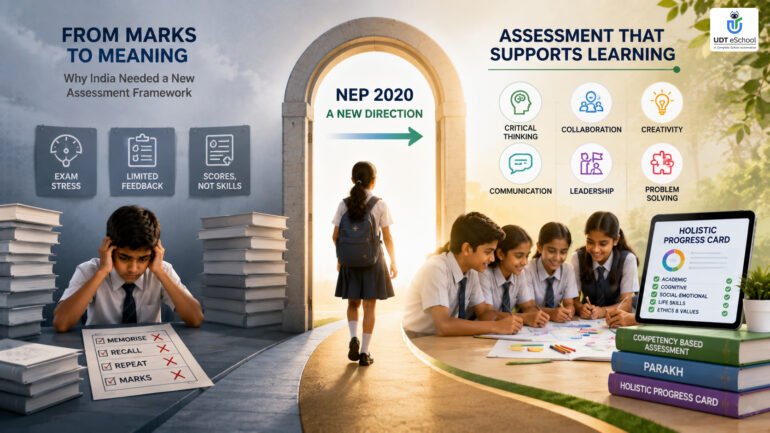
Students frequently experienced examination stress, teachers had limited opportunities to provide meaningful feedback during the learning process, and report cards often reflected academic scores without capturing the broader aspects of a learner’s development.
More importantly, traditional assessments rarely measured essential competencies such as innovation, collaboration, leadership, communication, ethical decision-making, or problem-solving—skills that are increasingly important in today’s rapidly changing world.
Recognising these gaps, the National Education Policy 2020 recommends transforming assessment into a tool that supports learning instead of simply measuring performance.
The National Education Policy 2020, published by the Ministry of Education, calls for assessment practices that support learning, higher-order thinking and competency development rather than relying predominantly on rote memorisation.
This philosophy also aligns with the gradual introduction of competency-based question papers by CBSE and the implementation of learner-focused initiatives such as PARAKH and the Holistic Progress Card.
From Marks-Centric Learning to Competency-Based Learning
One of the most significant transformations introduced by the NEP 2020 Assessment Framework is the shift from marks-centric education to competency-based learning.
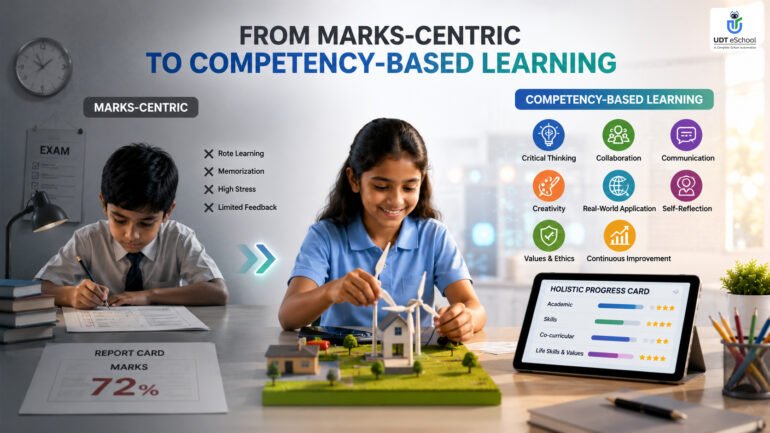
In a traditional assessment system, students were primarily rewarded for remembering information and reproducing it accurately during examinations. While this approach assessed factual recall, it often failed to evaluate whether learners truly understood concepts or could apply them in unfamiliar situations.
The NEP framework encourages schools to assess learning in a much broader and more meaningful way.
Teachers are expected to evaluate how students:
- Apply concepts to solve real-world problems.
- Analyse information and think critically.
- Communicate ideas effectively.
- Work collaboratively with peers.
- Demonstrate creativity and innovation.
- Reflect on their own learning.
- Show ethical values and responsible behaviour.
- Continuously improve through constructive feedback.
This learner-centred approach helps create classrooms where assessment becomes part of everyday teaching rather than an activity conducted only at the end of an academic term.
Schools implementing learner-centric reporting systems can further strengthen this approach through the Holistic Progress Card, which provides a more comprehensive view of student growth across academic, co-curricular, and socio-emotional domains.
Assessment as a Continuous Learning Process
Perhaps the most transformative aspect of the NEP 2020 Assessment Framework is its emphasis on continuous improvement rather than one-time evaluation.
Instead of waiting until the end of the academic year to understand student performance, teachers are encouraged to gather evidence of learning throughout the year using classroom observations, discussions, projects, presentations, quizzes, portfolios, peer assessment, self-assessment, and competency-based activities.
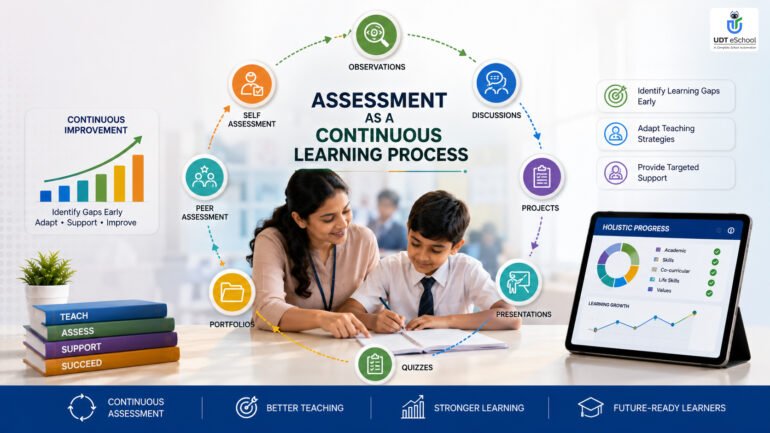
This continuous flow of assessment enables schools to identify learning gaps early, adapt teaching strategies, and provide targeted academic support before challenges become long-term barriers to student success.
As you continue through this guide, you’ll discover how initiatives such as PARAKH, Competency-Based Assessment, and the Holistic Progress Card work together to translate the vision of NEP 2020 into practical classroom implementation, helping schools build an assessment ecosystem that is transparent, inclusive, and future-ready.
The Core Principles of the NEP 2020 Assessment Framework
The shift towards competency-based education cannot be achieved by simply changing examination patterns or introducing new report cards. It requires schools to rethink the very purpose of assessment and align classroom practices with the broader vision of the National Education Policy (NEP) 2020.
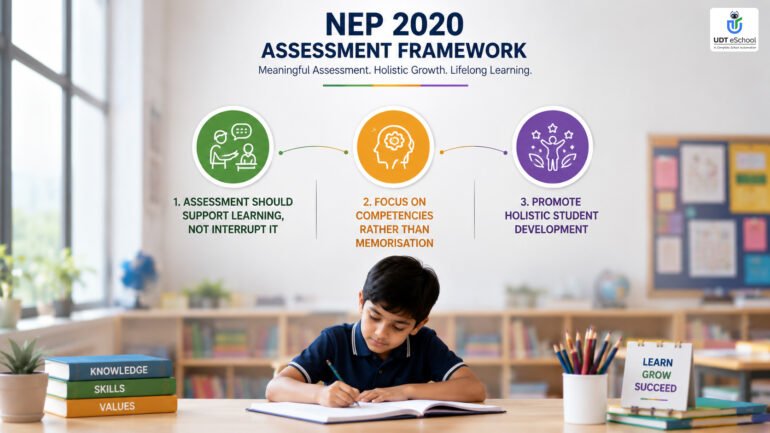
At its core, the NEP 2020 Assessment Framework is built on a set of guiding principles that encourage continuous learning, holistic development, and meaningful student progress. These principles influence everything from classroom instruction and lesson planning to assessment design, reporting, and parent communication.
For school leaders and teachers, understanding these foundational principles is the first step towards successfully implementing assessment reforms in a practical and sustainable manner.
1. Assessment Should Support Learning, Not Interrupt It
Traditionally, assessment has often been viewed as the final stage of teaching—a process conducted after completing a chapter or syllabus. The NEP 2020 Assessment Framework challenges this approach by positioning assessment as an ongoing part of everyday learning.
Instead of waiting until the end of a unit to measure student performance, teachers are encouraged to collect evidence of learning continuously through classroom discussions, projects, observations, presentations, quizzes, peer learning, and reflective activities.
This approach enables educators to identify misconceptions early, provide timely feedback, and adapt instructional strategies before learning gaps become significant.
Schools implementing digital assessment workflows through a School ERP can further streamline this process by maintaining continuous records of student performance, generating progress reports, and sharing timely feedback with parents throughout the academic year.
According to the National Education Policy 2020, assessment should evolve into a developmental tool that improves learning outcomes rather than functioning solely as a mechanism for assigning marks.
Embed Assessment into Daily Classroom Learning
High-performing schools do not treat assessment as a separate event. Instead, they integrate questioning, classroom discussions, projects, presentations, peer reviews, and regular feedback into everyday teaching so that assessment continuously informs instruction and supports student growth.
2. Focus on Competencies Rather Than Memorisation
One of the defining characteristics of the NEP 2020 Assessment Framework is its emphasis on competency development.
Rather than rewarding students for reproducing textbook content, assessments should evaluate how effectively learners apply concepts, analyse information, solve problems, communicate ideas, and use their knowledge in unfamiliar situations.
This shift encourages deeper conceptual understanding while reducing dependence on rote memorisation.
Schools beginning this transition can also explore our comprehensive guide on Competency-Based Assessment Examples for Schools, which explains practical classroom strategies aligned with NEP 2020.
Competency-based assessment also prepares students for higher education and future careers where analytical thinking, collaboration, creativity, and adaptability are increasingly valued.
Traditional Assessment and Competency-Based Assessment: What’s Changing?
| Assessment Area | Traditional Assessment | NEP 2020 Competency-Based Assessment |
|---|---|---|
| Primary Focus | Marks and grades | Learning outcomes and competencies |
| Student Success | Memorisation | Conceptual understanding |
| Classroom Approach | Teacher-centred | Learner-centred |
| Feedback | Mostly after examinations | Continuous and constructive |
| Skills Evaluated | Subject knowledge | Knowledge, skills, attitudes and values |
| Learning Goal | Completing the syllabus | Developing lifelong learners |
3. Promote Holistic Student Development
Academic achievement remains important, but it represents only one aspect of student growth.
The assessment reforms envisioned under NEP 2020 to assess learners across multiple dimensions, including:
- Academic understanding
- Critical thinking
- Creativity
- Communication skills
- Collaboration
- Social and emotional development
- Ethical values
- Leadership qualities
- Physical well-being
- Self-reflection
This broader approach ensures that report cards provide a more complete picture of each learner’s progress rather than simply listing examination scores.
Schools adopting this philosophy are increasingly implementing the Holistic Progress Card, which aligns closely with the recommendations of NEP 2020 by documenting growth across academic and non-academic domains
Holistic Assessment Creates Better Learning Outcomes
When schools assess academic achievement alongside critical thinking, creativity, collaboration, communication, and socio-emotional development, teachers gain a far richer understanding of each learner. This enables more personalised instruction, helps identify learning gaps earlier, and supports meaningful long-term student success through timely interventions and continuous feedback.
Make Assessment Continuous Instead of Exam-Centred
One of the important assessment shifts envisioned under NEP 2020 is to complement periodic examinations with continuous assessment and feedback throughout the academic year.
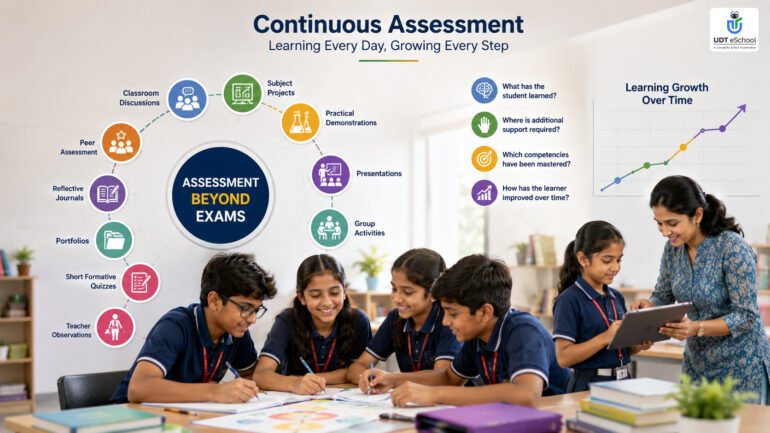
Traditional assessment systems often place excessive emphasis on mid-term and final examinations. While these tests measure academic performance at a specific point in time, they rarely capture how a student develops knowledge, applies concepts, overcomes learning challenges, or improves through regular practice.
Continuous assessment enables teachers to observe student growth over weeks and months rather than evaluating performance through a single examination.
Schools can collect evidence of learning through multiple classroom activities, including:
- Classroom discussions
- Subject projects
- Practical demonstrations
- Student presentations
- Group activities
- Peer assessment
- Reflective journals
- Portfolios
- Teacher observations
- Short formative quizzes
Instead of asking “How many marks did the student score?”, continuous assessment encourages educators to ask:
- What has the student learned?
- Where is additional support required?
- Which competencies have been mastered?
- How has the learner improved over time?
This developmental approach makes assessment an integral part of teaching rather than a separate administrative exercise.
Collect Assessment Evidence Naturally During Every Lesson
Teachers do not need additional examinations every week. Simple classroom questioning, collaborative activities, practical demonstrations, observation notes, exit tickets, and project discussions can provide valuable evidence of student learning while keeping classroom instruction engaging and stress-free.
Assessment Methods Recommended Under the NEP 2020 Assessment Framework
Rather than depending on written examinations alone, schools should adopt a balanced combination of assessment strategies that evaluate knowledge, skills, attitudes, and real-world application.
| Assessment Method | Purpose | Examples |
|---|---|---|
| Observation | Monitor classroom behaviour and participation | Teacher observation, anecdotal records |
| Projects | Evaluate application of knowledge | Research projects, models, presentations |
| Portfolios | Track learner growth over time | Student work samples, reflections |
| Peer Assessment | Develop collaboration and reflection | Peer review activities |
| Self Assessment | Build ownership of learning | Reflection journals, learning logs |
Continuous assessment forms the foundation of the Holistic Progress Card, which combines academic achievement with learner competencies, values, skills, participation, and overall development. Schools exploring the digital side of holistic assessment can also read our guide to Holistic Progress Card with AI, which examines how technology can support assessment evidence, reporting and student progress management.
Technology Makes Continuous Assessment Practical
Maintaining observation records, competency tracking, student portfolios, feedback, and progress reports manually can quickly become time-consuming. AI-powered School ERP platforms help schools digitise assessment evidence, automate reporting, simplify parent communication, and maintain comprehensive learner profiles throughout the academic year.
Develop Clear Assessment Rubrics and Meaningful Feedback
One of the biggest challenges schools face while implementing the NEP 2020 Assessment Framework is maintaining consistency across classrooms. Without clearly defined assessment criteria, the same student performance may be evaluated differently by different teachers.
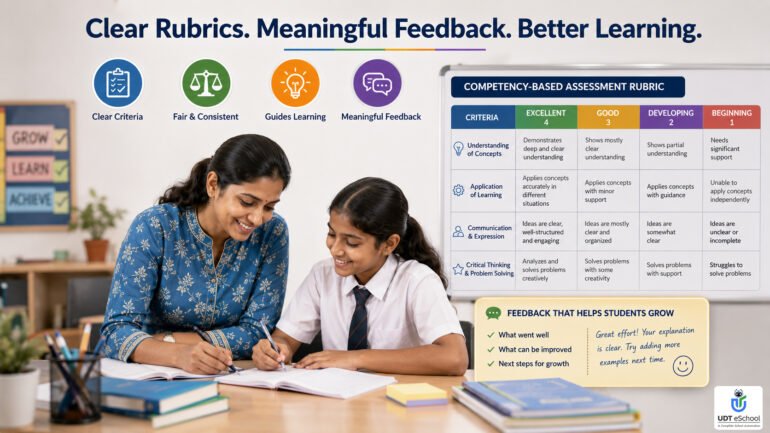
This is why NEP 2020 encourages schools to establish competency-based assessment rubrics that clearly define what successful learning looks like.
Rather than assigning marks based on subjective judgement, teachers assess students against predefined performance indicators. This makes assessment more transparent, objective, and fair for every learner.
Well-designed rubrics also help students understand what is expected before they begin an activity, enabling them to take greater ownership of their learning.
Good Assessment Begins with Clear Expectations
Students perform better when they clearly understand how their work will be evaluated. Competency-based rubrics remove ambiguity, improve consistency among teachers, and make feedback more meaningful for students and parents.
Sample Competency-Based Assessment Rubric
Instead of simply awarding marks, schools can classify student performance across progressive competency levels.
| Performance Level | Learner Characteristics | Teacher Response |
|---|---|---|
| Beginning | Requires significant guidance and demonstrates limited understanding. | Provide structured support and additional practice. |
| Developing | Shows partial understanding with occasional teacher assistance. | Offer guided feedback and reinforce concepts. |
| Proficient | Applies learning independently in familiar situations. | Encourage deeper application and extension activities. |
| Advanced | Transfers learning confidently to new and complex situations. | Provide enrichment opportunities and leadership roles. |
Schools looking for additional classroom-ready strategies can explore our comprehensive guide on Competency-Based Assessment Examples for Schools, which includes practical implementation ideas aligned with NEP 2020.
Feedback Should Explain the Next Step for Improvement
Instead of writing comments such as “Good”, “Average”, or “Needs Improvement”, provide actionable feedback that tells students what they did well, what needs improvement, and how they can achieve the next competency level. Constructive feedback encourages continuous growth rather than focusing solely on grades.
Build Student Portfolios to Track Learning Progress
The NEP 2020 Assessment Framework also recommends maintaining evidence of student learning over time rather than relying solely on examination papers.
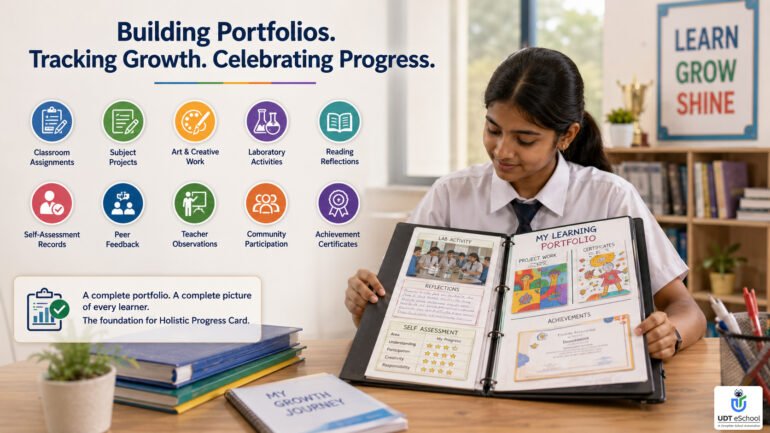
A well-maintained student portfolio may include:
- Classroom assignments
- Subject projects
- Art and creative work
- Laboratory activities
- Reading reflections
- Self-assessment records
- Peer feedback
- Teacher observations
- Community participation
- Achievement certificates
Portfolios provide a comprehensive picture of learner development and become an important foundation for preparing the Holistic Progress Card.
Schools implementing portfolio-based assessment should also read PARAKH Report Card Explained, which explains how competency-based reporting aligns with India’s evolving assessment reforms.
Use Digital Portfolios Instead of Paper Files
Digital student portfolios simplify documentation, reduce paperwork, enable evidence-based assessment, and make it easier for teachers and parents to monitor learner progress throughout the academic year. They also support faster preparation of competency-based report cards and continuous assessment records.
How Schools Can Successfully Implement the NEP 2020 Assessment Framework
Understanding the principles of the NEP 2020 Assessment Framework is only the beginning. The real challenge lies in transforming these recommendations into everyday classroom practices that teachers can implement consistently across all grades and subjects.
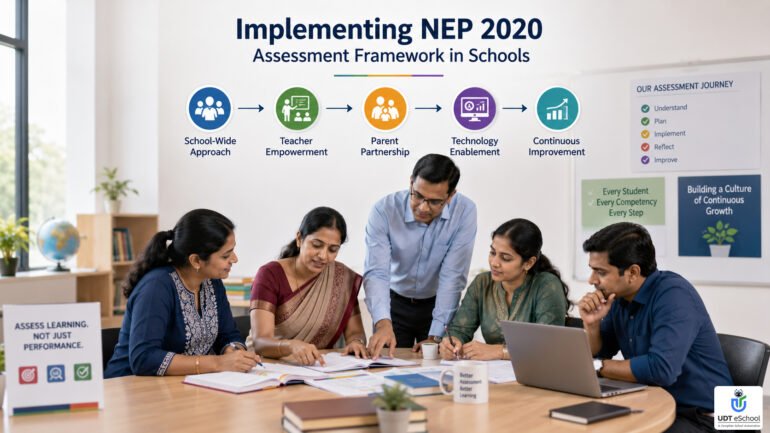
Successful implementation requires a structured, school-wide approach rather than isolated classroom initiatives. School leaders, teachers, parents, and technology platforms all play an important role in ensuring that competency-based assessment becomes part of the school’s teaching and learning culture.
Schools that adopt a phased implementation strategy are more likely to achieve sustainable improvements while reducing resistance to change.
School Readiness Checklist for NEP 2020 Assessment
✔ Define competency-based learning outcomes for every subject.
✔ Develop common assessment rubrics across all grades.
✔ Train teachers in formative and competency-based assessment.
✔ Introduce student portfolios and evidence-based evaluation.
✔ Digitise assessment records for easier monitoring.
✔ Strengthen parent communication through regular progress updates.
✔ Review assessment data periodically to improve teaching strategies.
Role of Teachers in Competency-Based Assessment
Teachers are at the heart of assessment reform.
Rather than functioning primarily as exam evaluators, teachers become facilitators of learning who continuously observe student progress, provide constructive feedback, and personalise instruction based on assessment evidence.
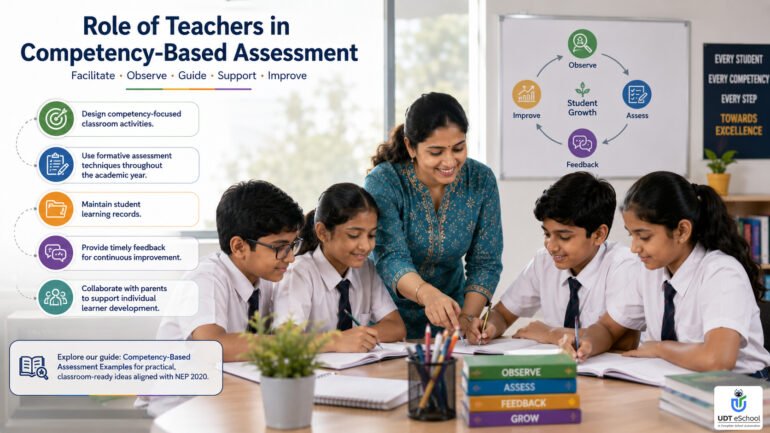
Their responsibilities include:
- Designing competency-focused classroom activities.
- Using formative assessment techniques throughout the academic year.
- Maintaining student learning records.
- Providing timely feedback for continuous improvement.
- Collaborating with parents to support individual learner development.
Schools looking to strengthen classroom assessment practices can also explore our guide on Competency-Based Assessment Examples, which provides practical classroom-ready assessment ideas aligned with NEP 2020.
Role of School Leaders and Principals
School leadership plays an equally critical role in creating an assessment ecosystem that supports continuous learning.

Principals should focus on:
- Building a common assessment policy.
- Organising regular teacher capacity-building programmes.
- Monitoring implementation across departments.
- Encouraging collaborative lesson planning.
- Reviewing assessment data to improve teaching quality.
- Ensuring alignment with CBSE and NEP recommendations.
A collaborative leadership approach helps create consistency across classrooms while encouraging innovation in teaching practices.
Assessment Reform Begins with Leadership
The success of competency-based assessment depends less on changing examination papers and more on creating a school culture where continuous feedback, teacher collaboration, and evidence-based decision-making become part of everyday practice. Strong leadership ensures consistency, accountability, and long-term sustainability.
How School ERP Software Supports NEP 2020 Assessment Reforms
Managing continuous assessment manually can quickly become overwhelming as schools begin recording classroom observations, competency levels, portfolios, projects, feedback, and holistic learner profiles.
This is where digital school management platforms can become valuable, particularly as the volume of assessment evidence grows across grades, subjects and academic terms.
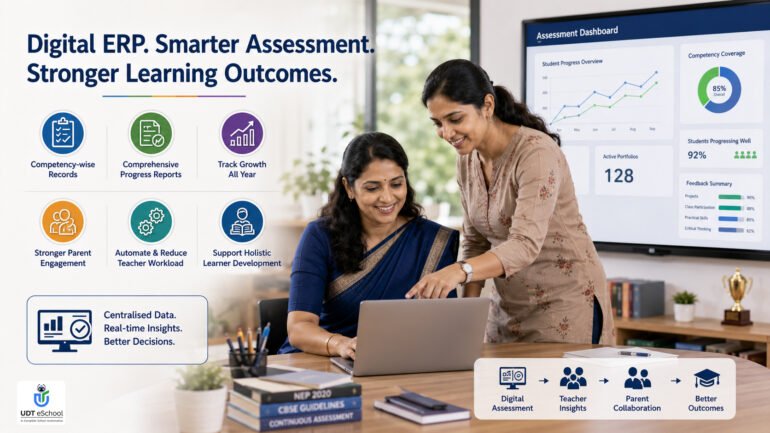
Technology does not make an assessment competency-based; the learning outcome, assessment task, evidence and evaluation criteria do. Digital systems help schools organise and manage that evidence more efficiently.
A modern School ERP Software helps schools centralise assessment records, automate report generation, simplify teacher workflows, and improve communication with parents.
Instead of maintaining multiple spreadsheets and paper files, teachers can record assessment evidence digitally, while school leaders gain access to real-time dashboards that support data-driven academic planning.
AI-powered platforms such as UDT eSchool further simplify this process by enabling schools to:
- Maintain competency-wise student records.
- Generate comprehensive progress reports.
- Monitor student growth throughout the academic year.
- Improve parent engagement through timely updates.
- Reduce teacher workload by automating administrative tasks.
- Support holistic learner development with integrated assessment data.
Schools implementing assessment reforms often combine digital assessment with stronger family engagement. Our article on How Schools Can Improve Parent Engagement explains how regular communication between teachers and parents strengthens student outcomes.
According to the CBSE Academic and the NCERT, assessment reforms are most effective when schools integrate continuous evaluation, teacher professional development, and meaningful stakeholder engagement into their overall academic planning.
Technology Makes Competency-Based Assessment Scalable
While competency-based assessment can be implemented manually, digital platforms significantly improve efficiency, consistency, and reporting accuracy. Schools that digitise assessment workflows reduce administrative workload, strengthen parent communication, and gain valuable academic insights that support continuous school improvement.
Common Challenges Schools Face While Implementing the NEP 2020 Assessment Framework
Although the transition to competency-based assessment offers significant long-term benefits, many schools encounter practical challenges during implementation. Recognising these challenges early allows school leaders to develop effective strategies that ensure a smoother transition.
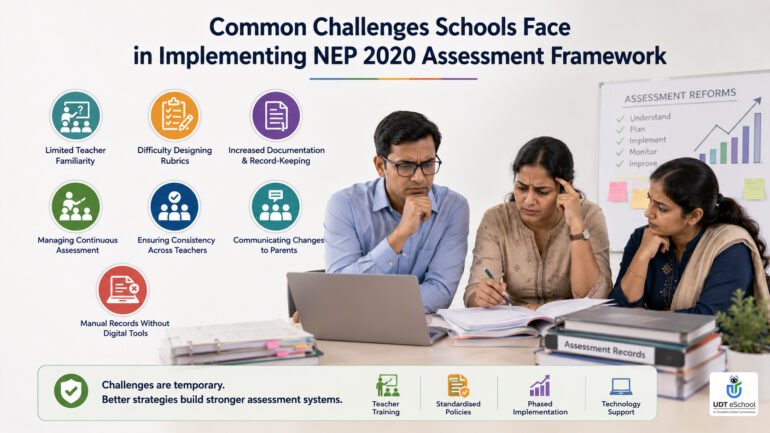
Some of the most common implementation challenges include:
- Limited teacher familiarity with competency-based assessment practices.
- Difficulty designing assessment rubrics for different subjects.
- Increased documentation and record-keeping requirements.
- Managing continuous assessment across multiple classes.
- Ensuring consistency among teachers and departments.
- Communicating assessment changes effectively to parents.
- Maintaining assessment records manually without digital tools.
Fortunately, these challenges can be addressed through structured teacher training, standardised assessment policies, phased implementation, and appropriate technology support.
Don’t Replace One Examination with Another
A common misconception is that competency-based assessment simply means conducting more frequent tests. In reality, NEP 2020 encourages schools to gather evidence of learning through classroom observations, projects, discussions, portfolios, practical activities, peer assessment, and constructive feedback rather than increasing the number of written examinations.
The Future of Assessment in Indian Schools
India’s education system is steadily moving towards a learner-centred model where assessment becomes an integral part of teaching and learning rather than an isolated event.
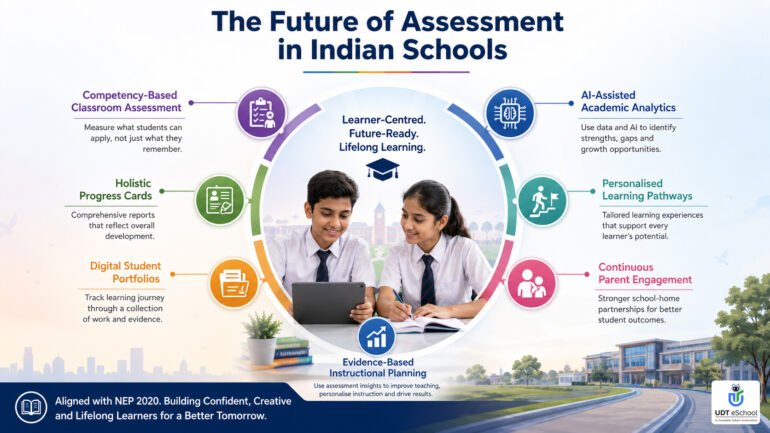
Future-ready schools are increasingly adopting practices such as:
- Competency-based classroom assessment.
- Holistic Progress Cards.
- Digital student portfolios.
- AI-assisted academic analytics.
- Personalised learning pathways.
- Continuous parent engagement.
- Evidence-based instructional planning.
These reforms align with the broader vision of the National Education Policy 2020, which aims to create confident, creative, and lifelong learners prepared for the evolving demands of higher education and the modern workforce.
Schools that embrace these practices today will be better positioned to meet future academic standards while delivering richer learning experiences for every student.
NEP 2020 Assessment Framework at a Glance
✔ Assessment should support continuous learning rather than simply measure academic performance.
✔ Competency-based assessment focuses on applying knowledge, skills, and critical thinking.
✔ Holistic Progress Cards provide a comprehensive picture of student development.
✔ Assessment rubrics improve transparency, consistency, and fairness.
✔ Continuous feedback helps identify learning gaps early and supports personalised instruction.
✔ Digital School ERP platforms simplify assessment management and reporting.
✔ Successful implementation requires collaboration among teachers, school leaders, parents, and technology.
NEP 2020 Assessment Framework Implementation Roadmap for Schools
Implementing the NEP 2020 Assessment Framework is most effective when schools adopt a phased approach rather than attempting to transform their entire assessment system at once. A structured roadmap enables teachers, school leaders, students, and parents to adapt gradually while maintaining consistency and quality.
The following roadmap can help schools plan and monitor their transition towards competency-based assessment.
| Phase | School Action | Expected Outcome |
|---|---|---|
| Phase 1 | Train teachers on competency-based assessment and NEP 2020 principles. | Common understanding across the school. |
| Phase 2 | Develop learning outcomes, rubrics, and assessment plans. | Standardised classroom assessment. |
| Phase 3 | Introduce formative assessments and digital student portfolios. | Continuous evidence of learning. |
| Phase 4 | Implement Holistic Progress Cards and strengthen parent communication. | Greater transparency and parent engagement. |
| Phase 5 | Review assessment data regularly using School ERP analytics. | Continuous school improvement and better learning outcomes. |
Is Your School Ready for NEP 2020 Assessment Reforms?
Your school is on the right path if you can answer “Yes” to most of the following questions:
✔ Do teachers use competency-based assessment techniques?
✔ Are assessment rubrics standardised across grades?
✔ Is continuous feedback provided to students?
✔ Are student portfolios maintained systematically?
✔ Is parent communication regular and evidence-based?
✔ Can assessment reports be generated digitally?
✔ Does school leadership regularly review assessment data?
Frequently Asked Questions (FAQs)
1. What is the NEP 2020 Assessment Framework?
The NEP 2020 Assessment Framework shifts school assessment from rote memorisation and examination scores to competency-based, continuous, and holistic evaluation. It focuses on measuring how students apply knowledge, develop skills, and demonstrate overall growth.
2. What is competency-based assessment?
Competency-based assessment evaluates students based on clearly defined learning outcomes and competencies rather than their ability to memorise textbook content. It encourages conceptual understanding, critical thinking, creativity, and real-world application.
3. How is the Holistic Progress Card related to NEP 2020?
The Holistic Progress Card is one of the practical implementation tools that supports the NEP 2020 Assessment Framework. It records academic achievement alongside skills, values, socio-emotional development, and overall learner progress. Learn more in our guide on How Schools Can Implement Holistic Progress Card
4. How can schools implement competency-based assessment effectively?
Schools should define competency-based learning outcomes, develop assessment rubrics, train teachers, maintain student portfolios, provide continuous feedback, and use digital assessment tools to monitor learner progress throughout the academic year.
5. How does School ERP software support NEP 2020 assessment reforms?
Modern School ERP Software helps schools digitise assessment records, automate report generation, manage student portfolios, improve parent communication, and simplify continuous assessment workflows, making NEP 2020 implementation more efficient.
6. Is NEP 2020 Assessment Framework Mandatory for CBSE Schools?
NEP 2020 provides the national policy direction for transforming assessment, while specific implementation requirements for CBSE schools should be determined from the latest CBSE circulars, curriculum documents and applicable assessment guidance. Schools should therefore distinguish between the broader assessment vision of NEP 2020 and specific instructions issued by the competent authorities.
7. What Is the Difference Between NEP 2020 Assessment and Competency-Based Assessment?
NEP 2020 provides a broader policy vision for transforming education and assessment, while competency-based assessment is one of the approaches used to put that vision into practice. Competency-based assessment focuses on whether students can apply knowledge, demonstrate skills and achieve defined learning outcomes rather than relying mainly on memorisation.
🚀 Transform Assessment with UDT eSchool
Implementing the NEP 2020 Assessment Framework becomes significantly easier with the right digital platform. UDT eSchool helps schools manage competency-based assessment, maintain student portfolios, automate progress reporting, strengthen parent communication, and support holistic learner development through one integrated School ERP solution.
Why Schools Choose UDT eSchool
- ✅ AI-Powered School ERP
- ✅ Digital Assessment Management
- ✅ Holistic Progress Card Support
- ✅ Parent Engagement Tools
- ✅ Real-Time Academic Analytics
- ✅ Automated Reporting & Communication
Explore more resources on
UDT eSchool
to help your institution successfully implement NEP 2020, CBSE reforms, competency-based assessment, and future-ready school management practices.
People Also Search For In Schools
Readers exploring the NEP 2020 Assessment Framework often search for these related topics to better understand competency-based learning, assessment reforms, and school implementation strategies.
Related Topics
Continue Reading About NEP 2020
If you’re planning your school’s transition towards competency-based education, these guides will help you implement related reforms step by step:
- How Schools Can Implement Holistic Progress Card
- Competency-Based Assessment Examples for Schools
- PARAKH Report Card Explained
- How Schools Can Improve Parent Engagement
- School ERP Software: Complete Guide
Authoritative References
The information presented in this guide is based on recommendations and policy documents published by:
- National Education Policy (NEP) 2020 – Ministry of Education, Government of India
- CBSE Academic
- National Council of Educational Research and Training (NCERT)
- Ministry of Education, Government of India
PARAKH — Holistic Progress Cards
The official PARAKH HPC page states that HPCs have been developed for all four stages of school education and describes the HPC as an integrative document capturing learner progress across curricular elements through competency-based and multidisciplinary activities.
CBSE — Competency-Based Education
The CBSE competency-based learning framework provides learning outcomes, assessment objectives, question-type guidance, mark-scheme approaches and rubric-related guidance for relevant subjects.
Final Thoughts On NEP 2020 Assessment Framework
The NEP 2020 Assessment Framework represents one of the most significant educational reforms in India, encouraging schools to move beyond examination-centric learning towards continuous, competency-based, and holistic assessment.
For schools, this transformation is not simply about introducing new report cards or conducting different types of tests. It requires building an assessment culture where learning is continuously observed, meaningful feedback is valued, student growth is documented over time, and every learner receives opportunities to develop academically, socially, emotionally, and creatively.
By combining well-trained educators, clearly defined assessment rubrics, active parent participation, and digital school management systems, institutions can successfully implement the vision of NEP 2020 while improving both learning outcomes and administrative efficiency.
As assessment practices continue to evolve, schools that embrace these reforms today will be better prepared to create future-ready learners equipped with the knowledge, competencies, and confidence required to thrive in an increasingly dynamic world.

✔ Reviewed & Published
UDT eSchool Editorial Team
This article has been researched, reviewed, and published by the UDT eSchool Editorial Team, specialists in School ERP Software, NEP 2020 implementation, CBSE reforms, AI in Education, Competency-Based Assessment, Holistic Progress Cards, Parent Engagement, and Digital School Transformation.
Editorial Standards
✔ Official CBSE Circulars
✔ Ministry of Education Guidelines
✔ NCERT Frameworks
✔ Education Industry Best Practices
✔ Reviewed Before Publication
✔ Updated as Policies Change
Editorial Expertise
School ERPNEP 2020CBSE ReformsHolistic Progress CardCompetency-Based AssessmentAI in EducationSchool Management
Digital Transformation
Article Information
| Content Type | Expert Educational Guide |
| Reviewed By | UDT eSchool Editorial Team |
| Fact Checked | ✔ Yes |
| Primary Sources | CBSE, NCERT, Ministry of Education & NEP 2020 |
| Updated | July 2026 |
| Article Version | Version 1.0 |

Education Technology Consultant at UDt eSchool with 10+ years of experience helping schools digitize operations and implement CBSE-aligned systems.