📢 CBSE Reforms 2026: Exam Changes & School Guide
The Central Board of Secondary Education is steadily transforming school education in alignment with the National Education Policy 2020.
As we move through 2026, schools are witnessing a clear shift toward competency-based learning, continuous assessment, and greater use of technology in everyday operations.
At the same time, there is growing curiosity around questions like:
👉 Will CBSE conduct board exams twice a year?
To avoid confusion, it’s important to understand what is officially implemented, what is evolving, and how schools should realistically prepare.
🔍 Confirmed CBSE Reforms 2026 Schools Must Act On
These CBSE Reforms 2026 are not just academic changes but require schools to rethink their operational systems.

1. Competency-Based Question Papers
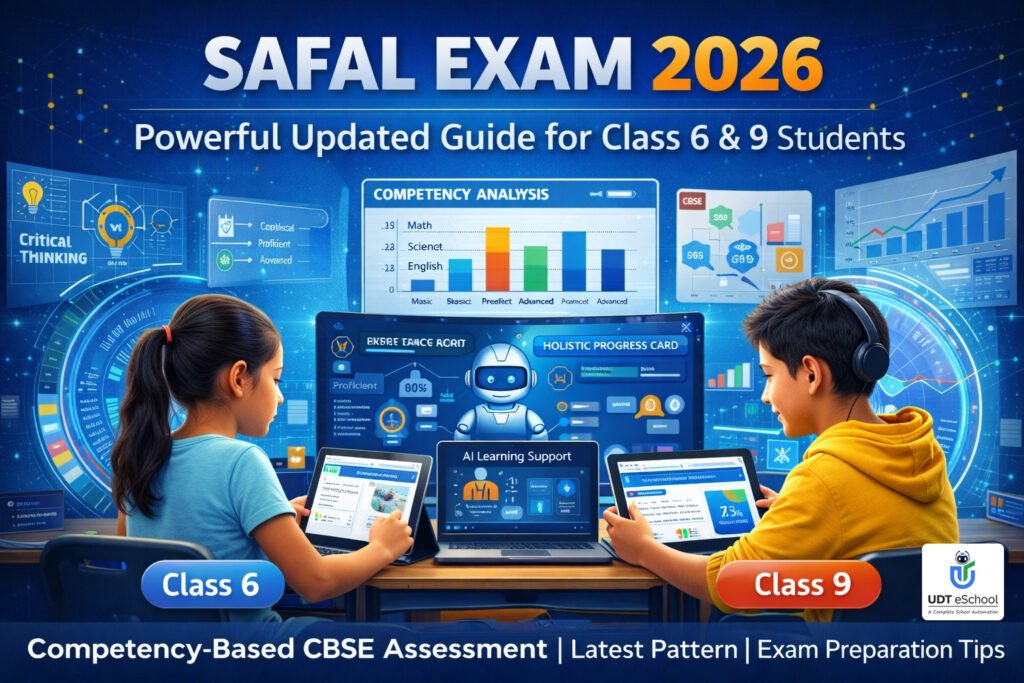
CBSE has significantly increased the weightage of competency-based questions (around 40–50%), focusing on application and analytical skills rather than memorization.
This shift means schools must move beyond traditional teaching methods and focus more on concept clarity and real-time performance tracking.
2. Continuous & Formative Assessment
The reliance on a single final exam is gradually reducing. Instead, CBSE emphasizes:
- Regular class assessments
- Project-based evaluation
- Internal performance tracking
For schools still managing records manually, this creates operational challenges. Many institutions are now exploring structured systems explained in this complete guide to school ERP systems in India (2026)
3. Reduced Focus on Rote Learning
CBSE’s direction is clear—rote learning is no longer enough. Students are expected to:
- Apply knowledge in real-life scenarios
- Think critically
- Solve problems analytically
This directly impacts how teachers teach and how schools evaluate students.
4. Digital Academic Records & Transparency
Schools are expected to maintain accurate and accessible academic records. CBSE has also been encouraging digital practices through its academic guidelines, which you can review on the official CBSE academic portal.
This level of transparency becomes difficult to manage without centralized systems.
5. Alignment with NEP 2020 Vision
The reforms are part of a larger shift toward:
- Holistic development
- Skill-based education
- Flexible learning structures
AI in Education 2026: NEP, PARAKH & Future of School Assessment
⚠️ What About “Twice-a-Year Board Exams”?
This topic has been widely discussed, but clarity is important.

As of now:
- The idea of conducting board exams twice a year is under consideration
- It aligns with flexibility proposed in the NEP framework
- It may be introduced in phases or pilot formats
❗ However, it is not yet fully implemented across all CBSE schools
A safe way to understand this is:
👉 CBSE is moving toward flexibility, but schools should focus first on continuous assessment readiness
⚠️ Real Challenges Schools Are Facing
One of the biggest concerns under CBSE Reforms 2026 is managing continuous assessment effectively.

Even without full exam restructuring, schools are already dealing with:
- Managing continuous assessments
- Handling large volumes of student data
- Generating accurate report cards
- Ensuring coordination between teachers and administration
These challenges become more visible after admissions when the academic session is in full swing. Many of these issues are also discussed in practical scenarios like how schools can manage the academic session smoothly.
💡 Why Traditional Systems Are No Longer Enough
Manual processes such as registers and spreadsheets were never designed for continuous evaluation systems.

They often result in:
- Data inconsistencies
- Delayed reporting
- Increased workload for staff
In contrast, schools that are transitioning toward structured platforms are finding it easier to manage these evolving requirements.
🚀 How Schools Are Adapting to CBSE Reforms
Forward-thinking schools are now using integrated platforms like
UDT eSchool to simplify operations.

These systems help in:
- Tracking student performance continuously
- Automating report generation
- Maintaining centralized academic records
- Improving communication between teachers and parents
Instead of reacting to reforms later, these schools are preparing in advance.
📊 Role of Technology, School ERP in CBSE Compliance

To align with CBSE’s direction, schools need:
- Performance analytics dashboards
- Continuous assessment tracking
- Automated report cards
- Secure and accessible data systems
If you compare traditional methods with modern systems, the difference becomes clear—as explained in this comparison of manual vs digital school management in 2026.
🔎 People Also Ask
❓ What are CBSE reforms in 2026?
CBSE reforms focus on competency-based education, continuous assessment, and reducing dependence on rote learning.
❓ Is CBSE conducting board exams twice a year?
CBSE is exploring this idea, but it has not been fully implemented across all schools yet.
❓ What is competency-based education in CBSE?
It emphasizes understanding concepts and applying knowledge rather than memorizing answers.
❓ How should schools prepare for CBSE reforms?
Schools should adopt systems that allow continuous performance tracking, structured data management, and efficient reporting.
❓ FAQ Section
Q1. Are CBSE reforms mandatory for all schools?
Yes, CBSE-affiliated schools are expected to gradually align with updated academic and assessment frameworks.
Q2. What is the biggest change in CBSE exams?
The shift toward competency-based questions and continuous evaluation is the most significant change.
Q3. Will exams become easier?
No, exams will become more application-based, requiring deeper understanding.
Q4. Why do schools need digital systems now?
Because manual systems cannot efficiently handle continuous assessment and large-scale data tracking.
Q5. How can schools manage these reforms effectively?
By adopting structured solutions like UDT eSchool that streamline operations and improve accuracy.
🎯 Final Thoughts
CBSE reforms are not just about exams—they represent a broader shift in how schools operate and evaluate students.

Schools that adapt early will find it easier to:
- Maintain compliance
- Improve efficiency
- Deliver better academic outcomes
Those relying only on traditional systems may struggle as expectations continue to evolve.
As CBSE Reforms 2026 continue to evolve, early adoption of structured systems will give schools a strong advantage.
 Call to Action
As CBSE continues to move toward a more structured and data-driven education system, adopting the right tools becomes essential.
Platforms like UDT eSchool can help schools transition smoothly while staying aligned with modern academic requirements.


Education Technology Consultant at UDt eSchool with 10+ years of experience helping schools digitize operations and implement CBSE-aligned systems.