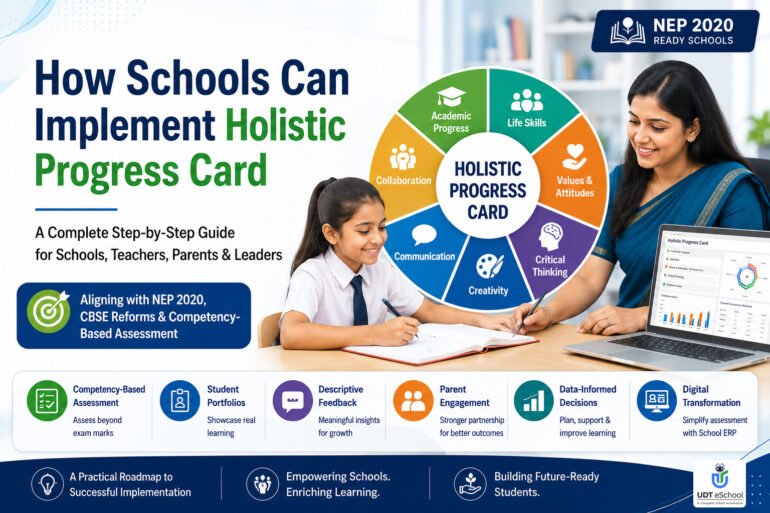
How Schools Can Implement Holistic Progress Card
The shift from traditional report cards to a Holistic Progress Card marks one of the most significant changes introduced under NEP 2020. Rather than measuring students solely through examination scores, schools are now encouraged to assess the complete learning journey—including academic achievement, critical thinking, creativity, collaboration, life skills, values, and overall well-being.
For school leaders, the bigger challenge is not understanding the idea of a Holistic Progress Card—it is translating the framework into everyday assessment practices. Schools need to decide how learning outcomes will be mapped to competencies, how evidence will be collected, how teachers will be trained, how parents and students will participate, and how progress will be documented consistently.
This guide provides a practical implementation framework for schools, from leadership planning and teacher preparation to assessment rubrics, portfolios, stakeholder participation, review processes and digital assessment management. It also explains how schools can align implementation with the stage-wise Holistic Progress Cards developed by PARAKH.
📘 QUICK ANSWER
How Schools Can Implement Holistic Progress Card
Schools can implement a Holistic Progress Card by first identifying the appropriate stage-wise HPC framework, aligning learning outcomes with competencies, defining evidence and assessment criteria, training teachers, introducing observation and portfolio-based assessment, involving students and parents, and establishing a consistent review process. PARAKH has developed separate Holistic Progress Cards for the Foundational, Preparatory, Middle and Secondary Stages, so implementation should be adapted to the learner’s stage rather than treated as a single report-card format.
📚 In This Guide You’ll Learn
- ✔ What a Holistic Progress Card really measures
- ✔ Why schools are moving beyond traditional report cards
- ✔ Step-by-step implementation framework
- ✔ Common challenges and practical solutions
- ✔ The role of teachers, parents and school leaders
- ✔ How School ERP simplifies assessment management
- ✔ Best practices for sustainable implementation
Key Takeaways From This Guide On How Schools Can Implement Holistic Progress Card
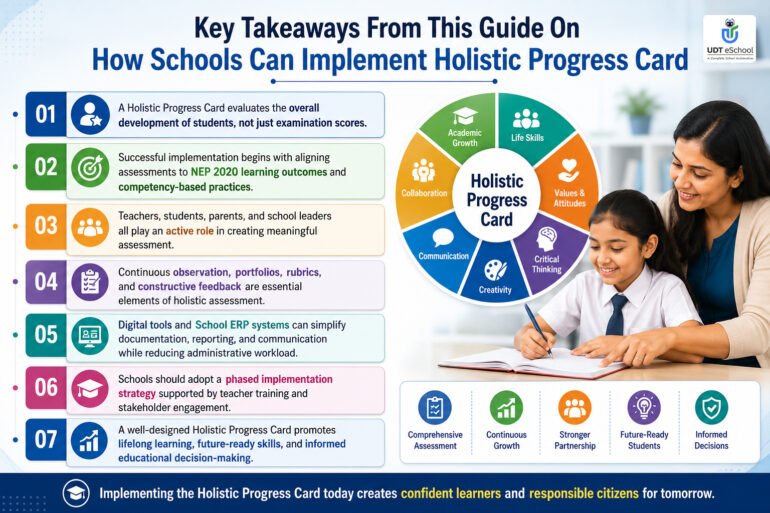
- A Holistic Progress Card evaluates the overall development of students, not just examination scores.
- Successful implementation begins with aligning assessments to NEP 2020 learning outcomes and competency-based practices.
- Teachers, students, parents, and school leaders all play an active role in creating meaningful assessment.
- Continuous observation, portfolios, rubrics, and constructive feedback are essential elements of holistic assessment.
- Digital tools and School ERP systems can simplify documentation, reporting, and communication while reducing administrative workload.
- Schools should adopt a phased implementation strategy supported by teacher training and stakeholder engagement.
- A well-designed Holistic Progress Card promotes lifelong learning, future-ready skills, and informed educational decision-making.
What Is a Holistic Progress Card?
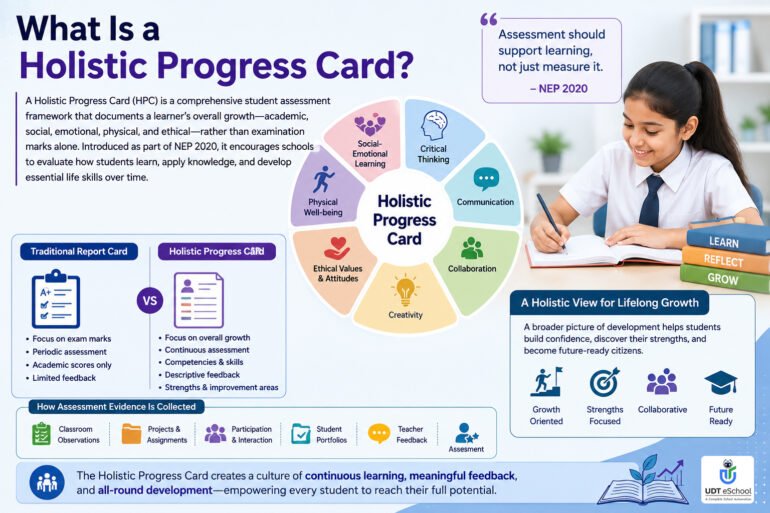
A Holistic Progress Card (HPC) is a comprehensive student assessment framework that documents a learner’s overall growth rather than reporting examination marks alone. Envisioned within the assessment reforms of the National Education Policy (NEP) 2020 and subsequently developed into stage-wise Holistic Progress Cards by PARAKH, the Holistic Progress Card encourages schools to evaluate how students learn, apply knowledge, develop essential life skills, and progress over time.
Unlike a traditional report card that primarily reflects academic scores from periodic examinations, a Holistic Progress Card presents a broader picture of student development. It combines classroom performance with competencies such as critical thinking, communication, collaboration, creativity, ethical values, physical well-being, and social-emotional learning. This enables teachers and parents to understand each learner’s strengths, areas for improvement, and overall learning journey.
One of the key principles behind the Holistic Progress Card is that assessment should support learning rather than simply measure it. Continuous feedback, reflective practices, and evidence gathered through projects, classroom participation, observations, and portfolios help create a more meaningful picture of student progress.
As discussed in our guide on Competency-Based Assessment Examples, modern assessment focuses on what students can demonstrate through real-world application. The Holistic Progress Card builds upon this concept by organising those observations into a structured format that supports long-term student development instead of isolated examination results.
For schools, this approach also strengthens collaboration among teachers, students, and parents by making assessment more transparent, personalised, and growth-oriented.
Understand the Stage-Wise Holistic Progress Card Before Implementation
Before implementing a Holistic Progress Card, schools should first identify which stage-wise framework applies to their learners. PARAKH has developed four Holistic Progress Cards corresponding to the four stages of school education: Foundational, Preparatory, Middle and Secondary.
This means schools should not treat the HPC as a single universal report-card template. The assessment approach, evidence collected, learner participation and reporting expectations should reflect the developmental stage of students.
| Stage | School Level | Implementation Focus |
|---|---|---|
| Foundational | Early years | Observation, activities, developmental progress and descriptive feedback |
| Preparatory | Grades III–V | Competencies, activities, evidence, learner reflection and feedback |
| Middle | Grades VI–VIII | Competencies, self-reflection, peer feedback, projects and broader learner development |
| Secondary | Grades IX–XII | Deeper competency development, inquiry, reflection, projects and future-oriented learning |
PARAKH, under NCERT, has developed stage-wise Holistic Progress Cards for the Foundational, Preparatory, Middle and Secondary Stages. Schools should consult the relevant official HPC resources when designing or adapting their assessment processes.
Why Schools Must Adopt a Holistic Progress Card
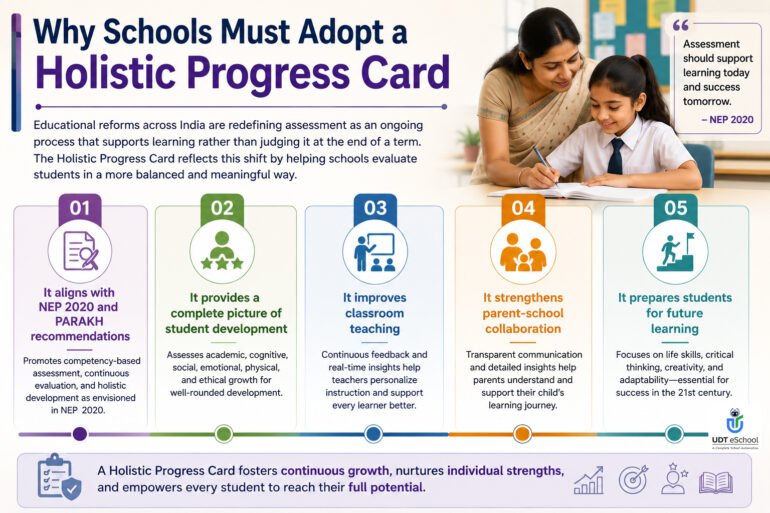
Educational reforms across India are redefining assessment as an ongoing process that supports learning rather than judging it at the end of a term. The Holistic Progress Card reflects this shift by helping schools evaluate students in a more balanced and meaningful way.
Several factors make its adoption increasingly important.
1. It connects classroom assessment with the broader assessment reforms under NEP 2020 and PARAKH.
NEP 2020 calls for assessment to become more regular, formative, competency-based and supportive of learner development. PARAKH has translated this direction into stage-wise Holistic Progress Cards that bring together multiple forms of evidence and stakeholder perspectives.
The National Education Policy (NEP) 2020 envisions assessment systems that encourage conceptual understanding, competency development, creativity, and lifelong learning. Similarly, PARAKH aims to promote more consistent, competency-based assessment practices across schools. Implementing a Holistic Progress Card enables schools to gradually align their internal assessment processes with these broader educational reforms.
2. It provides a complete picture of student development
Every child learns differently. While examinations measure performance at a specific point in time, they often overlook qualities such as leadership, collaboration, resilience, communication, curiosity, and problem-solving. A Holistic Progress Card captures these dimensions, allowing educators to recognise individual progress more accurately.
3. It improves classroom teaching
When teachers continuously observe learning rather than preparing students only for examinations, classroom instruction naturally becomes more engaging and student-centred. Assessment data helps teachers identify learning gaps early and adjust instructional strategies before difficulties become long-term challenges.
4. It strengthens parent-school collaboration
Parents gain a clearer understanding of their child’s development when feedback extends beyond marks. Instead of asking, “How many marks did my child score?”, conversations begin to focus on questions such as:
- Which competencies has my child developed?
- Where does my child need additional support?
- How can learning continue at home?
- What strengths should we nurture further?
This creates more constructive and meaningful parent-teacher discussions.
5. It prepares students for future learning
Higher education institutions and employers increasingly value critical thinking, adaptability, communication, collaboration, and ethical decision-making alongside academic achievement. By documenting these competencies throughout a student’s school journey, the Holistic Progress Card encourages learners to develop skills that remain valuable well beyond the classroom.
💡 Expert Insight
One of the biggest misconceptions about the Holistic Progress Card is that it requires schools to abandon their existing report card system immediately. In practice, successful schools treat it as an evolution rather than a replacement. They gradually integrate competency-based observations, student portfolios, formative assessments, and descriptive feedback into their existing processes while training teachers and familiarising parents with the new approach.
A phased implementation reduces resistance, improves consistency, and allows schools to refine assessment practices before expanding them across all grades. Schools that focus first on teacher readiness and clear assessment rubrics typically experience smoother adoption and stronger stakeholder confidence.
Prerequisites Before Schools Begin Holistic Progress Card Implementation

Implementing a Holistic Progress Card is not simply about introducing a new report card format. It requires schools to establish the right academic, administrative, and technological foundations before the first assessment cycle begins.
Schools that invest time in planning experience smoother implementation, greater teacher confidence, and more meaningful assessment outcomes. Rather than attempting a complete transformation in one academic session, a phased approach allows school leaders to refine processes, gather feedback, and build long-term sustainability.
Below are the key prerequisites every school should address before implementing a Holistic Progress Card.
1. Identify the Applicable PARAKH HPC Framework
Schools should first identify which stage-wise Holistic Progress Card applies to their learners. PARAKH has developed separate HPCs for the Foundational, Preparatory, Middle and Secondary Stages. This prevents schools from creating a generic assessment model that does not reflect the developmental needs of the learner.
The school should review the relevant HPC framework, identify its assessment components, and map those requirements against existing classroom practices, portfolios, observation processes and reporting formats.
2. Develop a Shared Understanding Across the School
One of the most common reasons assessment reforms struggle is that different stakeholders interpret the purpose of the Holistic Progress Card differently.
Before implementation, ensure that all stakeholders understand:
- The objectives of NEP 2020 assessment reforms.
- The difference between marks-based and competency-based assessment.
- The role of continuous observation and evidence collection.
- How descriptive feedback supports student growth.
- Why holistic assessment benefits every learner.
This common understanding reduces confusion and creates consistency across classrooms.
3. Align Learning Outcomes with Assessment
Every subject should clearly define what students are expected to know, understand, and demonstrate.
Instead of asking:
“Did the student score well in the test?”
Teachers begin asking:
- Can the student apply concepts?
- Can they solve unfamiliar problems?
- Can they communicate ideas effectively?
- Can they collaborate with peers?
- Can they reflect on their own learning?
Assessment becomes evidence-based rather than marks-driven.
4. Create Clear Assessment Rubrics
A Holistic Progress Card relies on consistent evaluation criteria.
Well-designed rubrics help teachers assess students fairly while reducing subjectivity.
Typical assessment indicators may include:
- Conceptual Understanding
- Critical Thinking
- Communication Skills
- Collaboration
- Creativity
- Problem Solving
- Responsibility
- Leadership
- Self-Reflection
- Participation
Rubrics also make feedback easier for parents and students to understand.
Important: A rubric should describe observable evidence rather than simply assign a numerical score. Teachers should be able to explain what the learner demonstrated, what evidence supports the judgement, and what the learner should work on next.
5. Prepare Teachers Before Students
Successful implementation depends more on teacher readiness than on the report card itself.
Professional development programmes should help teachers learn:
- Observation techniques
- Competency-based assessment
- Constructive feedback writing
- Portfolio assessment
- Student conferencing
- Evidence documentation
- Rubric design
- Parent communication
When teachers understand why the assessment is changing, they are more confident in how to implement it.
6. Communicate Early with Parents
Parents often associate report cards with marks and ranks.
Without proper communication, they may misunderstand the purpose of a Holistic Progress Card.
Schools should organise:
- Parent orientation sessions
- Sample report card demonstrations
- FAQ documents
- Workshops explaining competency-based assessment
- Regular progress discussions
Transparent communication builds trust and encourages parents to become active partners in their child’s learning journey.
📊 Traditional Report Card vs Holistic Progress Card
| Traditional Report Card | Holistic Progress Card |
|---|---|
| Primarily examination marks | Overall learner growth and competencies |
| End-of-term evaluation | Continuous and formative assessment |
| Primarily teacher-reported | Multiple perspectives including teacher, learner, peer and parent/caregiver input |
| Academic performance only | Academic, social, emotional and life skills |
| Focus on marks | Focus on progress and improvement |
| Limited feedback | Detailed developmental feedback |
| Static document | Living record of continuous learning |
🏫 School Readiness Framework
Before introducing a Holistic Progress Card, school leaders can use the following checklist to assess implementation readiness.
- ✅ Do teachers understand competency-based assessment?
- ✅ Are learning outcomes defined for every subject?
- ✅ Have assessment rubrics been standardised?
- ✅ Are teachers trained to provide qualitative feedback?
- ✅ Is there a process for maintaining student portfolios?
- ✅ Have parents been informed about the new assessment approach?
- ✅ Can the school collect assessment evidence throughout the year?
- ✅ Does the school have a digital platform or School ERP to manage assessment records efficiently?
🏛️ School Leadership Insight
Successful implementation of a Holistic Progress Card is fundamentally a change management initiative, not just an assessment reform. School leaders who communicate a clear vision, provide continuous teacher support, allocate time for collaborative planning, and review implementation regularly are more likely to achieve sustainable adoption.
Rather than expecting immediate perfection, leaders should focus on building a culture of continuous improvement where teachers feel supported, parents remain informed, and students receive meaningful feedback that guides their learning journey.
Digital Transformation Perspective
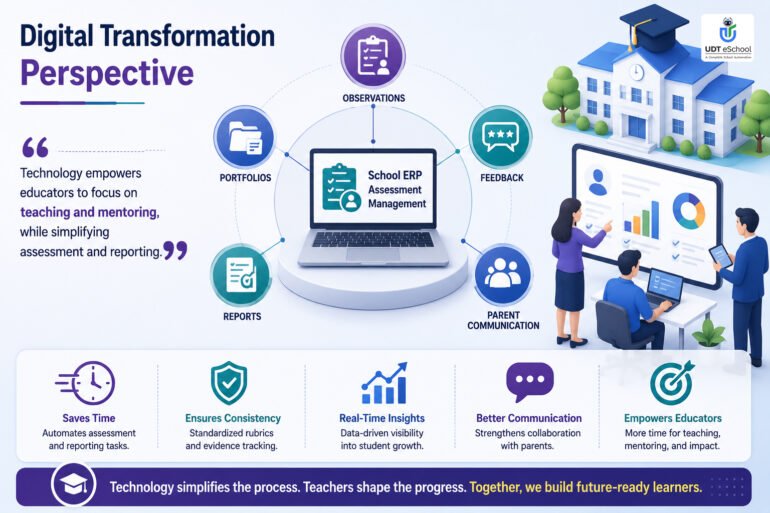
As schools scale holistic assessment across multiple grades and subjects, managing observations, portfolios, feedback, and reporting manually can become time-consuming and inconsistent. A modern School ERP with integrated assessment management can streamline evidence collection, generate comprehensive progress reports, facilitate parent communication, and provide school leaders with real-time insights into student development. Technology should not replace professional judgement—it should enable educators to focus more on teaching and mentoring while reducing administrative workload.
Step-by-Step Framework to Implement a Holistic Progress Card in Schools

Implementing a Holistic Progress Card is a continuous improvement journey rather than a one-time project. Schools that achieve the best results typically follow a structured roadmap that gradually builds teacher confidence, standardises assessment practices, and actively involves students and parents.
The following framework provides a practical implementation plan that schools of different sizes can adapt to their own context.
Step 1 – Build Leadership Consensus and Define the Vision
Every successful educational initiative begins with strong leadership.
Before introducing the Holistic Progress Card, school leaders should clearly define:
- Why the school is adopting the new assessment approach.
- How it aligns with NEP 2020 and school improvement goals.
- What changes teachers, students, and parents can expect.
- The implementation timeline and responsibilities.
A leadership team comprising the Principal, Academic Coordinator, Section Heads, and senior teachers should oversee planning and monitor progress throughout the academic year.
👩🏫 Principal’s Perspective
Rather than announcing a new reporting format, explain the educational purpose behind the change. When teachers understand why the transition is necessary, implementation becomes more collaborative and sustainable.
Step 2 – Map Learning Outcomes to Competencies
The next step is translating curriculum objectives into measurable competencies.
Instead of evaluating whether a student simply remembers information, schools should assess whether the learner can:
- Apply knowledge in unfamiliar situations.
- Analyse and solve problems.
- Communicate ideas effectively.
- Work collaboratively.
- Demonstrate creativity.
- Reflect on their own learning.
Each department should prepare competency maps aligned with subject-specific learning outcomes.
The mapping process should also identify what evidence will demonstrate each competency. Depending on the stage and learning context, evidence may include classroom activities, projects, learner work, observations, portfolios, self-assessment, peer feedback and parent/caregiver input. PARAKH’s current HPC framework emphasises multiple sources of evidence rather than relying on a single examination or test.
Step 3 – Develop Standardised Assessment Rubrics
Consistency is essential.
Without common rubrics, assessment becomes subjective.
Every competency should include clearly defined performance indicators such as:
📊 Sample Competency Assessment Rubric
Schools can use standardized performance levels to ensure consistent and transparent evaluation across subjects.
| Performance Level | Description |
|---|---|
| 🔴 Beginning | Requires continuous guidance and support to complete learning tasks. The learner is developing foundational understanding but needs regular teacher assistance. |
| 🟡 Developing | Demonstrates partial understanding and can perform tasks with occasional guidance. Continued practice will improve consistency. |
| 🟢 Proficient | Applies knowledge and skills independently in familiar situations while demonstrating confidence and accuracy. |
| 🔵 Advanced | Demonstrates mastery by applying learning confidently in new situations, solving complex problems, and supporting peers through collaboration. |
💡 Educational Insight: Performance descriptors should focus on a student’s learning progress rather than comparing learners with one another. Clear competency rubrics help teachers provide consistent feedback, enable students to understand their growth areas, and support meaningful discussions with parents
👩🏫 Teacher Tip
Avoid trying to assess every competency during every lesson. Instead, identify two or three focus competencies for each learning activity and gather evidence gradually throughout the term. Small, consistent observations are far more reliable than attempting to evaluate everything at once.
Step 4 – Define an Evidence Collection Process
A Holistic Progress Card becomes meaningful only when teachers have reliable evidence to support their observations and feedback.
Schools should define what evidence will be collected, how frequently it will be recorded, who will contribute it, and where it will be stored.
Evidence may include:
- Classroom observations
- Student work samples
- Projects and activities
- Portfolios
- Presentations
- Self-assessment
- Peer feedback
- Parent/caregiver observations
- Teacher feedback
- Reflective activities
The purpose is not to create more paperwork. The goal is to build a reliable record of learner progress that can inform meaningful feedback and reporting. PARAKH describes the HPC as a participatory assessment process involving multiple perspectives and forms of evidence.
Step 5 – Train Teachers Through Practical Workshops
Training should not focus only on how to fill the HPC. Teachers need practice in observing learning, collecting evidence, interpreting competency indicators, writing descriptive feedback and using the relevant stage-wise HPC framework.
Professional development should extend beyond policy discussions.
Teachers benefit most from hands-on training that includes:
- Designing competency-based tasks.
- Using observation checklists.
- Writing descriptive feedback.
- Conducting peer and self-assessments.
- Maintaining student portfolios.
- Applying assessment rubrics consistently.
Collaborative moderation sessions, where teachers review sample assessments together, also help improve consistency across classes.
Step 6 – Introduce Student Portfolios
The portfolio should not become a digital storage folder containing every piece of student work. Schools should define what evidence is meaningful, how it demonstrates progress, and how teachers and learners will use it for reflection.
A Holistic Progress Card should be supported by authentic evidence rather than memory alone.
Student portfolios may include:
- Project work.
- Creative assignments.
- Reflection journals.
- Practical activities.
- Presentations.
- Art and creative work.
- Community service documentation.
- Certificates of participation.
These records help demonstrate growth over time and enrich parent-teacher discussions.
Step 7 – Encourage Student Self and Peer Assessment
One of the defining features of the Holistic Progress Card is student participation in the assessment process.
Students can regularly reflect on questions such as:
- What did I learn?
- What challenged me?
- What am I proud of?
- Which skill should I improve next?
- How did I contribute to my group?
Similarly, structured peer feedback helps students develop empathy, communication, and collaborative learning skills.
These inputs should complement—not replace—professional teacher judgement. The objective is to create a richer picture of learner progress rather than simply collecting additional ratings.
These inputs should complement—not replace—professional teacher judgement. The objective is to create a richer picture of learner progress rather than simply collecting additional ratings.
Step 8 – Engage Parents Throughout the Process
Parents or caregivers can contribute useful observations about learning habits, interests, behaviour, strengths and areas where additional support may be required. Their input should be structured and purposeful rather than treated as another marks-based evaluation.
Schools can:
- Share progress updates each month.
- Organise portfolio exhibitions.
- Conduct student-led conferences.
- Explain competency descriptors during PTMs.
- Encourage parents to support learning goals at home.
This transforms assessment into a partnership focused on student growth.
📋 Holistic Progress Card Implementation Checklist
📋 Implementation Checklist
- ✅ Leadership implementation committee established
- ✅ Learning outcomes mapped to competencies
- ✅ Assessment rubrics standardised
- ✅ Teachers trained in holistic assessment
- ✅ Student portfolios introduced
- ✅ Parent orientation completed
- ✅ Feedback process standardised
- ✅ Assessment calendar prepared
- ✅ School ERP configured for assessment management
- ✅ Review and improvement schedule established
📖 Mini Case Study
Illustrative School Implementation Scenario
A CBSE-affiliated K–12 school decided to introduce the Holistic Progress Card in Grades III to V before expanding it across the entire school.

Instead of replacing the existing report card immediately, the school adopted a phased approach:
- Teachers attended competency-based assessment workshops.
- Subject departments created common assessment rubrics.
- Students maintained digital learning portfolios.
- Monthly review meetings allowed teachers to discuss implementation challenges and share best practices.
- Parents received orientation sessions explaining how competencies would be assessed and reported.
In this illustrative scenario, the school could expect to review whether teachers are experiencing more meaningful classroom discussions, whether students are reflecting more actively on their learning, and whether parent-teacher meetings are shifting towards strengths, learning goals and development.
🚀 Digital Transformation Insight
As the number of competencies, observations, and student portfolios grows, manual documentation can quickly become difficult to manage. A modern School ERP can streamline assessment workflows by allowing teachers to record observations, attach evidence, generate Holistic Progress Cards, share reports securely with parents, and provide school leaders with real-time analytics on student progress. This reduces administrative effort while improving the consistency and quality of assessment data.
Building on This Framework
Once the implementation process is underway, schools often encounter practical questions related to teacher workload, assessment consistency, parent expectations, and technology adoption. Addressing these challenges proactively ensures that the Holistic Progress Card becomes a sustainable part of the school’s assessment culture rather than a short-term initiative.
Common Challenges Schools Face While Implementing a Holistic Progress Card

Implementing a Holistic Progress Card is a significant step towards student-centred assessment, but like any educational reform, it comes with practical challenges. These challenges are rarely caused by the framework itself. More often, they arise due to limited preparation, inconsistent implementation, or uncertainty among stakeholders.
The encouraging news is that most of these challenges can be addressed through thoughtful planning, continuous professional development, and the strategic use of digital tools.
Challenge 1 – Teacher Readiness and Confidence
Teachers play the most important role in the successful implementation of a Holistic Progress Card. However, many educators have spent years working within a marks-based assessment system, making the transition to competency-based evaluation feel unfamiliar.
Common concerns include:
- How should competencies be assessed consistently?
- How much evidence should be collected?
- How should descriptive feedback be written?
- Will continuous assessment increase workload?
The solution lies in ongoing professional development rather than one-time training sessions. Schools should organise regular workshops, peer learning sessions, classroom observations, and moderation meetings where teachers can discuss assessment practices and share successful strategies.
👩🏫 Teacher Perspective
A Holistic Progress Card should support teaching—not create additional paperwork.
Teachers who integrate assessment into everyday classroom activities often find that observations become more natural and less time-consuming. Instead of conducting separate assessments, evidence can be gathered during discussions, projects, presentations, practical activities, and collaborative learning experiences.
Challenge 2 – Maintaining Consistency Across Classrooms
When different teachers interpret assessment criteria differently, student evaluations can become inconsistent.
For example, one teacher may consider a student’s communication skills to be “Advanced,” while another may rate similar performance as “Proficient.”
Consistency can be improved by:
- Standardising competency rubrics.
- Conducting moderation meetings.
- Reviewing sample student work collectively.
- Establishing common assessment guidelines.
- Periodically auditing assessment practices.
These collaborative practices help ensure fairness and reliability across the school.
Challenge 3 – Parent Expectations
Many parents naturally associate academic success with examination marks and class rankings. When schools introduce descriptive feedback and competency-based reporting, parents may initially be unsure how to interpret the new format.
Schools can bridge this gap by:
- Conducting orientation programmes.
- Sharing sample Holistic Progress Cards.
- Explaining competency descriptors.
- Organising student-led conferences.
- Encouraging regular two-way communication.
When parents understand how holistic assessment supports their child’s long-term development, they become valuable partners in the learning process.
Challenge 4 – Managing Assessment Data
As schools begin documenting classroom observations, portfolios, projects, self-assessments, and teacher feedback, maintaining records manually can become increasingly complex.
Without a structured system, schools may encounter:
- Duplicate documentation.
- Inconsistent records.
- Delayed report generation.
- Difficulty tracking student progress over multiple terms.
- Increased administrative workload.
This is where digital assessment management becomes especially valuable.
Challenge 5 – Turning HPC Into a Compliance Exercise
A common implementation risk is treating the Holistic Progress Card as a new reporting form rather than as a change in assessment practice.
Schools may technically complete the required fields while continuing to rely primarily on examinations and marks.
To avoid this, academic leaders should periodically review whether classroom activities, evidence collection, feedback and learner participation actually reflect the principles of holistic and competency-based assessment.
For the latest stage-wise HPC resources and guidance, schools should consult the official PARAKH/NCERT resources before finalising their implementation process.
🚀 Digital Transformation Insight
As holistic assessment becomes more comprehensive, schools need efficient systems to capture observations, maintain student portfolios, generate progress reports, and communicate with parents. A modern School ERP enables teachers to record assessment evidence throughout the academic year while reducing repetitive administrative work. School leaders also gain access to dashboards that provide valuable insights into student development, helping them make informed academic decisions.
The Role of School ERP in Holistic Progress Card Implementation
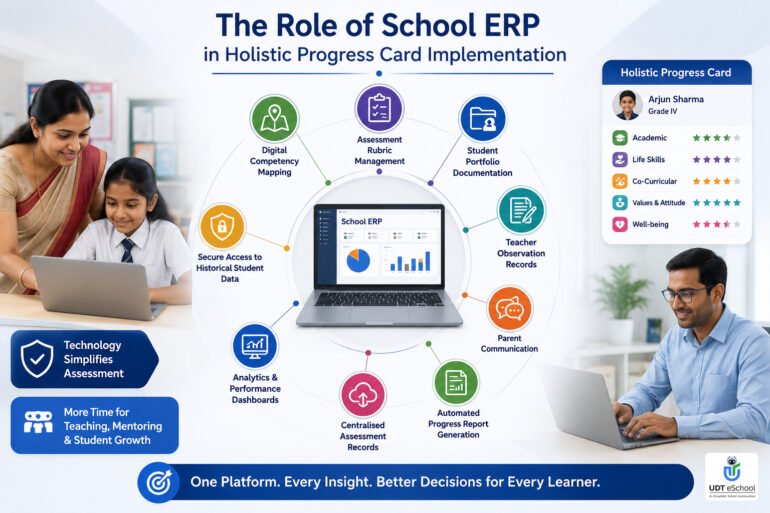
Technology is not a substitute for effective teaching—it is an enabler of effective assessment.
A well-designed School ERP can simplify every stage of the Holistic Progress Card process while allowing educators to focus more on supporting student learning.
Once the assessment framework, competencies, evidence requirements and teacher processes are defined, technology can help schools manage the operational side of implementation. A School ERP should support—not define—the assessment model.
Its value is greatest when it reduces repetitive documentation, keeps assessment evidence organised, supports consistent reporting, and makes relevant information accessible to teachers, school leaders and parents.
Key benefits include:
- Digital competency mapping.
- Assessment rubric management.
- Student portfolio documentation.
- Teacher observation records.
- Parent communication.
- Automated progress report generation.
- Centralised assessment records.
- Analytics and performance dashboards.
- Secure access to historical student data.
Rather than maintaining multiple spreadsheets and paper records, schools can manage assessment data through a single integrated platform.
🏫 School Management Insight
School leaders often discover that the greatest challenge is not evaluating students—it is organising assessment information in a consistent, accessible, and meaningful way. Integrating holistic assessment within the school’s digital ecosystem improves collaboration between teachers, simplifies documentation, and ensures that progress reports accurately reflect each learner’s development over time.
What ERP Should Actually Do
| Implementation Need | What a School ERP Should Support |
|---|---|
| Competency Mapping | Map competencies and learning outcomes |
| Evidence Collection | Record observations and assessment evidence |
| Portfolios | Store relevant student work and evidence |
| Rubrics | Apply standardised assessment criteria |
| Feedback | Record descriptive teacher feedback |
| Reporting | Generate structured progress reports |
| Parent Engagement | Share relevant progress information securely |
| Analytics | Identify progress patterns and learning needs |
Best Practices for Long-Term Success
Schools that successfully sustain Holistic Progress Card implementation typically follow several common practices.
- Begin with a pilot programme before expanding school-wide.
- Provide continuous teacher mentoring and professional development.
- Review competency rubrics annually.
- Encourage student reflection after every assessment cycle.
- Make parents active participants through regular communication.
- Use assessment data to improve teaching strategies rather than simply reporting outcomes.
- Leverage digital tools to streamline assessment workflows.
- Periodically evaluate the implementation process and refine it based on feedback.
These practices help embed holistic assessment into the school’s culture rather than treating it as a compliance exercise.
🎯 Moving from Assessment Reform to Effective Implementation
Implementing a Holistic Progress Card is not about replacing one report card with another. It is about creating an assessment culture that supports continuous learning, meaningful feedback, and informed educational decisions.
Schools that combine clear implementation planning, teacher capacity building, parent engagement, and digital assessment management are better positioned to deliver a consistent and sustainable assessment experience for every learner.
As schools continue their NEP 2020 transformation journey, integrating assessment processes with modern school management practices can reduce administrative effort while enabling educators to focus on what matters most—student learning and development.
Building a Whole-School Culture Around the Holistic Progress Card
The successful implementation of a Holistic Progress Card is not determined by the report card template alone. It depends on how effectively every stakeholder within the school community contributes to the assessment process.
From classroom teachers and academic coordinators to parents and school leaders, each stakeholder has a unique responsibility in ensuring that assessment becomes a meaningful tool for student growth rather than merely an administrative requirement.
Schools that embrace this collaborative approach are more likely to create an assessment culture that supports continuous improvement, personalised learning, and stronger educational outcomes.
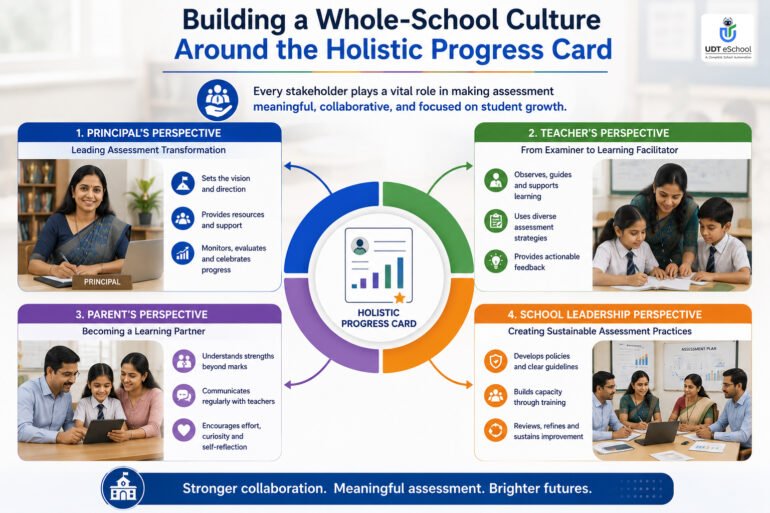
1. Principal’s Perspective – Leading Assessment Transformation
The Principal plays a pivotal role in shaping the school’s assessment philosophy. While teachers implement classroom practices, it is the Principal who establishes the vision, allocates resources, and creates an environment where educational innovation can thrive.
A successful transition to the Holistic Progress Card requires school leaders to move beyond administrative supervision and become instructional leaders who actively support assessment reform.
Key leadership responsibilities include:
- Defining a clear implementation roadmap.
- Building awareness among teachers and parents.
- Ensuring alignment with NEP 2020 and CBSE assessment reforms.
- Encouraging collaborative planning across departments.
- Monitoring implementation through regular academic reviews.
- Promoting a culture of reflective teaching and continuous improvement.
Rather than expecting immediate perfection, Principals should view implementation as an evolving process that improves with regular feedback and refinement.
🏛️ Principal’s Perspective
The success of a Holistic Progress Card depends less on introducing a new report card and more on creating a shared vision for student development. School leaders who encourage collaboration, invest in teacher capacity building, and communicate openly with parents often experience smoother implementation and stronger educational outcomes.
Assessment reform should be viewed as a continuous journey that evolves through reflection, professional learning, and evidence-based decision-making.
2. Teacher’s Perspective – From Examiner to Learning Facilitator
The introduction of a Holistic Progress Card transforms the teacher’s role from evaluating performance at the end of a unit to supporting learning throughout the academic year.
Instead of relying primarily on written examinations, teachers continuously observe how students:
- Apply classroom concepts.
- Solve real-world problems.
- Collaborate with peers.
- Communicate ideas.
- Demonstrate creativity.
- Reflect on their own learning.
- Show resilience when facing challenges.
This shift encourages teachers to gather evidence through authentic classroom experiences rather than isolated assessment events.
Teachers also become mentors who provide regular, constructive feedback that helps students identify strengths and areas for growth.
👩🏫 Teacher Tip
Continuous assessment does not require teachers to record every classroom activity. Instead, identify meaningful learning opportunities where students naturally demonstrate competencies such as collaboration, communication, critical thinking, creativity, and problem-solving.
Quality observations collected consistently throughout the term provide richer evidence than a large number of isolated assessment records.
3. Parent’s Perspective – Becoming a Learning Partner
Parents often view report cards as indicators of academic achievement. A Holistic Progress Card broadens this perspective by helping families understand how children develop academically, socially, emotionally, and personally.
Instead of focusing exclusively on examination marks, parents gain insights into:
- Learning habits.
- Communication skills.
- Collaboration.
- Leadership qualities.
- Creativity.
- Emotional well-being.
- Responsibility.
- Goal-setting abilities.
This creates opportunities for more meaningful conversations between parents, teachers, and students.
Parents also become active participants by:
- Encouraging reflection at home.
- Celebrating progress rather than only results.
- Supporting learning goals.
- Reinforcing positive learning habits.
- Maintaining regular communication with teachers.
👨👩👧 Parent Engagement Insight
Parents should view the Holistic Progress Card as a conversation starter rather than a performance report. Discussing learning experiences, personal growth, and future goals helps children develop confidence, motivation, and a positive attitude towards learning.
When schools and families work together, assessment becomes a shared responsibility that supports every learner’s long-term development.
4. School Leadership Perspective – Creating Sustainable Assessment Practices
Implementing a Holistic Progress Card requires more than individual classroom efforts. Sustainable success depends on creating school-wide systems that ensure consistency, collaboration, and continuous improvement.
School leadership teams should focus on establishing:
Standardised Assessment Practices
Develop common assessment rubrics, observation formats, and reporting guidelines that can be applied consistently across classes and departments.
Professional Learning Communities
Encourage teachers to meet regularly to discuss assessment strategies, review student work, and share effective classroom practices.
Continuous Monitoring
Review implementation progress periodically through classroom observations, teacher feedback, student reflections, and parent input.
Data-Informed Decision Making
Assessment evidence should inform:
- Curriculum planning.
- Academic interventions.
- Teacher professional development.
- Student support programmes.
- School improvement initiatives.
By analysing assessment trends, school leaders can identify both strengths and areas requiring additional support.
🏫 School Leadership Insight
Schools that successfully implement Holistic Progress Cards rarely focus only on documentation. They invest equally in teacher development, collaborative planning, stakeholder communication, and continuous review. These four pillars create a sustainable assessment culture where educational improvement becomes an ongoing process rather than a one-time initiative.
Strong leadership ensures that assessment remains centred on improving learning experiences while maintaining consistency, transparency, and alignment with national education reforms.
Building Towards Digital Transformation
As schools mature in their Holistic Progress Card implementation, the volume of assessment evidence, observations, student portfolios, and progress reports increases significantly. Managing this information efficiently requires more than manual documentation—it calls for integrated digital systems that simplify assessment workflows while supporting informed decision-making.
Integrating School ERP with Holistic Progress Card Implementation
As schools expand holistic assessment across grades, subjects, and co-curricular activities, managing large volumes of assessment data manually becomes increasingly challenging. Teachers must record classroom observations, maintain student portfolios, document competencies, prepare descriptive feedback, and generate comprehensive progress reports—all while continuing their regular teaching responsibilities.
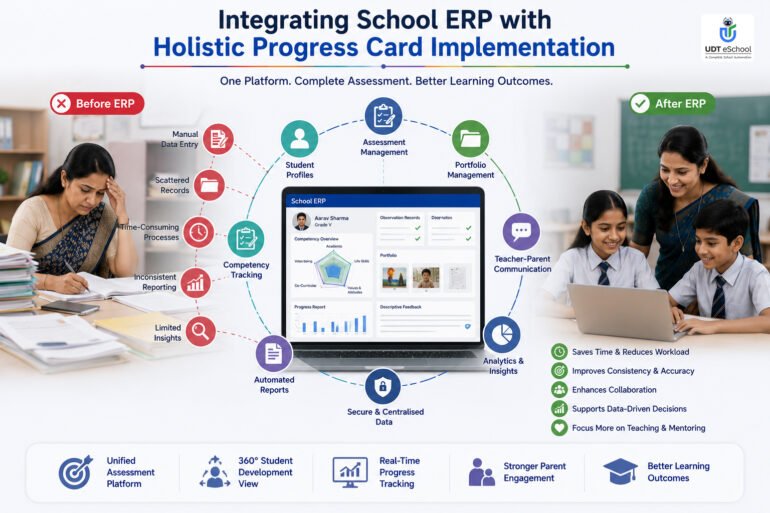
A modern School ERP can simplify these processes by bringing assessment, communication, and reporting into one integrated platform. Rather than replacing educators’ professional judgement, technology helps reduce repetitive administrative tasks so teachers can devote more time to mentoring students and improving learning outcomes.
When thoughtfully implemented, a School ERP becomes an enabler of educational transformation by improving consistency, accessibility, and collaboration throughout the assessment cycle.
How School ERP Supports the Holistic Progress Card
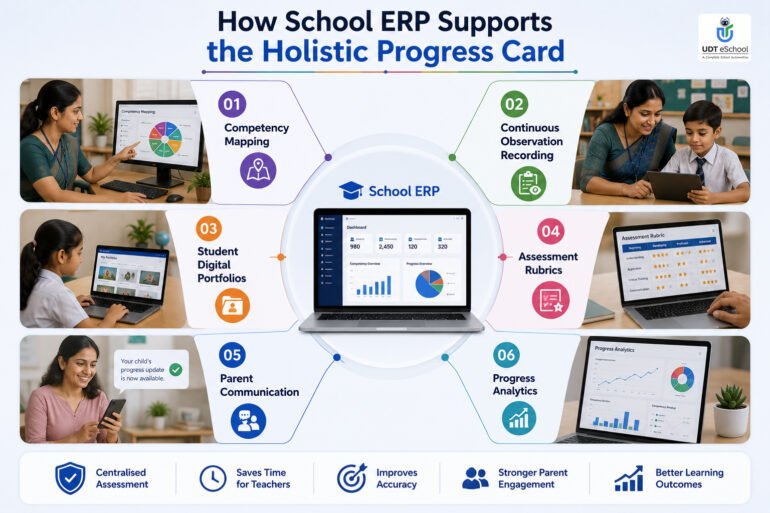
An integrated School ERP can support schools in several practical ways:
1. Competency Mapping
Schools can digitally map competencies and learning outcomes to each subject, ensuring consistent assessment across classes and academic sessions.
2. Continuous Observation Recording
Teachers can record classroom observations throughout the year instead of relying on end-term recollection.
3. Student Digital Portfolios
Assignments, projects, presentations, certificates, artwork, and evidence of learning can be securely stored as part of each student’s digital portfolio.
4. Assessment Rubrics
Standardised rubrics help teachers maintain fairness and consistency while evaluating competencies.
5. Parent Communication
Assessment updates, feedback, and progress reports can be shared securely with parents, encouraging continuous engagement rather than communication only during report card distribution.
6. Progress Analytics
School leaders gain access to dashboards that identify learning trends, support early interventions, and inform academic planning.
🚀 Digital Transformation Insight
Digital transformation is not about replacing teachers with technology. It is about creating systems that simplify assessment workflows, improve collaboration, reduce administrative effort, and provide timely insights into every student’s learning journey.
When routine documentation is automated, educators have more time to focus on personalised instruction, mentoring, and meaningful student interactions.
Automation Opportunities for Schools
Automation should enhance educational processes—not make them more complex. Schools implementing a Holistic Progress Card can automate several routine tasks while preserving the teacher’s role in professional judgement and feedback.

Some practical automation opportunities include:
- Recording competency-based observations through mobile devices.
- Automatically generating student progress summaries.
- Sending assessment notifications to parents.
- Scheduling parent-teacher meetings based on assessment milestones.
- Tracking student portfolio submissions.
- Monitoring completion of assessment rubrics.
- Generating school-wide assessment analytics.
- Maintaining secure digital assessment records for future reference.
These improvements reduce paperwork, minimise duplication, and allow educators to spend more time supporting student learning.
⚙️ School Management Insight
Automation should eliminate repetitive administrative work—not educational decision-making. Teachers remain responsible for observing, mentoring, and providing meaningful feedback, while technology supports documentation, reporting, communication, and data analysis.
Creating a Future-Ready Assessment Ecosystem
The Holistic Progress Card is more than a reporting format—it represents a broader shift towards a learning ecosystem where assessment continuously informs teaching, supports students, and strengthens collaboration between schools and families.
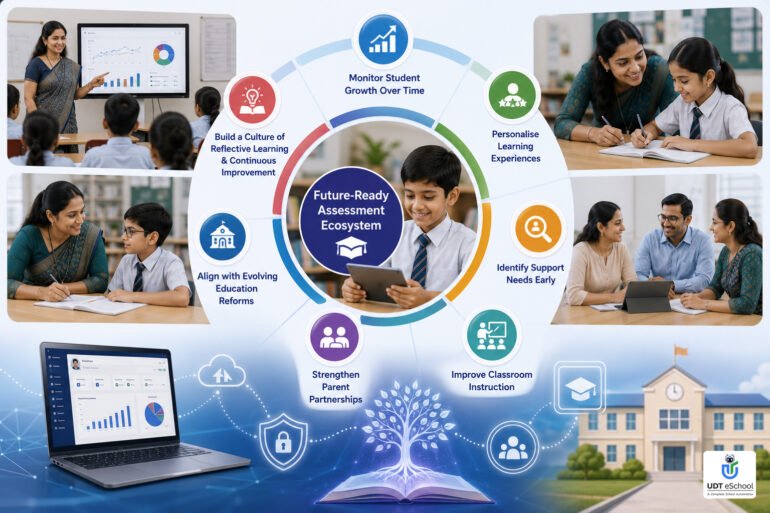
Schools that embrace this approach are better positioned to:
- Monitor student growth over time.
- Personalise learning experiences.
- Identify support needs early.
- Improve classroom instruction.
- Strengthen parent partnerships.
- Align with evolving national education reforms.
- Build a culture of reflective learning and continuous improvement.
As assessment practices evolve, digital systems, professional development, and collaborative leadership become essential pillars of sustainable implementation.
Conclusion
The transition from traditional report cards to a Holistic Progress Card reflects a significant change in how schools understand and support student learning. Rather than measuring success through examination marks alone, holistic assessment recognises the importance of competencies, life skills, values, creativity, collaboration, and continuous growth.
Successful implementation requires thoughtful planning, teacher preparedness, stakeholder collaboration, and ongoing reflection. Schools that adopt a phased approach, develop clear assessment rubrics, engage parents, and leverage digital tools are better equipped to create meaningful assessment experiences that benefit every learner.
Ultimately, a Holistic Progress Card is not simply a document—it is a framework that encourages schools to focus on the complete development of each student while supporting the broader vision of NEP 2020 and future-ready education.
🎯 Strengthen Assessment Before You Digitise It
A successful Holistic Progress Card begins with well-defined learning outcomes, consistent assessment practices, and meaningful feedback. Technology becomes most effective when it supports strong educational processes rather than attempting to replace them.
Schools that invest in teacher capacity building, collaborative planning, and structured assessment frameworks create a stronger foundation for long-term educational excellence.
See How UDT eSchool Simplifies Holistic Progress Card Implementation
Schools that already have their assessment framework in place can use technology to simplify the documentation, reporting and communication involved in HPC implementation.
Managing competency-based assessments, student portfolios, teacher observations, descriptive feedback, and parent communication manually can quickly become time-consuming. A modern School ERP helps schools streamline these processes while allowing educators to focus more on teaching and student development.
UDT eSchool – India’s First AI-Powered School ERP empowers schools to digitise holistic assessments, automate routine administrative tasks, generate comprehensive progress reports, strengthen parent engagement, and make data-driven academic decisions through one integrated platform.
Why Schools Choose UDT eSchool
- ✅ Holistic Progress Card Management
- ✅ Competency-Based Assessment Tracking
- ✅ Digital Student Portfolios
- ✅ AI-Powered Analytics & Dashboards
- ✅ Parent Communication & Mobile App
- ✅ Attendance, Fees & Complete School Management
- ✅ CBSE & NEP 2020 Ready
Whether your school is beginning its NEP 2020 transformation journey or looking to modernise its assessment process, our experts can demonstrate how UDT eSchool supports every stage of implementation.
Helping schools embrace NEP 2020, Competency-Based Assessment, and Holistic Student Development through intelligent school management solutions.
Frequently Asked Questions (FAQs) about How Schools Can Implement Holistic Progress Card
1. What is a Holistic Progress Card?
A Holistic Progress Card (HPC) is a comprehensive student assessment framework introduced under the National Education Policy (NEP) 2020. Unlike traditional report cards that primarily focus on examination marks, a Holistic Progress Card evaluates a student’s overall development, including academic achievement, critical thinking, communication, collaboration, creativity, life skills, values, and social-emotional growth. It provides a more balanced picture of a learner’s progress throughout the academic year.
2. How can schools implement a Holistic Progress Card successfully?
Schools can implement a Holistic Progress Card by identifying the appropriate stage-wise HPC framework, mapping learning outcomes to competencies, defining evidence and assessment criteria, training teachers, collecting observations and learner work, using portfolios and self/peer assessment, involving parents or caregivers, and reviewing progress regularly. PARAKH has developed separate HPCs for the Foundational, Preparatory, Middle and Secondary Stages, so implementation should be adapted to the learner’s stage.
3. Is the Holistic Progress Card mandatory for CBSE schools?
The implementation status of the Holistic Progress Card should be understood in the context of the latest CBSE and PARAKH guidance applicable to the school and stage. CBSE has stated that it adopted the prototype developed by PARAKH and has released implementation guidance and conducted orientation and training programmes related to HPC. Schools should therefore refer to the latest official CBSE and PARAKH communications rather than relying on a generic statement that applies to every school and stage.
4. What is the difference between a traditional report card and a Holistic Progress Card?
A traditional report card mainly reports examination marks and grades, whereas a Holistic Progress Card evaluates a student’s complete development.
A Holistic Progress Card includes:
- Academic progress
- Competency development
- Communication skills
- Critical thinking
- Creativity
- Collaboration
- Behaviour and values
- Student reflections
- Teacher observations
- Continuous feedback
This provides parents and teachers with a richer understanding of each learner’s strengths and areas for improvement.
5. Why is teacher training important for implementing a Holistic Progress Card?
Teachers are central to the success of holistic assessment. Training helps educators understand competency-based evaluation, use assessment rubrics consistently, provide meaningful descriptive feedback, maintain student portfolios, and collect reliable classroom evidence. Well-prepared teachers ensure fair, transparent, and student-centred assessment practices.
6. How does a School ERP help manage a Holistic Progress Card?
A School ERP can support Holistic Progress Card implementation by helping schools organise competency mapping, teacher observations, assessment evidence, portfolios, feedback, progress reports and parent communication. The ERP should support the school’s assessment framework rather than replace teacher judgement. Its main value is reducing repetitive administrative work and keeping assessment information organised and accessible throughout the academic year.
7. How should parents support the Holistic Progress Card process?
Parents play an important role by discussing learning experiences with their children, encouraging reflection, supporting learning goals at home, attending parent-teacher meetings, and understanding competency-based feedback instead of focusing only on examination marks. Strong parent-school collaboration contributes significantly to student success.
8. What challenges do schools face while implementing a Holistic Progress Card?
Some common challenges include:
- Teacher readiness
- Parent awareness
- Assessment consistency
- Documentation workload
- Competency mapping
- Managing assessment records
- Limited technology support
These challenges can be addressed through structured planning, professional development, stakeholder communication, and digital assessment tools.
9. How long does it take to implement a Holistic Progress Card?
The implementation timeline depends on the school’s size, existing assessment practices, and teacher preparedness. Many schools begin with a pilot programme in selected grades before expanding across the entire institution over one or more academic sessions. A phased approach allows schools to refine processes and build stakeholder confidence.
10. How does the Holistic Progress Card support NEP 2020?
The Holistic Progress Card supports the assessment vision of NEP 2020 by moving reporting beyond marks alone towards holistic, competency-based and formative assessment. PARAKH has developed stage-wise HPCs that incorporate multiple dimensions of learner development and multiple sources of feedback, including teacher, learner, peer and parent/caregiver perspectives.
11. What are the steps to implement a Holistic Progress Card?
Identify the applicable stage-wise HPC.
- Build school leadership consensus.
- Map learning outcomes to competencies.
- Define evidence and assessment criteria.
- Develop consistent rubrics.
- Train teachers.
- Introduce portfolios and evidence collection.
- Include student and peer reflection.
- Engage parents/caregivers.
- Review implementation and improve the process.
People Also Ask How Schools Can Implement Holistic Progress Card
These are related questions schools, educators, and parents frequently search for when exploring holistic assessment and NEP 2020 reforms.
- What is the purpose of a Holistic Progress Card in schools?
- How is a Holistic Progress Card different from a traditional report card?
- What are the key components of a Holistic Progress Card?
- How do teachers assess competencies in a Holistic Progress Card?
- What role do parents play in holistic student assessment?
- Can School ERP software support Holistic Progress Card implementation?
- How does the Holistic Progress Card align with NEP 2020?
- What are the benefits of competency-based assessment for students?
- How can schools prepare teachers for Holistic Progress Card implementation?
- What challenges should schools expect during Holistic Progress Card implementation?
- How many Holistic Progress Cards are there?
- What are the four stages of the Holistic Progress Card?
- Who developed the Holistic Progress Card in India?
1. What are the four stages of the Holistic Progress Card?
PARAKH has developed four stage-wise Holistic Progress Cards: Foundational, Preparatory, Middle and Secondary. Each stage is designed to reflect the developmental and learning needs of students at that stage.
2. Who developed the Holistic Progress Card?
he Holistic Progress Card has been developed through PARAKH, the National Assessment Centre under NCERT, to support the shift towards holistic and competency-based assessment envisioned by NEP 2020.
3. How many Holistic Progress Cards are there?
PARAKH has developed four Holistic Progress Cards corresponding to the Foundational, Preparatory, Middle and Secondary Stages of school education.
Official Sources for Holistic Progress Card Implementation
Schools implementing or reviewing their Holistic Progress Card processes should consult primary sources rather than relying solely on secondary summaries.PARAKH / NCERT — Stage-wise Holistic Progress Card resources and assessment guidance. CBSE — Official assessment and HPC-related guidance for affiliated schools. Ministry of Education — National Education Policy and broader education-reform guidance.
📚 Continue Exploring School Transformation
Expand your understanding of NEP 2020, assessment reforms, and school digital transformation with these related guides.

Education Technology Consultant at UDt eSchool with 10+ years of experience helping schools digitize operations and implement CBSE-aligned systems.