Tag: AI in Education

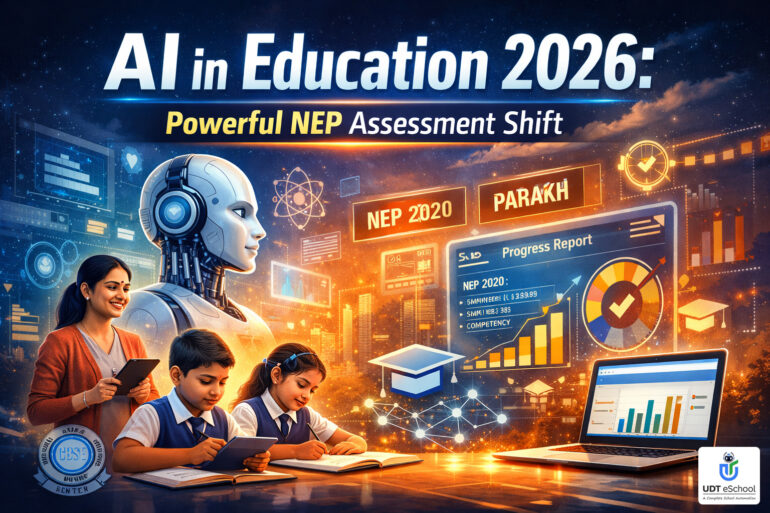
  • AI in Education 2026: NEP, PARAKH & Future of School Assessment | UDT eSchool

    AI in Education 2026: NEP, PARAKH & Future of School Assessment | UDT eSchool

    AI in Education 2026 - UDT eSchool
    AI in Education 2026 – UDT eSchool

    ๐Ÿš€ AI in Education 2026: NEP, PARAKH & the Future of School Assessment

    Indiaโ€™s education system is undergoing a powerful transformation under the National Education Policy 2020 and the introduction of PARAKH, guided by reforms from the Central Board of Secondary Education.

    These reforms emphasize:

    • Competency-based learning

    • Holistic progress tracking

    • Skill-driven evaluation

    • Reduced rote memorization

    As we move into 2026, Artificial Intelligence is becoming the operational backbone that enables schools to implement these reforms effectively.


    1๏ธโƒฃ NEP 2020: From Rote Learning to Real Competency

    According to the official NEP document published by the Ministry of Education, the goal is to shift toward experiential and outcome-based education.

    ๐Ÿ‘‰ Official Policy Reference: https://www.education.gov.in/sites/upload_files/mhrd/files/NEP_Final_English_0.pdf

    NEP Assessment Highlights:

    NEP Assessment Highlights - UDT eSchool
    NEP Assessment Highlights – UDT eSchool
    • 360-degree holistic progress card

    • Skill-based and competency-based questions

    • Formative and adaptive evaluation

    • Reduced high-stakes board exam pressure

    Manual systems struggle to handle such dynamic evaluation models.

    This is where AI-driven systems become essential.


    2๏ธโƒฃ PARAKH: Standardizing Assessment Across India

    PARAKH Aims - UDT eSchool
    PARAKH Aims – UDT eSchool

    PARAKH (Performance Assessment, Review, and Analysis of Knowledge for Holistic Development) was established under National Council of Educational Research and Training to bring uniformity in assessments.

    ๐Ÿ‘‰ Official NCERT Resource: https://ncert.nic.in

    PARAKH aims to:

    • Create national assessment benchmarks

    • Ensure competency mapping

    • Align school assessments with national standards

    • Promote analytical performance review

    For schools, this means:

    โœ” Standardized evaluation formats
    โœ” Data-backed assessment insights
    โœ” Structured competency frameworks

    Without integrated ERP and analytics tools, implementation becomes operationally overwhelming.


    3๏ธโƒฃ CBSEโ€™s Push Toward AI & Competency-Based Exams

    CBSE and AI - UDT eSchool
    CBSE and AI – UDT eSchool

    The Central Board of Secondary Education has already:

    • Introduced Artificial Intelligence as a subject

    • Increased competency-based questions in board exams

    • Issued academic circulars encouraging digital transformation

    ๐Ÿ‘‰ CBSE Academic Portal: https://www.cbseacademic.nic.in

    CBSEโ€™s exam reforms clearly indicate that schools must modernize assessment infrastructure.


    4๏ธโƒฃ What AI in Education 2026 Actually Means

    What AI in Education 2026 Actually Means - UDT eSchool
    What AI in Education 2026 Actually Means – UDT eSchool

    AI in 2026 is not about replacing teachers.

    It means:

    ๐Ÿ“Š Intelligent Question Bank Generation

    • Bloomโ€™s taxonomy alignment

    • Competency-level tagging

    • Auto difficulty mapping

    ๐Ÿ“ˆ Real-Time Student Analytics

    • Skill gap identification

    • Performance forecasting

    • Outcome tracking

    ๐Ÿง  Adaptive Learning Assistance

    • Instant concept explanations

    • Practice question generation

    • AI-supported academic guidance


    5๏ธโƒฃ The Ground Reality: Challenges Schools Face

    The Ground Reality: Challenges Schools Face
    The Ground Reality: Challenges Schools Face

    Despite reforms, schools struggle with:

    • Manual progress card compilation

    • Complex competency mapping

    • Teacher workload overload

    • Disconnected software tools

    • Limited performance analytics

    This leads to:

    โŒ Compliance gaps
    โŒ Inconsistent evaluation
    โŒ Increased administrative burden


    6๏ธโƒฃ How UDT eSchool Supports NEP & PARAKH Implementation

    How UDT eSchool Supports NEP & PARAKH Implementation
    How UDT eSchool Supports NEP & PARAKH Implementation

    UDT eSchool integrates AI directly inside its ERP ecosystem through the โ€œU & AIโ€ module.

    Instead of using external generic tools, schools get a controlled, education-focused AI system aligned with policy reforms.


    ๐ŸŽ“ U & AI Module โ€“ Practical Academic Support

    U & AI Module โ€“ Practical Academic Support
    U & AI Module โ€“ Practical Academic Support

    For Students:

    • Concept explanation

    • Creative story generation

    • Project assistance

    • Practice question generation

    For Teachers:

    • Question paper creation

    • Competency-aligned question suggestions

    • Lesson planning support

    • Bloomโ€™s taxonomy integration

    For Parents:

    • Academic progress clarity

    • Homework assistance support

    • Transparent performance insights


    7๏ธโƒฃ Holistic Progress Card Automation

    Holistic Progress Card Automation
    Holistic Progress Card Automation

    NEP mandates a 360-degree progress card including:

    • Academic growth

    • Co-curricular activities

    • Behavioral development

    • Skill mastery

    UDT eSchool enables automated holistic report generation aligned with NEP standards.

    ๐Ÿ”— Related: ๐Ÿ‘‰ Holistic Progress Card with AI in Schools | 2026 Guide

    This ensures:

    โœ” Outcome-based grading
    โœ” Reduced teacher workload
    โœ” Structured evaluation compliance


    8๏ธโƒฃ AI-Powered Online Examination & Analytics

    AI-Powered Online Examination & Analytics - UDT eSchool
    AI-Powered Online Examination & Analytics – UDT eSchool

    Modern assessments require digital infrastructure.

    UDT eSchool offers:

    • AI-powered online exams

    • Performance dashboards

    • Section-wise analytics

    • Student-level insights

    ๐Ÿ”— Related: ๐Ÿ‘‰ Smart Attendance Management System for Schools in 2026

    This supports:

    โœ” Competency tracking
    โœ” Performance comparison
    โœ” Data-driven improvement


    9๏ธโƒฃ Attendance & Continuous Evaluation Integration

    Attendance & Continuous Evaluation Integration
    Attendance & Continuous Evaluation Integration

    Continuous assessment is incomplete without attendance analytics.

    UDT eSchool integrates smart attendance tracking.

    ๐Ÿ”— Related: ๐Ÿ‘‰ Increase School Admission Leads in 2026 | With AI Enabled UDT eSchool ERP

    Attendance patterns can now correlate with academic performance trends โ€” a powerful insight for administrators.


    People Also Ask: AI in Education 2026

    What is AI in Education 2026 in simple terms?

    AI in Education 2026 means using artificial intelligence in schools to improve learning, automate assessments, and track student performance. It helps teachers create competency-based questions, monitor progress, and align with NEP 2020 reforms while reducing administrative workload.

    How is AI changing school assessments in India?

    AI is transforming school assessments by enabling competency-based evaluation, real-time analytics, adaptive testing, and automated progress reports. Under NEP 2020 and PARAKH guidelines, schools now focus on skills and understanding rather than rote memorization.

    How does NEP 2020 promote AI in education?

    The National Education Policy 2020 encourages technology integration to support personalized learning, digital assessments, and data-driven evaluation. AI tools help schools implement 360-degree progress cards and competency-based testing more efficiently.

    What is PARAKH in the new education system?

    PARAKH is a national assessment body established under NCERT to standardize competency-based evaluation across India. It ensures schools align with structured benchmarks and adopt transparent, data-driven assessment systems.

    Will AI replace teachers in schools?

    No, AI will not replace teachers. AI in Education 2026 supports teachers by automating repetitive tasks, generating structured assessments, and providing performance analytics. Teachers remain essential for mentoring, creativity, emotional development, and classroom leadership.

    How can schools prepare for AI-based assessment systems?

    Schools should adopt AI-integrated ERP systems that align with NEP 2020 assessment reforms and CBSE competency-based frameworks. This includes implementing digital exams, automated holistic progress cards, and real-time analytics dashboards.

    Is AI mandatory under CBSE reforms?

    The Central Board of Secondary Education promotes AI learning and competency-based questions but does not mandate a specific software. However, digital assessment tools are strongly encouraged to meet modern evaluation standards.


    What are the benefits of AI-powered school ERP systems?

    What are the benefits of AI-powered school ERP systems
    What are the benefits of AI-powered school ERP systems

    AI-powered ERP systems offer:

    • Competency-based question generation

    • Holistic progress tracking

    • Automated report cards

    • Data-driven academic decisions

    • Reduced teacher workload

    They help schools align with NEP 2020 and future-ready assessment models.


    ๐Ÿ”’ Responsible AI in Education

    Responsible AI in Education - UDT eSchool
    Responsible AI in Education – UDT eSchool

    AI in schools must be:

    • Secure

    • Controlled

    • Role-based

    • Education-focused

    UDT eSchool ensures:

    โœ” Admin control over AI access
    โœ” Structured academic responses
    โœ” Secure data handling
    โœ” ERP-level integration

    This prevents misuse and maintains institutional discipline.


    ๐Ÿ”ฎ The Future of School Assessment Beyond 2026

    The Future of School Assessment Beyond 2026 - UDT eSchool
    The Future of School Assessment Beyond 2026 – UDT eSchool

    We are moving toward:

    • On-demand board exams

    • Competency passports

    • AI-based continuous assessment

    • Skill-indexed student profiling

    Schools that modernize early will gain:

    ๐Ÿ“ˆ Academic excellence
    ๐Ÿ“Š Stronger board results
    ๐Ÿ† Institutional credibility
    ๐Ÿ‘จโ€๐Ÿ‘ฉโ€๐Ÿ‘ง Higher parent trust


    โœ… Final Thoughts

    UDT eSchool Bridges The Gap To Intelligent Education
    UDT eSchool Bridges The Gap To Intelligent Education

    The alignment of:

    • National Education Policy 2020

    • PARAKH Assessment Framework

    • CBSE competency-based reforms

    • AI-powered ERP systems

    โ€ฆmarks a historic turning point in Indian education.

    Schools must transition from manual evaluation models to intelligent, data-driven systems.

    UDT eSchool enables this transition responsibly โ€” blending policy compliance with practical technology.


    ๐Ÿ“ž Call to Action

    If your institution is preparing for NEP-aligned assessments and AI-powered academic systems, now is the time to modernize.

    ๐Ÿ‘‰ Book a personalized demo of UDT eSchool today and lead confidently into the future of school assessment.


    Frequently Asked Questions (FAQs)

    1. What is AI in Education 2026?

    AI in Education 2026 refers to the integration of artificial intelligence tools in schools to support competency-based learning, assessment analytics, personalized instruction, and NEP-aligned evaluation systems. It enables real-time student performance tracking, automated question generation, and holistic progress reporting.


    2. How does AI support NEP 2020 assessment reforms?

    Under the National Education Policy 2020, assessment must shift from rote memorization to competency-based evaluation. AI supports this by:

    • Generating Bloomโ€™s taxonomy-based questions

    • Mapping student performance to learning outcomes

    • Automating holistic progress cards

    • Providing continuous formative assessment insights

    AI reduces teacher workload while ensuring NEP compliance.


    3. What is PARAKH and why is it important for schools?

    PARAKH (Performance Assessment, Review, and Analysis of Knowledge for Holistic Development) is a national assessment regulator established under NCERT.

    It aims to:

    • Standardize competency-based assessments

    • Create uniform evaluation benchmarks

    • Improve transparency in school assessment

    Schools must adopt structured, data-driven systems to align with PARAKH guidelines.


    4. How is CBSE changing assessment patterns?

    The Central Board of Secondary Education is increasing competency-based questions in board exams and promoting digital academic tools.

    CBSE reforms now emphasize:

    • Application-based questions

    • Analytical thinking

    • Continuous evaluation

    • Skill-focused grading

    Schools using AI-powered systems are better prepared for these changes.


    5. Can AI replace teachers in schools?

    No. AI in Education 2026 is designed to support teachers, not replace them.

    AI helps by:

    • Automating repetitive tasks

    • Generating structured assessments

    • Providing analytics insights

    • Assisting with lesson planning

    Teachers remain central to mentoring, emotional development, and classroom leadership.


    6. How can schools implement AI responsibly?

    Responsible AI implementation requires:

    • Secure data handling

    • Role-based access control

    • Admin oversight

    • Education-focused AI usage

    Schools should adopt ERP systems that integrate AI within a controlled academic environment rather than relying on open, unmanaged tools.


    7. How does UDT eSchool align with AI in Education 2026?

    UDT eSchool integrates AI directly into its ERP through the โ€œU & AIโ€ module. It supports:

    • Competency-based question generation

    • Holistic progress card automation

    • NEP-aligned assessment mapping

    • PARAKH-ready performance analytics

    This ensures schools can transition smoothly into future-ready assessment systems.


    8. What are the benefits of AI-powered assessment systems?

    Benefits include:

    • Reduced teacher workload

    • Real-time student analytics

    • Standardized evaluation formats

    • Improved board exam readiness

    • Better parent transparency

    AI enables schools to move from manual processes to intelligent academic systems.


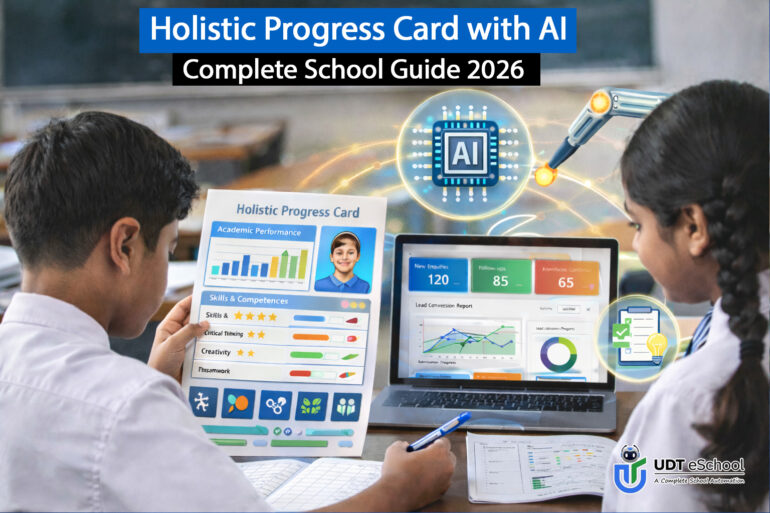
  • Holistic Progress Card with AI in Schools | 2026 Guide

    Holistic Progress Card with AI in Schools | 2026 Guide

    Holistic Progress Card with AI
    Holistic Progress Card with AI

    Holistic Progress Card with AI in Schools – A 2026 Implementation Guide

    Holistic progress card with AI is transforming how schools assess students in 2026. Moving beyond marks and grades, schools are now adopting competency-based, multi-dimensional evaluation models aligned with CBSE (Central Board of Secondary Education), NEP 2020 (National Education Policy 2020), and PARAKH guidelines.

    In 2026, schools across India are shifting from traditional marks-based evaluation to Holistic Progress Cards (HPC)โ€”structured, multi-dimensional reports that capture a studentโ€™s complete learning journey. This transition is driven by NEP 2020 and national frameworks, making HPC essential for compliance and modern education standards. With AI-enabled platforms like your school ERP, schools can implement these systems efficiently, accurately, and at scale.

    What Is a Holistic Progress Card?

    What Is A Holistic Progress Card
    What Is A Holistic Progress Card

    The holistic progress card with AI enables schools to assess both academic and non-academic development in a unified and structured format.

    A Holistic Progress Card (HPC) provides a 360-degree evaluation of student performance. Instead of focusing only on exam marks, it includes:

    Traditional To Holistic Progress
    Traditional To Holistic Progress
    • Cognitive skills
    • Emotional and social development
    • Physical growth
    • Creativity and problem-solving
    • Self-assessment and peer feedback

    This model reflects the learner-centric vision of NEP 2020 and is widely adopted by CBSE schools moving toward competency-based assessment systems.

    ๐Ÿ‘‰ Common searches this section answers:

    • โ€œwhat is holistic progress card in CBSEโ€
    • โ€œ360 degree assessment NEP meaningโ€

    This approach mirrors the learner-centric philosophy of the National Education Policy (NEP) 2020.


    Why Schools Must Adopt HPC in 2026

    HPC Assesment Transformation
    HPC Assesment Transformation

    ๐Ÿ“Š Moves Beyond Marks

    HPC shifts evaluation from memorization-based exams to competency-based learning, improving conceptual understanding and critical thinking.

    ๐Ÿ‘จโ€๐Ÿ‘ฉโ€๐Ÿ‘ง Integrates Teacher, Parent & Peer Feedback

    HPC incorporates multiple perspectives, making assessment more collaborative, transparent, and accurate.

    ๐Ÿ“… Ongoing Development Mapping

    Instead of year-end results, HPC tracks student progress continuously, helping schools improve long-term learning outcomes.


    Core Features Of Holistic Progress Cards

    Core Features Of Holistic Progress Cards
    Core Features Of Holistic Progress Cards

    Holistic Progress Cards are designed to provide a detailed and meaningful understanding of student development.

    They typically include:

    • Self-assessment and reflection
    • Teacher observations and qualitative feedback
    • Peer and parent inputs
    • Academic performance indicators
    • Skill and competency tracking
    • Co-curricular and activity records

    These elements ensure that student evaluation goes beyond marks and reflects real learning progress.


    Role of AI in Holistic Progress Cards

    Role of AI in Holistic Progress Cards
    Role of AI in Holistic Progress Cards

    An AI-enabled holistic progress card allows schools to move from manual evaluation to intelligent, data-driven assessment systems.

    Artificial Intelligence enhances accuracy, efficiency, and insights in HPC implementation:

    ๐Ÿ” Automated Analysis

    AI processes large volumes of academic and behavioral data to identify patterns, strengths, and learning gaps.

    ๐Ÿง  Adaptive Feedback

    AI provides personalized insights and recommendations based on student performance, supporting continuous improvement.

    ๐Ÿ“Š Smart Reporting

    AI generates structured progress reports instantly, supported by real-time dashboards for teachers and parents.

    According to UNESCO, digital assessment tools significantly improve learning outcomes when applied effectively.


    Benefits of AI-Enabled HPC Implementation

    Benefits of AI-Enabled HPC Implementation
    AI-Enabled HPC Benefits

    AI-powered HPC systems offer clear advantages for schools, teachers, and parents.

    ๐Ÿš€ Faster, Better Assessment

    Automates evaluation tasks, reducing manual workload and saving time.

    ๐Ÿ“ˆ Insightful Parent Engagement

    Provides structured, easy-to-understand progress reports for parents.

    ๐Ÿ“Œ Early Intervention

    Helps identify learning gaps early, enabling timely corrective actions.

    ๐Ÿง  Competency-Driven Learning

    Supports skill-based education aligned with NEP 2020 goals.


    Challenges Schools Face Without AI

    Challenges Schools Face Without AI HPC
    Challenges Schools Face Without AI HPC

    Without AI and digital systems, implementing HPC becomes complex and inefficient.

    Common challenges include:

    • Manual data collection and consolidation
    • Delayed feedback cycles
    • Increased teacher workload
    • Inconsistent evaluation standards

    Schools searching for โ€œproblems in implementing NEP 2020โ€ often encounter these exact issues. AI-based systems help eliminate these bottlenecks and improve accuracy.


    How UDT eSchool ERP Supports AI-Driven Holistic Progress Cards

    UDT eSchool ERP provides an integrated solution for implementing AI-powered Holistic Progress Cards effectively.

    ๐Ÿ“‹ Unified Student Data

    Centralizes academic, behavioral, and activity records in one platform.

    ๐Ÿค– AI-Assisted Evaluation

    Automates competency mapping and performance analysis.

    ๐Ÿ“Š Intelligent Dashboards

    Offers real-time insights for teachers and school leaders.

    ๐Ÿ‘ช Parent Portal

    Enhances communication through transparent and accessible progress tracking.

    ๐Ÿ”— Related read:
    SAFAL Exam Updated Guide

    ๐Ÿ‘‰ Also explore:


    Why Choose UDT eSchool for Holistic Progress Card?

    UDT eSchool offers a complete AI-powered solution designed specifically for modern schools.

    It simplifies Holistic Progress Card implementation by automating evaluation, data collection, and report generation.

    The platform ensures compliance with CBSE and NEP 2020 while reducing administrative workload.

    ๐Ÿ‘‰ Schools using UDT eSchoolโ€™s school ERP system can seamlessly manage assessments, attendance, and even fee management systemsย  from a single platform.

    This integrated approach allows schools to focus more on student growth rather than administrative challenges.


    HPC and NEP 2020 Alignment

    The Holistic Progress Card framework aligns directly with key national initiatives:

    • NEP 2020 learner-centric evaluation
    • PARAKH competency-based standards
    • NIPUN Bharat foundational goals

    This ensures that schools adopting HPC remain compliant with Indiaโ€™s evolving education policies.


    Practical Steps to Implement HPC with AI

    Schools can implement HPC effectively by following these steps:

    1. Define competency-based evaluation frameworks
    2. Configure ERP systems for structured data collection
    3. Train teachers on observational and skill-based assessment
    4. Integrate AI-driven analytics tools
    5. Generate and review progress cards regularly
    6. Engage parents through digital reporting systems

    ๐Ÿง  People Also Search For

    When exploring Holistic Progress Cards and AI-based assessment systems, users also search for related topics to better understand implementation, compliance, and tools. These queries reflect real concerns of schools adapting to NEP 2020 and CBSE guidelines.

    • What is CBSE holistic progress card format 2026?
    • How to implement holistic progress card in schools step by step?
    • What is competency-based assessment in NEP 2020?
    • AI in student assessment tools for schools in India
    • Best school ERP software for CBSE schools
    • Difference between report card and holistic progress card
    • PARAKH assessment framework explained
    • How AI helps teachers in student evaluation
    • Digital progress card system for schools India
    • Continuous and comprehensive evaluation vs HPC

    ๐Ÿ‘‰ These topics are closely aligned with frameworks from Central Board of Secondary Education and National Education Policy 2020, making them essential for schools aiming to stay compliant and future-ready.


    ๐Ÿ“‹ Frequently Asked Questions

    What is a Holistic Progress Card?

    A Holistic Progress Card is a 360-degree evaluation system that tracks academic, social, emotional, and skill-based development of students.

    What is a Holistic Progress Card in CBSE?

    A Holistic Progress Card is a comprehensive student evaluation system introduced under NEP 2020 that measures academic performance, skills, and overall development.

    Why do schools need AI for HPC?

    AI automates analysis, ensures consistency, and provides insights that are difficult to generate manually.

    Is Holistic Progress Card mandatory for CBSE schools in 2026?

    CBSE is gradually implementing HPC, making it essential for schools to adopt structured and digital assessment systems.

    Does HPC replace traditional report cards?

    HPC enhances traditional report cards by adding multiple assessment dimensions; many schools use both during transition.

    How can schools implement Holistic Progress Cards effectively?

    Schools can use AI-powered ERP platforms to manage evaluation, automate reporting, and ensure compliance with NEP guidelines.

    How does AI help in creating Holistic Progress Cards?

    AI automates data collection, ensures consistent evaluation, and generates reports instantly, saving time and improving accuracy.

    How does AI improve parent-school communication?

    AI-powered systems provide real-time updates, structured reports, and better transparency for parents.

    What is the difference between a report card and a Holistic Progress Card?

    A traditional report card focuses on marks, while a Holistic Progress Card evaluates complete student development, including skills and behavior.


    Conclusion

    The Holistic Progress Card with AI represents the future of student assessment in India. As education moves toward competency-based and learner-centric models, schools adopting AI-powered HPC systems gain efficiency, accuracy, and deeper engagement.

    Implementing a holistic progress card with AI is no longer optional for CBSE-aligned schoolsโ€”it is essential for compliance and long-term success.

    UDT eSchool ERP provides the tools needed to implement this transformation effectively and position schools as leaders in modern education.


    Related Articles