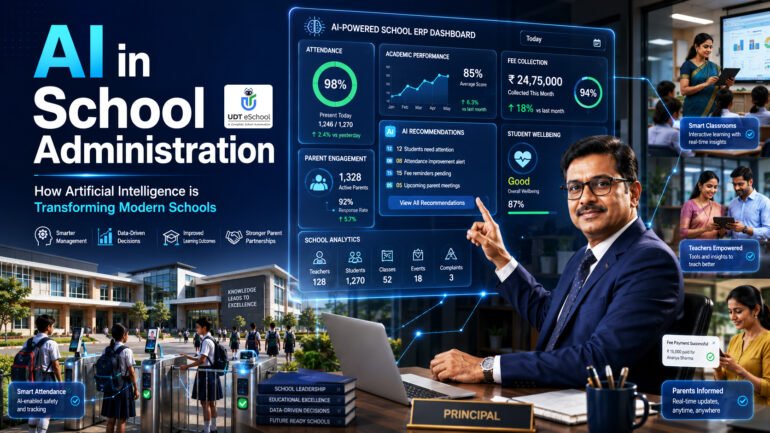
AI in School Administration: Transforming the Future of School Management
Running a modern school involves far more than managing classrooms. From admissions and attendance to fee collection, staff coordination, compliance reporting, parent communication, and academic planning, school administrators handle hundreds of interconnected responsibilities every day. As schools embrace digital transformation, AI in School Administration is emerging as a practical solution that helps leaders work more efficiently, make informed decisions, and deliver better educational experiences.
Building on our previous guide, Digital Transformation Roadmap for Schools, artificial intelligence represents the next stage of that journey. While digital systems help schools collect and organize information, AI goes a step further by analyzing data, identifying patterns, automating repetitive tasks, and providing intelligent recommendations that support faster and more accurate decision-making.
Importantly, AI is not designed to replace principals, teachers, or administrators. Instead, it acts as a powerful assistant that reduces administrative workload, improves operational efficiency, and allows educators to focus more on teaching, student development, and strategic school leadership.
In this comprehensive guide, you’ll learn what AI in school administration means, where it is being used today, its benefits and challenges, implementation best practices, and how AI-powered school management systems are shaping the future of education.
What Is AI in School Administration?
Artificial Intelligence (AI) in school administration refers to the use of intelligent software and machine learning technologies to support, automate, and improve the day-to-day management of a school. Unlike traditional software that performs predefined tasks, AI systems can analyze large volumes of data, identify patterns, predict outcomes, and provide recommendations that help school leaders make faster and better-informed decisions.
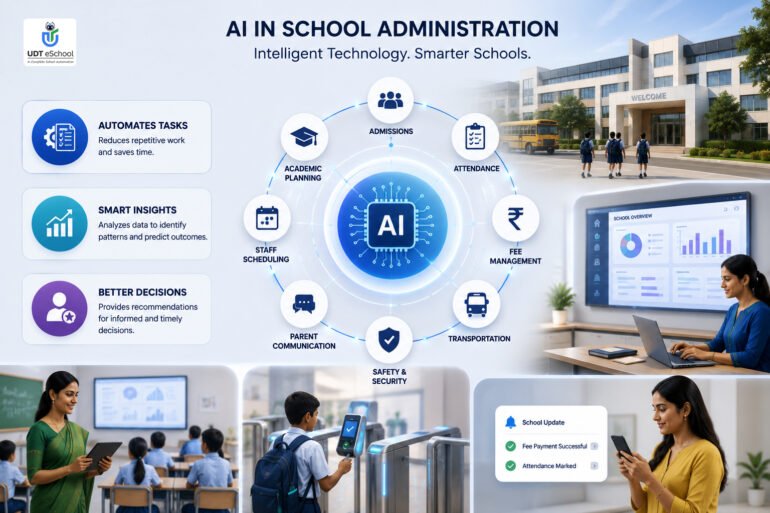
In a modern school, administrative responsibilities extend far beyond maintaining student records or preparing reports. Principals and administrators must oversee admissions, attendance, fee management, staff scheduling, academic planning, compliance, parent communication, transportation, safety, and institutional performance. As these responsibilities grow, managing them manually becomes increasingly time-consuming and prone to human error.
AI addresses these challenges by acting as an intelligent decision-support system rather than replacing school leaders. It automates repetitive administrative work while enabling educators to focus on leadership, teaching quality, and student development.
📖 Related Reading: Digital Transformation Roadmap for Schools →
From Digital Records to Intelligent Decisions
Many schools have already adopted digital systems such as School ERP platforms to replace paper-based processes. However, digitization is only the first step in the transformation journey.
The progression typically follows this path:
This evolution represents a shift from simply storing information to actively using it for continuous school improvement.
Why Schools Are Turning to AI
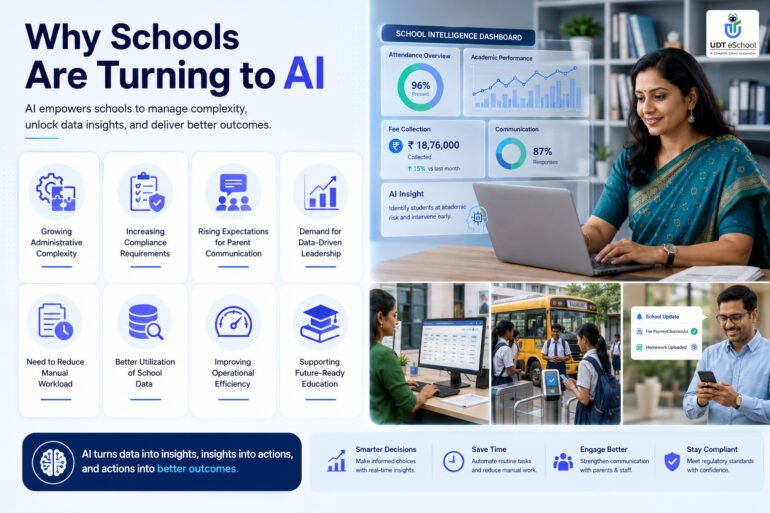
Several factors are driving the adoption of AI in school administration. Educational institutions today operate in an environment where expectations from parents, regulatory bodies, and school management committees continue to grow. Administrators are expected to make faster decisions, maintain accurate records, improve communication, and ensure compliance with evolving educational policies.
At the same time, schools generate an enormous amount of data every day—from attendance records and academic performance to fee payments, transport logs, and communication history. Without intelligent tools, much of this valuable information remains underutilized.
AI helps schools transform raw data into meaningful insights that support proactive rather than reactive management.
Some of the key drivers include:
- Growing administrative complexity
- Increasing compliance requirements
- Rising expectations for parent communication
- Demand for data-driven leadership
- Need to reduce manual workload
- Better utilization of school data
- Improving operational efficiency
- Supporting future-ready education
📚 Authority Reference: CBSE’s ongoing digital initiatives and the broader objectives of NEP 2020 encourage schools to adopt technology that enhances governance, transparency, and educational quality.
Core Areas Where AI Is Used in School Administration
Rather than being limited to one department, AI supports multiple operational functions across a school ecosystem.
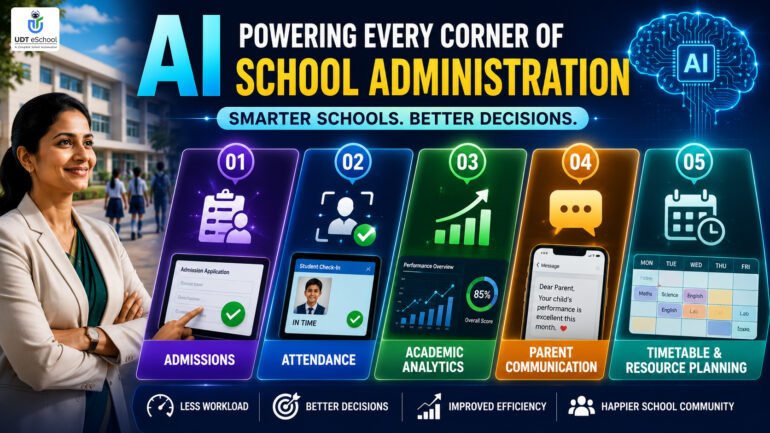
1. Admissions Management
Admissions often involve repetitive documentation, applicant communication, eligibility verification, and follow-ups.
AI can:
- Answer admission enquiries through intelligent chat assistants.
- Categorize applications automatically.
- Schedule counselling appointments.
- Send personalized reminders.
- Predict admission trends based on previous years.
As a result, administrative staff spend less time on routine communication and more time supporting prospective families.
2. Attendance Management
Attendance is one of the most repetitive administrative tasks in any school.
AI enhances attendance management by:
- Identifying irregular attendance patterns.
- Sending automated notifications to parents.
- Predicting chronic absenteeism.
- Supporting biometric or other automated attendance systems where legally, ethically and operationally appropriate.
- Generating real-time attendance analytics for school leaders.
Instead of reviewing attendance reports manually, administrators receive actionable insights immediately.
3. Academic Performance Analytics
AI enables school leaders to move beyond traditional report cards by identifying patterns that may not be immediately visible.
For example, AI can help schools:
- Detect learning gaps early.
- Identify students requiring additional academic support.
- Monitor progress across competency areas.
- Compare class-level performance.
- Generate visual dashboards for leadership teams.
This aligns well with competency-based assessment practices promoted under modern educational reforms.
📖 Related Reading: PARAKH Report Card Explained →
4. Parent Communication
Communication with parents often involves repetitive notifications regarding attendance, homework, events, fee reminders, examination schedules, and school announcements.
AI can:
- Personalize communication.
- Translate messages into multiple languages.
- Schedule automated reminders.
- Prioritize urgent notifications.
- Respond to frequently asked questions.
This improves responsiveness while reducing the communication burden on administrative teams.
5. Timetable and Resource Planning
Creating an academic timetable is one of the most complex administrative responsibilities.
AI can evaluate hundreds of scheduling variables simultaneously, including:
- Teacher availability
- Classroom allocation
- Subject requirements
- Laboratory availability
- Examination schedules
- Co-curricular activities
This reduces scheduling conflicts while improving resource utilization.
Benefits of AI in School Administration
The true value of Artificial Intelligence extends beyond automation. While reducing manual work is one of its immediate advantages, its long-term impact lies in enabling schools to become more efficient, data-driven, and future-ready institutions.
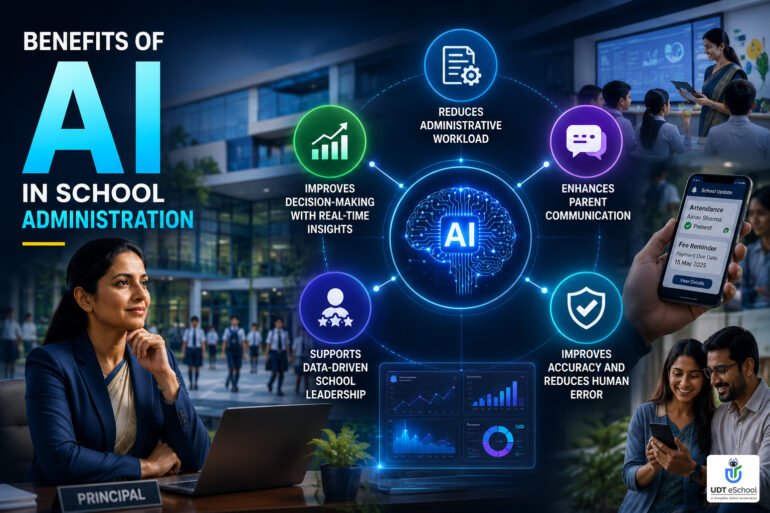
When implemented thoughtfully, AI supports better operational planning, strengthens decision-making, improves communication, and allows educators to devote more time to teaching and student development.
1. Reduces Administrative Workload
School administrators spend a significant portion of their day handling repetitive tasks such as attendance verification, report generation, fee tracking, timetable adjustments, document management, and responding to routine enquiries.
AI automates many of these time-consuming activities, allowing administrative teams to focus on higher-value responsibilities such as strategic planning, staff development, and school improvement initiatives.
Practical Example
Instead of manually compiling monthly attendance reports for every class, an AI-enabled School ERP can automatically generate dashboards, identify attendance trends, and notify administrators about students who may require intervention.
2. Improves Decision-Making with Real-Time Insights
Traditional reporting often tells schools what has already happened. AI goes a step further by identifying emerging trends and highlighting issues before they become significant challenges.
School leaders can access insights such as:
- Students showing declining attendance patterns
- Subjects with consistently lower academic performance
- Departments experiencing increased workload
- Fee collection trends
- Resource utilization across classrooms and laboratories
- Parent engagement levels
These insights enable proactive rather than reactive decision-making.
3. Enhances Parent Communication
Parents increasingly expect timely, transparent, and personalized communication from schools. Meeting these expectations manually can place a considerable burden on administrative staff.
AI-powered communication tools can:
- Send attendance alerts automatically.
- Deliver personalized academic updates.
- Schedule reminders for events and fee deadlines.
- Answer common admission enquiries through intelligent chat assistants.
- Translate messages into multiple languages where required.
The result is more consistent communication while reducing the workload on school offices.
📖 Related: How Schools Can Improve Parent Engagement →
4. Supports Data-Driven School Leadership
Effective leadership depends on reliable information.
Rather than relying on intuition alone, principals can use AI-generated dashboards to monitor key performance indicators across the school.
Examples include:
- Student attendance trends
- Teacher workload distribution
- Assessment outcomes
- Parent participation
- Infrastructure utilization
- Financial performance
- Operational efficiency
This enables leadership teams to identify opportunities for improvement more quickly and allocate resources more effectively.
5. Improves Accuracy and Reduces Human Error
Manual administrative processes inevitably introduce errors, particularly when managing large volumes of student and staff information.
AI minimizes these risks by:
- Automatically validating records.
- Detecting duplicate entries.
- Highlighting missing information.
- Reducing repetitive manual data entry.
- Identifying inconsistencies across multiple databases.
Improved data quality leads to greater confidence in school reporting and compliance.
Illustrative School Implementation Scenario (Mini Case Study)
How AI Could Improve Administrative Efficiency in a Mid-Sized CBSE School

Consider an illustrative CBSE school with approximately 1,800 students and more than 120 teaching and administrative staff members.
Before introducing AI-enabled administrative tools, routine activities such as attendance monitoring, timetable revisions, parent communication, and report preparation required significant manual effort. Administrative teams often spent several hours each week compiling information from different systems before leadership meetings.
After integrating AI capabilities into their existing School ERP:
- Attendance exceptions were identified automatically.
- Fee reminder schedules became automated.
- Parent enquiries were answered more quickly through intelligent assistance.
- Leadership dashboards were generated in real time.
- Teachers spent less time on repetitive reporting.
- School leaders gained faster access to operational insights.
While AI did not eliminate administrative responsibilities, it significantly improved efficiency and allowed staff to dedicate more time to educational planning and student support.
Challenges Schools May Face When Implementing AI
Although AI offers considerable advantages, successful implementation requires careful planning. Schools often encounter challenges related to technology adoption, staff readiness, data quality, and governance.
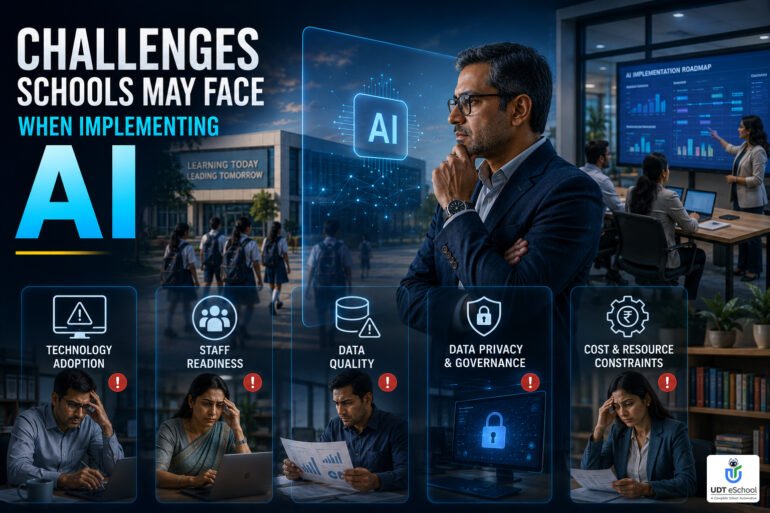
Recognizing these challenges early enables institutions to develop practical strategies that ensure sustainable implementation.
The following section explores the most common implementation challenges and the recommended approaches for overcoming them.
📖 Continue Learning: Digital Transformation Roadmap for Schools →
Challenges of Implementing AI in School Administration
While the advantages of Artificial Intelligence are compelling, successful implementation requires more than simply adopting new technology.
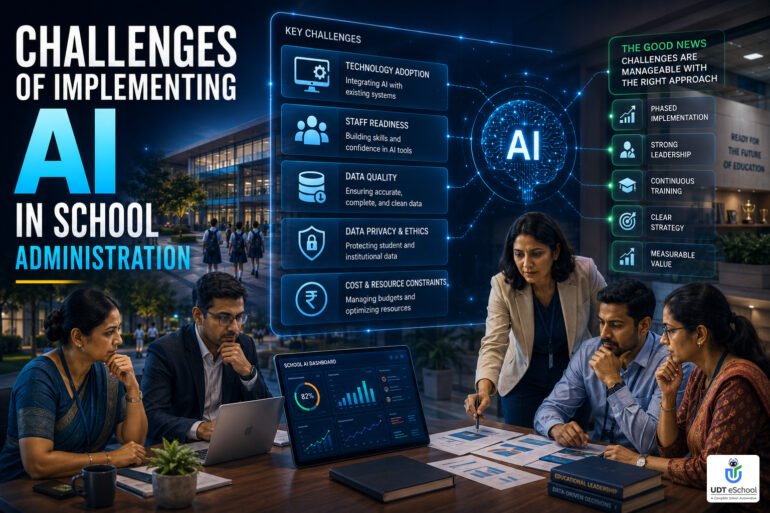
Schools must prepare their people, processes, and systems to ensure AI delivers measurable value rather than adding complexity.
The good news is that most implementation challenges are manageable when schools follow a phased, well-planned approach.
📖 Related Reading: How Schools Can Improve Parent Engagement →
📚 Further Reference: UNESCO‘s guidance on AI in education emphasizes that artificial intelligence should augment human expertise while promoting equity, transparency, and responsible use.
AI and School ERP: A Powerful Combination
Artificial Intelligence delivers its greatest value when integrated with a modern School ERP system. While an ERP centralizes school data and streamlines administrative workflows, AI transforms that data into meaningful insights, intelligent recommendations, and automated actions.
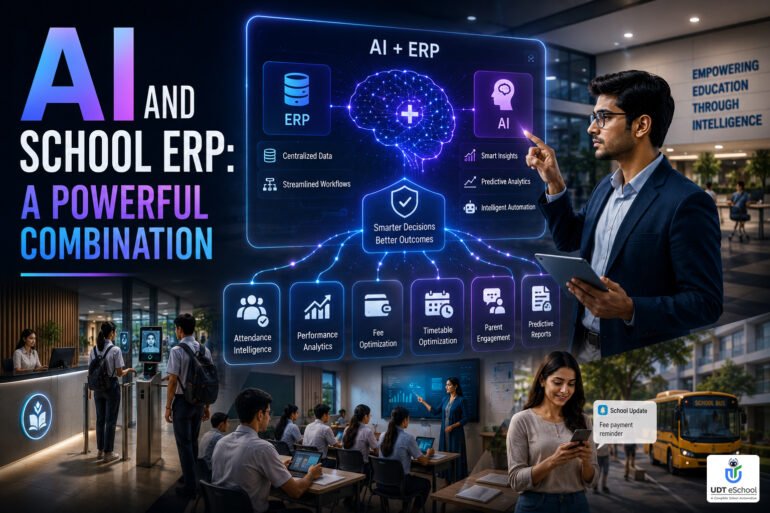
Think of a School ERP as the digital foundation of school management. AI builds upon this foundation by helping administrators move beyond data collection to data-driven decision-making.
For example, instead of simply recording attendance, an AI-enabled School ERP can identify students with declining attendance patterns, alert school leaders before issues escalate, and recommend timely interventions. Similarly, AI can analyze fee payment trends, optimize timetable planning, automate parent communication, and provide predictive reports that support better institutional planning.
The combination of ERP and AI enables schools to shift from managing day-to-day operations to continuously improving them.
📖 Related: School ERP Software Guide →
Is Your School Ready for AI?
Successful AI implementation begins with preparation rather than technology. Before introducing AI-powered solutions, school leaders should evaluate whether the necessary digital foundations are already in place.
Best Practices for Successful AI Adoption
Schools that achieve the greatest success with Artificial Intelligence generally follow a structured implementation strategy.
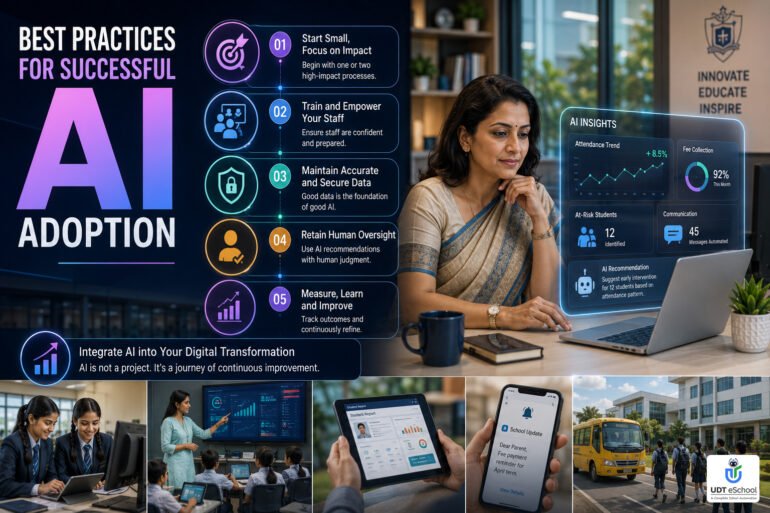
They typically:
- Begin with one or two high-impact administrative processes.
- Train staff before introducing new technology.
- Maintain accurate and secure school data.
- Review AI recommendations while retaining human oversight.
- Measure outcomes and continuously refine implementation.
Rather than viewing AI as a standalone project, successful schools integrate it into their broader digital transformation strategy.
📖 Continue Reading: Digital Transformation Roadmap for Schools →
The Future of AI in School Administration
Artificial Intelligence is no longer a concept reserved for the future—it is already reshaping how schools operate, communicate, and make decisions. As educational institutions continue their digital transformation journey, AI will play an increasingly important role in reducing administrative complexity, improving operational efficiency, and supporting evidence-based leadership.
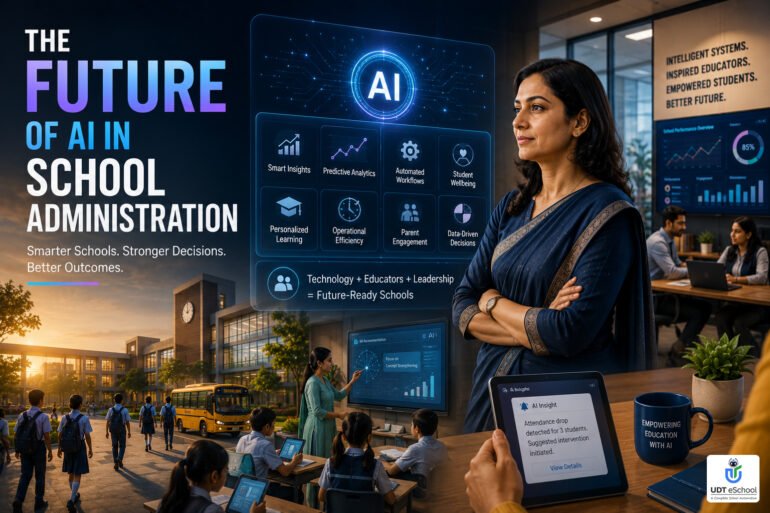
However, the future of school administration will not be defined by technology alone. It will be shaped by how effectively schools combine intelligent systems with experienced educators, visionary leadership, and student-centered decision-making.
Schools that embrace AI responsibly today will be better prepared to adapt to evolving educational policies, rising parent expectations, and the growing demand for personalized learning experiences.
Ultimately, Artificial Intelligence is not replacing schools—it is helping schools become more efficient, more responsive, and more future-ready.
📖 Continue Learning: How Schools Can Implement Holistic Progress Card Successfully →
🔍 People Also Search For In Schools
Related Topics School Leaders Frequently Explore
Readers researching AI in School Administration often explore these related topics to better understand digital transformation, School ERP solutions, artificial intelligence, and future-ready education management.
Frequently Asked Questions (FAQ) On AI In Education
Q. What is AI in school administration?
A. Artificial Intelligence in school administration refers to the use of intelligent technologies that automate routine administrative tasks, analyze school data, and support better decision-making for principals, teachers, and administrators.
Q. How does AI help school administrators?
A. AI helps administrators by automating repetitive work, generating real-time reports, identifying operational trends, improving communication, supporting admissions, optimizing timetables, and providing predictive insights for better planning.
Q. Can AI replace teachers or principals?
A. No. AI is designed to assist—not replace—educators and school leaders. Human judgment, educational expertise, and personal interaction remain essential in every school.
Q. Is AI useful for small schools?
A. Yes. Schools of all sizes can benefit from AI. Many AI-powered administrative features are available through modern School ERP systems and can be implemented gradually based on the institution’s needs and resources.
Q. What are the biggest challenges of implementing AI in schools?
A. The most common challenges include staff training, data quality, privacy and security, budget considerations, and change management. These can be addressed through phased implementation and continuous professional development.
Q. Is AI safe for managing student data?
A. AI can be used in school administration with appropriate security and governance controls. Schools should evaluate data protection, access controls, encryption, vendor practices, human oversight and applicable data protection requirements before deploying AI systems.
Final Thoughts On AI In Education
Artificial Intelligence represents the next stage in the evolution of school administration. While technology can automate routine processes and generate valuable insights, lasting success depends on how schools integrate these capabilities into a broader culture of continuous improvement.
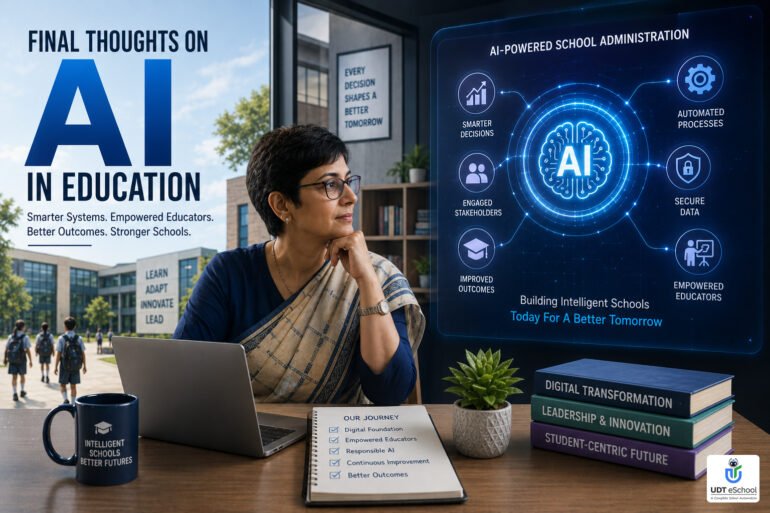
Schools that invest in digital infrastructure, empower educators through training, and adopt AI responsibly will be well positioned to deliver better operational efficiency, stronger stakeholder engagement, and improved educational outcomes.
The journey toward intelligent school management begins with a solid digital foundation—and every thoughtful step taken today helps build a more resilient and future-ready institution for tomorrow.
Official References
- NEP 2020 — Ministry of Education
- National Digital Education Architecture (NDEAR)
- CBSE official website
- NCERT
Ready to Transform Your School?
Empower your institution with an intelligent School ERP that streamlines administration, strengthens parent engagement, automates routine tasks, and helps school leaders make data-driven decisions with confidence.

✔ Reviewed & Published
UDT eSchool Editorial Team
This article has been researched, reviewed, and published by the UDT eSchool Editorial Team, specialists in School ERP Software, NEP 2020 implementation, CBSE reforms, AI in Education, Competency-Based Assessment, Holistic Progress Cards, Parent Engagement, and Digital School Transformation.
Editorial Standards
✔ Official CBSE Circulars
✔ Ministry of Education Guidelines
✔ NCERT Frameworks
✔ Education Industry Best Practices
✔ Reviewed Before Publication
✔ Updated as Policies Change
Editorial Expertise
School ERPNEP 2020CBSE ReformsHolistic Progress CardCompetency-Based AssessmentAI in EducationSchool Management
Digital Transformation
Article Information
| Content Type | Expert Educational Guide |
| Reviewed By | UDT eSchool Editorial Team |
| Fact Checked | ✔ Yes |
| Primary Sources | CBSE, NCERT, Ministry of Education & NEP 2020 |
| Created | July 2026 |
| Article Version | Version 1.0 |
| Updated | September 2026 |
| Article Version | Version 2.0 |

Education Technology Consultant at UDt eSchool with 10+ years of experience helping schools digitize operations and implement CBSE-aligned systems.