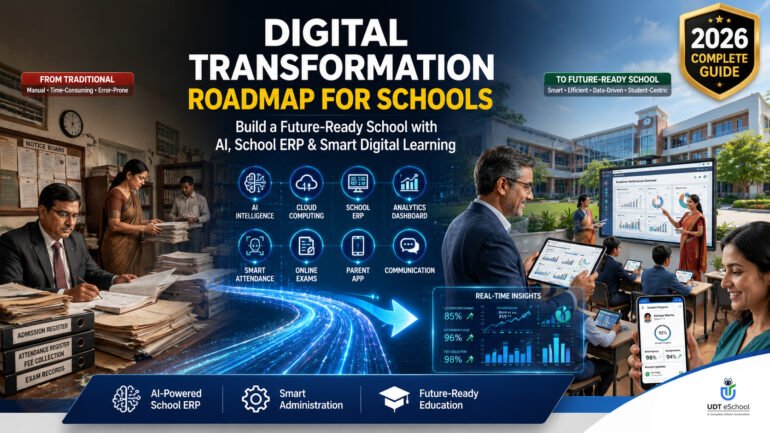
Digital Transformation Roadmap for Schools: A Step-by-Step Guide to Building Future-Ready Educational Institutions
Digital Transformation Roadmap for Schools is no longer a vision for the future—it has become a strategic necessity for educational institutions seeking to improve learning outcomes, streamline administration, and remain aligned with evolving educational policies such as NEP 2020 and CBSE reforms.
Many schools have already introduced digital tools like smart classrooms, online attendance systems, learning management platforms, or school management software. However, adopting individual technologies does not automatically result in meaningful digital transformation. Without a clear roadmap, schools often invest in disconnected systems that increase complexity instead of improving efficiency.
A successful digital transformation begins with a shared vision. It requires school leaders to evaluate existing processes, identify improvement opportunities, prioritize technology investments, prepare teachers for change, and establish measurable goals that enhance both academic excellence and operational efficiency.
In this comprehensive guide, you’ll learn how to build a practical Digital Transformation Roadmap for Schools, understand each stage of implementation, explore common challenges, and discover how technologies such as School ERP, automation, artificial intelligence, analytics, and digital collaboration tools can help schools become future-ready while keeping teaching and learning at the centre of every decision.
A Digital Transformation Roadmap for Schools is a structured strategy that helps educational institutions integrate technology across teaching, administration, communication, assessment, and decision-making. Instead of adopting isolated digital tools, schools create a long-term implementation plan that aligns technology investments with educational goals, teacher development, operational efficiency, and student success. A successful roadmap includes assessing digital readiness, strengthening infrastructure, implementing School ERP solutions, embracing AI-powered automation, improving cybersecurity, training staff, and continuously measuring progress to build a future-ready school.
- How digital transformation differs from simply adopting technology
- The essential phases of a successful digital transformation roadmap
- Common implementation challenges and practical solutions
- How School ERP supports long-term digital transformation
- The role of AI, automation, and analytics in modern schools
- Best practices for building a future-ready educational institution
- Key leadership strategies for sustainable digital success
What Is a Digital Transformation Roadmap for Schools?
A Digital Transformation Roadmap for Schools is a strategic framework that guides educational institutions through the process of integrating technology into every aspect of school operations. Rather than implementing isolated digital tools, the roadmap provides a structured plan for transforming teaching, learning, administration, communication, assessment, and decision-making into a connected digital ecosystem.
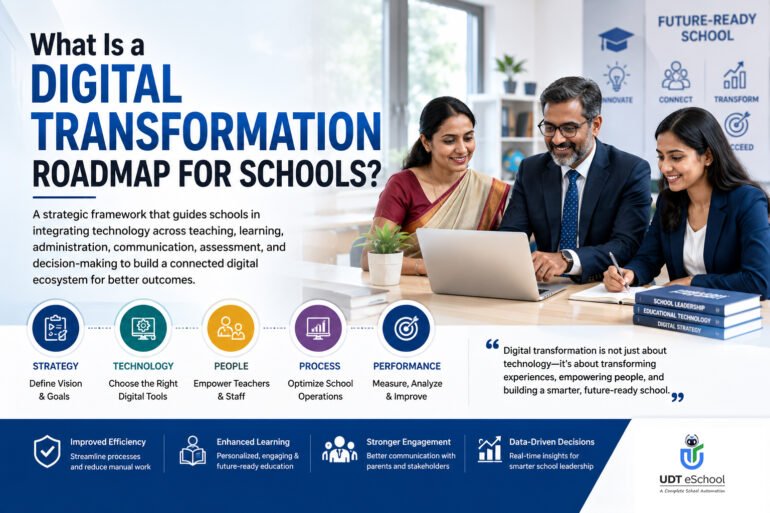
Digital transformation is not simply about purchasing smart boards, introducing online classes, or installing new software. It involves rethinking how a school functions, identifying opportunities for improvement, and leveraging technology to create better educational experiences for students, teachers, parents, and administrators.
An effective roadmap ensures that technology investments are aligned with the school’s vision, educational goals, and long-term development plans. It helps schools prioritise initiatives, allocate resources efficiently, prepare staff for change, monitor progress, and continuously improve through data-driven decision-making.
Schools that follow a structured digital transformation roadmap are better positioned to adapt to changing educational policies, improve operational efficiency, strengthen collaboration, enhance student learning outcomes, and remain competitive in an increasingly technology-driven education landscape.
Schools are no longer evaluated solely on academic performance. Parents, regulatory bodies, and educational boards increasingly expect institutions to demonstrate innovation, transparency, efficient communication, data-driven decision-making, and personalised learning experiences. A well-planned digital transformation roadmap enables schools to meet these expectations while improving operational efficiency and delivering better educational outcomes.
Key Components of a Digital Transformation Roadmap
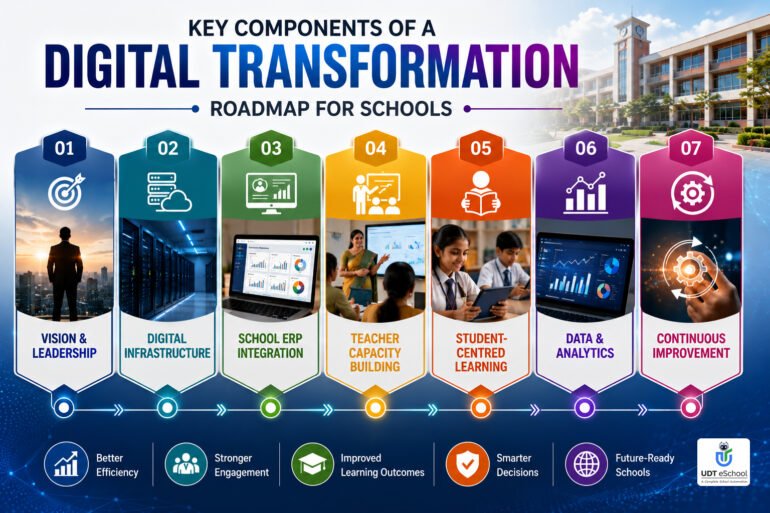
A successful digital transformation roadmap typically includes the following components:
1. Vision and Leadership
School leaders define clear objectives, establish priorities, and create a shared vision for digital transformation that aligns with the institution’s educational mission.
2. Digital Infrastructure
Reliable internet connectivity, secure networks, modern devices, cloud platforms, and smart classroom technologies form the technological foundation of digital transformation.
3. School ERP Integration
An integrated School ERP centralises admissions, attendance, examinations, finance, human resources, communication, and academic management into a single platform, reducing duplication and improving efficiency.
4. Teacher Capacity Building
Teachers require continuous professional development to confidently integrate digital tools, AI-powered resources, and modern teaching strategies into classroom instruction.
5. Student-Centred Learning
Technology should enhance collaboration, creativity, critical thinking, and personalised learning rather than simply replacing traditional teaching methods.
6. Data and Analytics
School leaders can use dashboards, reports, and predictive analytics to monitor student performance, optimise resource allocation, and make informed strategic decisions.
7. Continuous Improvement
Digital transformation is an ongoing journey. Schools should regularly review outcomes, gather stakeholder feedback, evaluate emerging technologies, and refine their implementation strategies.
Why Schools Need Digital Transformation Today
The education sector is experiencing one of its most significant transformations in history. Rapid technological advancements, changing student expectations, evolving parental involvement, and policy reforms such as NEP 2020 have reshaped how schools operate. Digital transformation is no longer a competitive advantage—it has become a fundamental requirement for schools that want to remain relevant, efficient, and future-ready.
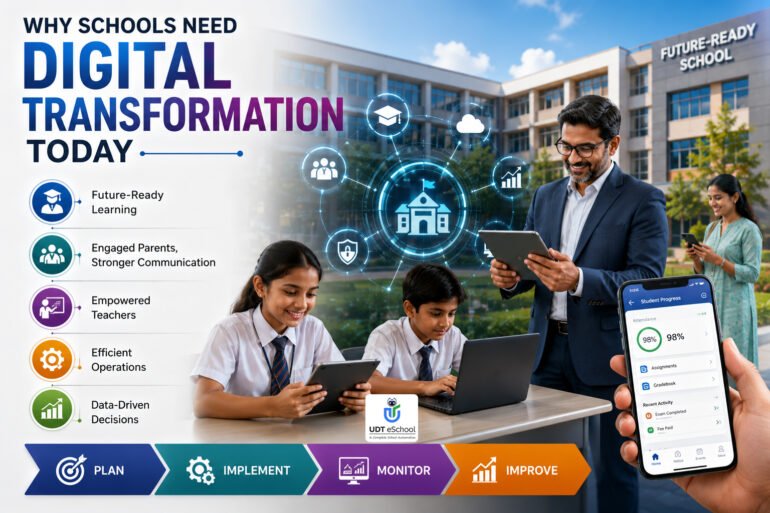
Today’s students are digital natives who expect engaging, interactive, and personalised learning experiences. Parents seek real-time communication, transparent academic updates, and convenient access to school information. At the same time, teachers require digital tools that simplify lesson planning, assessment, collaboration, and administrative tasks.
School leaders also face increasing pressure to improve operational efficiency while ensuring compliance with evolving educational regulations. Managing admissions, attendance, examinations, finance, transport, communication, and student performance manually is becoming increasingly complex as institutions grow.
A structured digital transformation roadmap helps schools respond to these changing expectations by integrating technology into every aspect of school management. Instead of isolated digital initiatives, schools can create a connected ecosystem where information flows seamlessly, decisions are supported by real-time data, and stakeholders remain engaged throughout the learning journey.
Ultimately, digital transformation enables schools to move beyond simply digitising existing processes. It empowers institutions to redesign workflows, improve educational outcomes, strengthen collaboration, and build a culture of continuous innovation.
Digital transformation should never begin with technology—it should begin with a clear educational vision. Schools that focus first on improving learning experiences, empowering teachers, and simplifying administration are far more likely to achieve sustainable success than those that simply invest in new software or hardware.
Major Drivers Behind School Digital Transformation
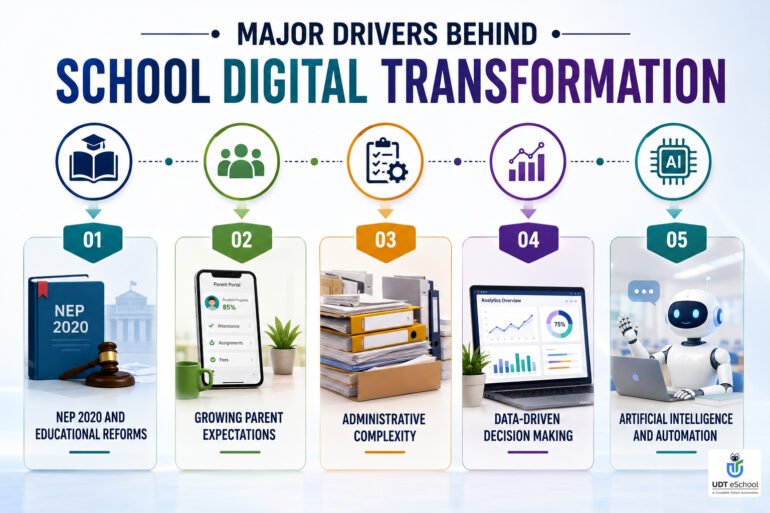
Digital transformation is being accelerated by several interconnected factors that are reshaping modern education.
1. NEP 2020 and Educational Reforms
National education reforms encourage schools to integrate technology into teaching, assessment, governance, and skill development. NEP 2020 provides a broader policy direction for using technology to support teaching, learning, assessment, governance and educational access, making digital readiness increasingly important for schools.
2. Growing Parent Expectations
Parents increasingly expect instant access to attendance records, examination results, fee information, homework, circulars, and school communication through secure digital platforms.
3. Administrative Complexity
As schools expand, managing admissions, examinations, finance, transport, staff records, and compliance manually becomes inefficient and prone to errors.
4. Data-Driven Decision Making
Modern schools increasingly rely on dashboards and analytics to identify learning gaps, monitor attendance trends, allocate resources effectively, and improve institutional performance.
5. Artificial Intelligence and Automation
AI-powered technologies help automate repetitive administrative tasks, generate reports, analyse academic performance, and provide personalised insights that support better educational decisions.
Many schools believe that purchasing digital tools automatically results in digital transformation. In reality, successful transformation requires leadership commitment, strategic planning, teacher training, stakeholder engagement, process redesign, and continuous evaluation. Technology is only one component of a much broader institutional change.
The 7 Stages of a Successful Digital Transformation Roadmap for Schools
Digital transformation is not a one-time technology project but a continuous journey that reshapes how a school teaches, manages operations, communicates, and makes decisions. Schools that achieve sustainable success follow a structured implementation roadmap instead of introducing multiple digital tools without a long-term strategy.
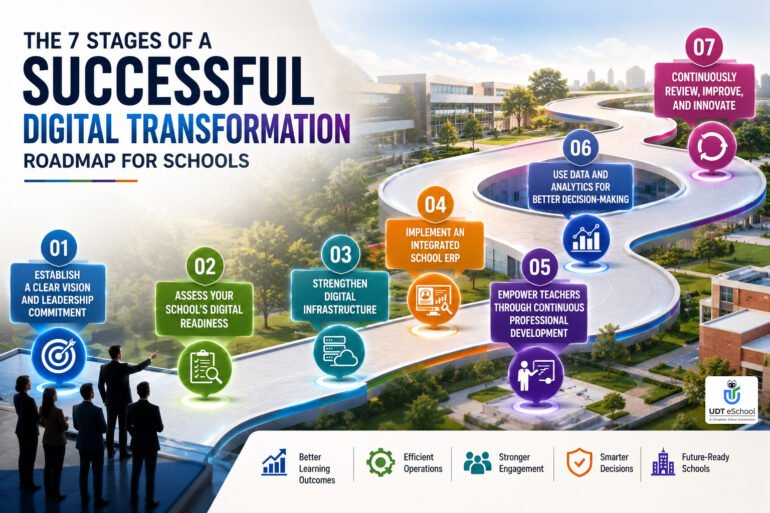
A phased approach allows school leaders to manage change effectively, optimise investments, minimise disruption, and ensure that every technological initiative contributes to better educational outcomes. The following seven stages provide a practical roadmap that schools of all sizes can adopt to build a future-ready institution.
1. Establish a Clear Vision and Leadership Commitment
Every successful digital transformation begins with strong leadership. Before investing in technology, school management should define a clear vision that explains why digital transformation is necessary and how it will improve teaching, learning, administration, and stakeholder engagement.
The roadmap should align with educational priorities such as competency-based learning, personalised education, operational excellence, and the recommendations outlined in the NEP 2020 Assessment Framework. Schools that develop a shared vision are better prepared to make strategic decisions, allocate resources efficiently, and sustain long-term institutional change.
2. Assess Your School’s Digital Readiness
Before implementing new digital initiatives, schools should conduct a comprehensive assessment of their current digital maturity. Understanding existing strengths and gaps enables school leaders to prioritise investments and avoid unnecessary expenditure.
Areas that should be evaluated include:
- Internet connectivity across the campus
- Smart classroom availability
- Existing School ERP or management software
- Teacher digital competency
- Parent communication systems
- Data security and cybersecurity practices
- Availability of digital devices
- Administrative workflow efficiency
Evaluate your school’s preparedness before beginning the digital transformation journey.
- ✅ Reliable internet connectivity across the campus
- ✅ Digital devices available for teachers and students
- ✅ Secure network and cybersecurity policies
- ✅ Teacher training programmes in place
- ✅ Parent communication platform available
- ✅ Existing School ERP evaluated
- ✅ Leadership committed to long-term digital transformation
- ✅ Clear implementation goals and success metrics defined
3. Strengthen Digital Infrastructure
Technology can only deliver meaningful results when it is supported by reliable infrastructure. Schools should prioritise investments that create a secure, scalable, and future-ready digital environment.
Essential infrastructure includes:
- High-speed internet connectivity
- Campus-wide secure Wi-Fi
- Interactive smart classrooms
- Cloud-based applications
- Digital learning devices
- Data backup systems
- Cybersecurity solutions
Schools that build a strong digital foundation are better positioned to adopt advanced technologies such as Artificial Intelligence, analytics, and automation without disrupting daily operations.
For guidance on national digital education initiatives, schools can also refer to the Ministry of Education and the CBSE
4. Implement an Integrated School ERP
One of the most significant milestones in any digital transformation roadmap is implementing a comprehensive School ERP.
Many schools continue to operate separate systems for admissions, attendance, examinations, finance, transport, and communication. This often leads to duplicate data entry, inconsistent records, and increased administrative workload.
A unified School ERP integrates every department into a single digital ecosystem, enabling real-time information sharing and improving collaboration across the institution.
An effective School ERP typically includes:
- Student Information Management
- Admission Management
- Attendance Automation
- Examination Management
- Fee Management
- Human Resource Management
- Parent Communication
- Analytics Dashboard
Schools planning long-term automation should also explore how AI in School Administration can further improve operational efficiency and decision-making.
Schools that implement an integrated School ERP early in their digital transformation journey often experience faster operational improvements because information becomes centralised, communication becomes seamless, and school leaders gain access to real-time insights for informed decision-making.
5. Empower Teachers Through Continuous Professional Development
Technology delivers value only when educators are confident in using it effectively. Schools should invest in continuous professional development programmes that help teachers integrate digital tools into classroom instruction and assessment.
Training should focus on:
- Digital pedagogy
- AI-assisted teaching tools
- Collaborative learning platforms
- Online assessment strategies
- Classroom technology integration
Schools implementing competency-based learning can further strengthen instructional practices by exploring Competency-Based Assessment Examples, which demonstrates how technology supports meaningful assessment.
6. Use Data and Analytics for Better Decision-Making
Modern schools generate valuable data every day. Attendance records, assessment results, parent engagement, fee collection, and academic performance all provide insights that support better planning.
By using analytics dashboards, school leaders can:
- Monitor student progress
- Identify learning gaps
- Track attendance trends
- Improve resource allocation
- Support evidence-based decision-making
Data-driven leadership enables schools to respond proactively rather than reactively to academic and operational challenges.
7. Continuously Review, Improve, and Innovate
Digital transformation is an ongoing process rather than a destination. Schools should regularly evaluate implementation progress, gather stakeholder feedback, monitor emerging technologies, and refine their digital strategy.
Institutions that embrace continuous improvement remain adaptable, resilient, and better prepared for future educational challenges.
Strengthening collaboration with families is equally important, and schools can enhance this aspect through effective strategies discussed in How Schools Can Improve Parent Engagement.
Common Challenges in School Digital Transformation and Practical Solutions
While the benefits of digital transformation are substantial, the implementation journey is not without challenges. Many schools begin with enthusiasm but struggle due to inadequate planning, resistance to change, budget limitations, fragmented technology adoption, or insufficient staff training.
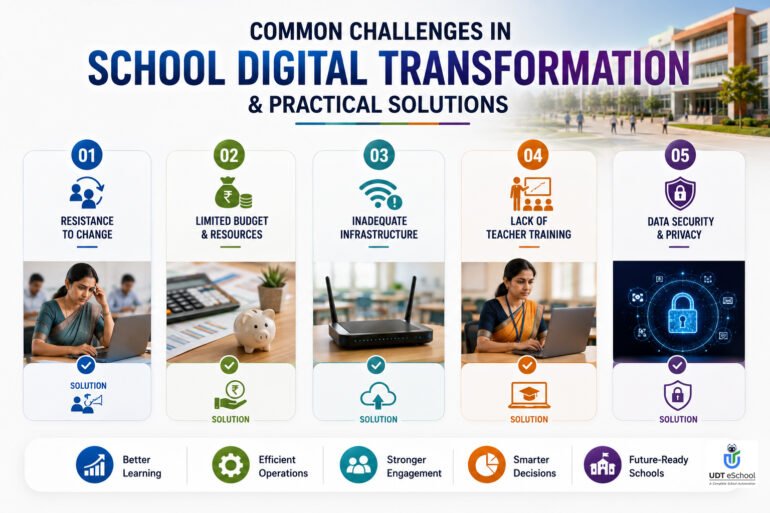
The good news is that these challenges can be anticipated and managed with a well-defined roadmap. Schools that address obstacles proactively are more likely to achieve sustainable digital transformation while maintaining continuity in teaching and administration.
1. Resistance to Change
One of the biggest barriers to digital transformation is resistance from stakeholders. Teachers, administrative staff, and even parents may hesitate to adopt new technologies because they are unfamiliar with digital systems or fear increased workload.
School leaders should involve stakeholders from the planning stage, communicate the long-term benefits clearly, and provide continuous support throughout the implementation process. Building trust and encouraging collaboration significantly improve adoption rates.
2. Limited Budget and Resource Constraints
Digital transformation does not require schools to replace every existing system at once. Instead, institutions should adopt a phased implementation strategy that prioritises investments based on educational impact and operational needs.
Starting with core systems such as an integrated School ERP often delivers immediate efficiency gains while creating a foundation for future digital initiatives.
3. Inadequate Digital Infrastructure
Reliable internet connectivity, secure networks, and appropriate hardware are essential for successful implementation. Schools with outdated infrastructure often experience slow system performance, reduced productivity, and poor user experience.
Before introducing advanced technologies such as Artificial Intelligence or analytics platforms, schools should ensure that their infrastructure can support future growth.
Schools can also explore digital education initiatives published by the NCERT and the Ministry of Education to align infrastructure planning with national priorities.
4. Lack of Teacher Training
Technology alone cannot transform education. Teachers remain the driving force behind successful digital learning.
Without proper training, even the most advanced digital platforms remain underutilised. Schools should provide regular professional development programmes covering:
- Digital classroom management
- AI-assisted teaching
- Online assessment methods
- Learning Management Systems
- Digital collaboration tools
Institutions implementing competency-based education can further strengthen classroom practices through Competency-Based Assessment Examples.
5. Data Security and Privacy Concerns
As schools digitise student records, financial information, attendance, assessments, and communication, protecting sensitive data becomes increasingly important.
School leaders should establish clear cybersecurity policies that include:
- Secure password practices
- Multi-factor authentication
- Regular data backups
- Access control policies
- Staff cybersecurity awareness training
Protecting digital information strengthens trust among parents, staff, and students while ensuring regulatory compliance.
Schools should also define clear rules for data access, retention, vendor access and incident response as their digital systems become more interconnected.
Successful schools introduce digital transformation gradually rather than attempting institution-wide change all at once. Pilot projects, regular stakeholder feedback, continuous teacher training, and measurable milestones help minimise risks while building confidence across the entire school community.
Leadership Strategies for Successful Digital Transformation
School leaders play the most important role in ensuring long-term success. Beyond selecting technology platforms, they must create an organisational culture that embraces innovation, collaboration, and continuous learning.
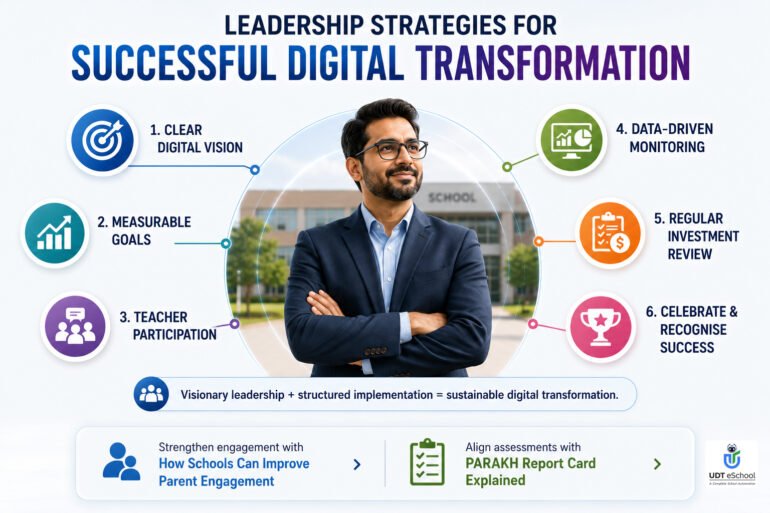
Effective leadership strategies include:
- Communicating a clear digital vision.
- Setting measurable transformation goals.
- Encouraging teacher participation in decision-making.
- Monitoring implementation progress through data and analytics.
- Reviewing technology investments regularly.
- Celebrating milestones and recognising successful adoption.
Schools that combine visionary leadership with structured implementation are better positioned to achieve sustainable digital transformation.
Schools can further strengthen leadership strategies by implementing recommendations discussed in How Schools Can Improve Parent Engagement and aligning assessment practices with the PARAKH Report Card Explained framework.
Measuring Success: Key Performance Indicators (KPIs) for School Digital Transformation
Implementing digital transformation is only the beginning. To ensure that technology investments deliver meaningful educational and operational value, schools must continuously measure performance using clearly defined Key Performance Indicators (KPIs).
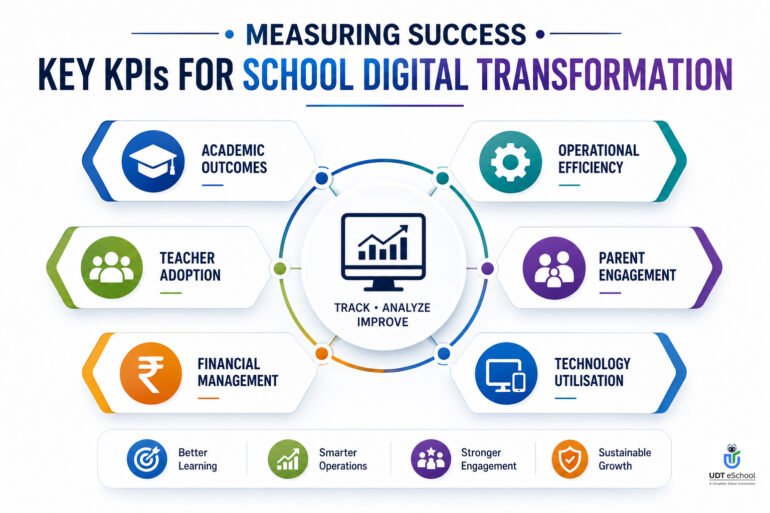
KPIs help school leaders evaluate whether digital initiatives are improving efficiency, enhancing learning experiences, increasing stakeholder engagement, and supporting long-term institutional goals. Regular monitoring also enables schools to identify improvement areas and make informed decisions based on measurable outcomes rather than assumptions.
A balanced KPI framework should evaluate academic performance, operational efficiency, teacher adoption, parent engagement, financial management, and technology utilisation.
Why Measuring Digital Transformation Matters
Without measurable outcomes, schools cannot determine whether their digital transformation strategy is delivering the expected return on investment.
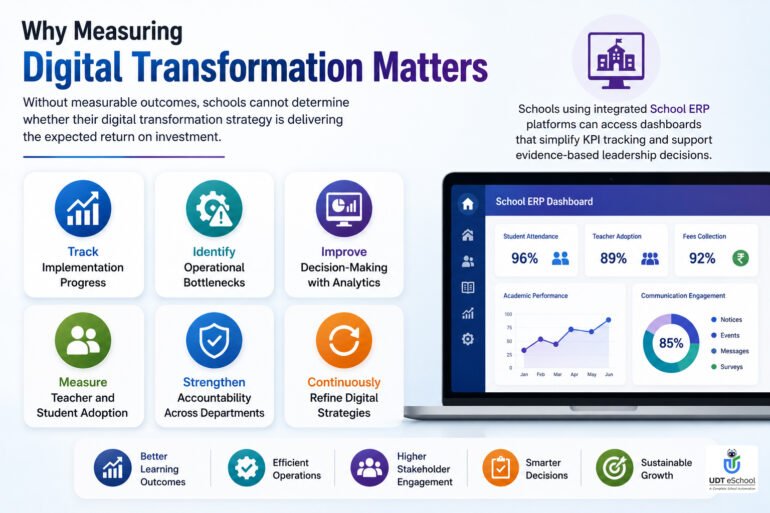
A structured KPI framework helps schools:
- Track implementation progress.
- Identify operational bottlenecks.
- Improve decision-making through real-time analytics.
- Measure teacher and student adoption.
- Strengthen accountability across departments.
- Continuously refine digital strategies.
Schools using integrated School ERP platforms can access dashboards that simplify KPI tracking and support evidence-based leadership decisions.
Essential KPIs Every School Should Monitor
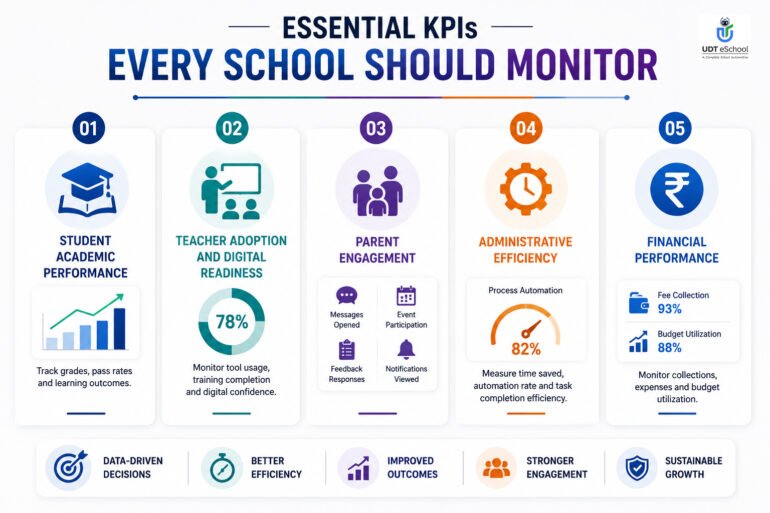
1. Student Academic Performance
Digital transformation should ultimately improve student learning outcomes.
Schools should monitor:
- Assessment performance
- Competency achievement
- Learning progress
- Attendance trends
- Assignment completion rates
- Student engagement
Schools implementing competency-based learning can align these indicators with the framework discussed in Competency-Based Assessment Examples.
2. Teacher Adoption and Digital Readiness
Technology only creates value when educators actively use digital tools.
Important indicators include:
- Percentage of teachers using digital platforms
- Training completion rates
- Smart classroom utilisation
- Online assessment adoption
- AI-assisted lesson planning
Continuous professional development ensures teachers remain confident as technology evolves.
3. Parent Engagement
Digital transformation should strengthen collaboration between schools and families.
Schools should monitor:
- Parent app usage
- Attendance during PTMs
- Circular acknowledgement rates
- Homework engagement
- Parent feedback participation
Schools looking to improve collaboration can also explore How Schools Can Improve Parent Engagement.
4. Administrative Efficiency
One of the primary objectives of School ERP implementation is reducing manual work.
Useful KPIs include:
- Admission processing time
- Attendance automation rate
- Report generation time
- Fee collection efficiency
- Staff productivity
- Document processing time
Automation allows school administrators to focus more on educational priorities rather than repetitive administrative tasks.
5. Financial Performance
Technology investments should also contribute to improved financial management.
Schools should monitor:
- Fee collection percentage
- Outstanding fee recovery
- Budget utilisation
- Operational cost savings
- Resource allocation efficiency
Financial insights help leadership make sustainable long-term investment decisions.
Avoid measuring success solely by the amount of technology deployed. True digital transformation is reflected in improved student outcomes, empowered teachers, stronger parent engagement, efficient administration, and informed decision-making supported by reliable data.
Building a Culture of Continuous Improvement
Digital transformation should become part of the school’s culture rather than a one-time project. Leadership teams should review KPIs regularly, collect feedback from teachers, parents, and students, and update their roadmap based on emerging educational needs and technological advancements.
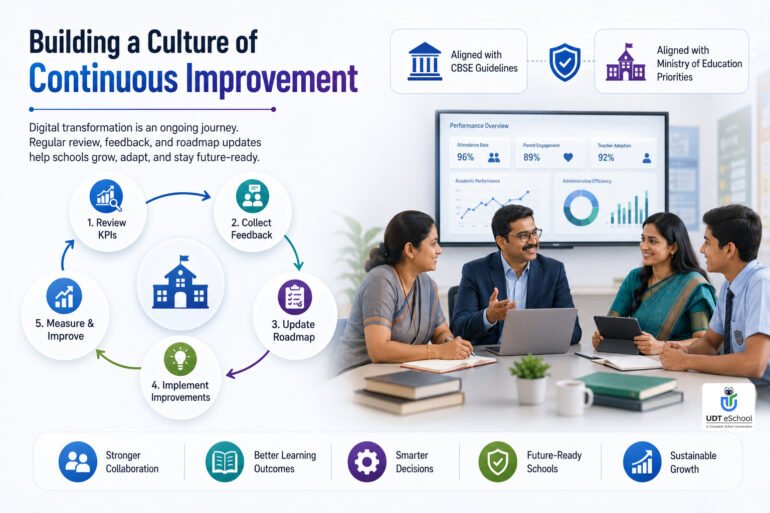
Schools should also remain aligned with national educational priorities published by the CBSE and the Ministry of Education to ensure that their transformation strategy continues to support future-ready education.
Choosing the Right Technology Stack for School Digital Transformation
Technology is the foundation of every successful digital transformation initiative. However, selecting the right technology stack is about much more than purchasing software.
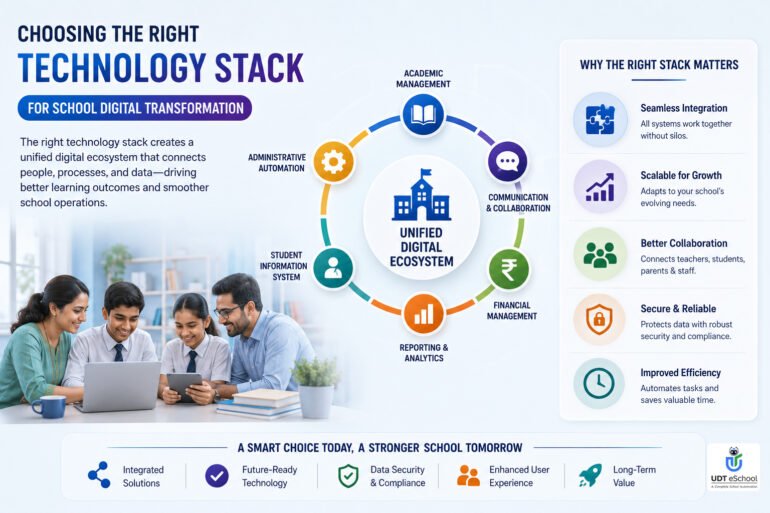
Schools need solutions that integrate seamlessly, support long-term growth, enhance collaboration, and adapt to evolving educational requirements.
Rather than investing in multiple disconnected applications, schools should focus on building a unified digital ecosystem where academic, administrative, financial, and communication processes work together efficiently.
A carefully selected technology stack reduces duplication, improves productivity, simplifies decision-making, and provides a consistent experience for teachers, students, parents, and school administrators.
Essential Components of a Modern School Technology Ecosystem
A future-ready school should consider implementing technologies that support every aspect of institutional management and student learning.
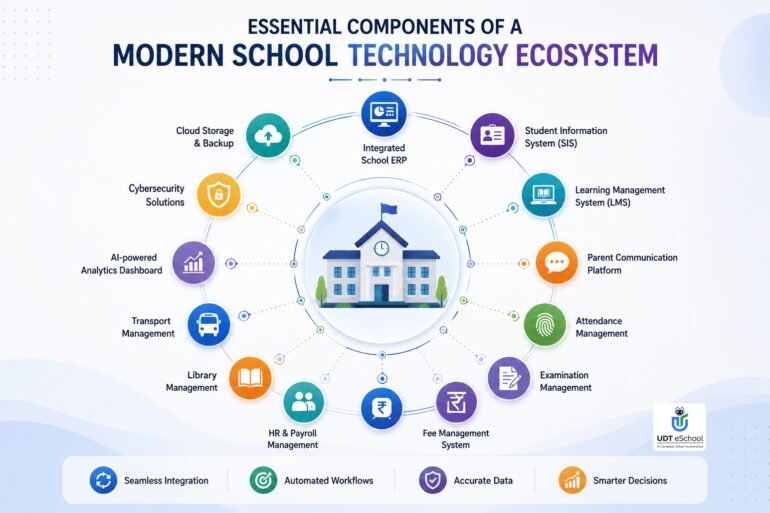
These include:
- Integrated School ERP
- Student Information System (SIS)
- Learning Management System (LMS)
- Parent Communication Platform
- Attendance Management
- Examination Management
- Fee Management System
- HR & Payroll Management
- Library Management
- Transport Management
- AI-powered Analytics Dashboard
- Document Management System
- Cybersecurity Solutions
- Cloud Storage & Backup
Instead of functioning independently, these systems should exchange information automatically, reducing manual work and improving data accuracy.
Why an Integrated School ERP Can Become the Digital Foundation
Many schools use different software for admissions, attendance, examinations, finance, and communication. While these individual solutions may solve specific problems, they often create isolated data silos that increase administrative complexity.
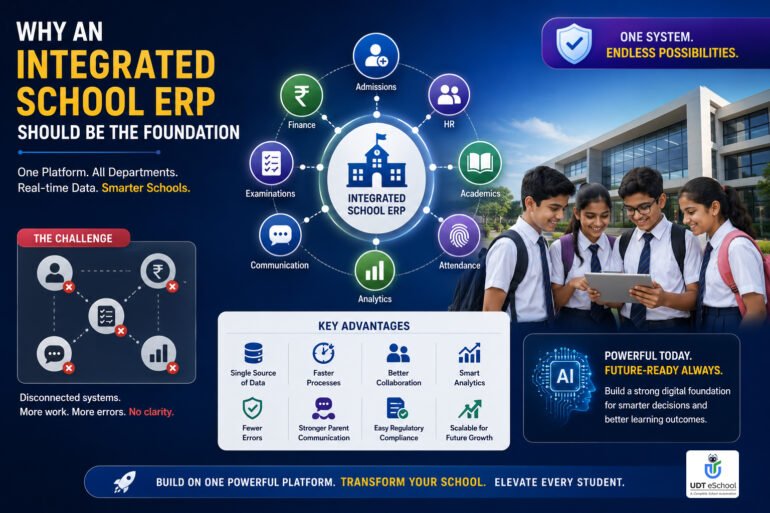
An integrated School ERP acts as the central platform that connects every department, enabling real-time data sharing and eliminating duplicate work.
Key advantages include:
- Single source of institutional data
- Faster administrative processes
- Improved collaboration between departments
- Better reporting and analytics
- Reduced manual errors
- Enhanced parent communication
- Simplified regulatory compliance
- Scalable digital infrastructure
Schools exploring AI-driven automation can also learn how technology supports operational excellence in AI in School Administration.
Key Factors to Consider Before Selecting a School ERP
Before investing in any School ERP solution, school leaders should evaluate whether the platform meets both current operational needs and future growth requirements.
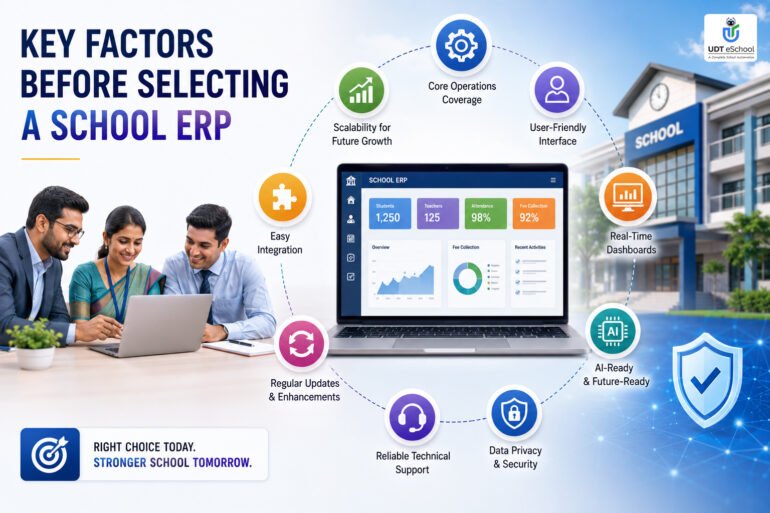
Consider the following questions:
- Does the ERP support all core school operations?
- Can it scale as student enrolment increases?
- Is the interface user-friendly for teachers and parents?
- Does it provide real-time dashboards and analytics?
- Can it integrate with future AI-powered features?
- Does it comply with data privacy and security standards?
- Is technical support readily available?
- Does the platform receive regular updates and feature enhancements?
Selecting the right platform is a strategic decision that directly influences the success of the school’s digital transformation journey.
- Supports admissions, attendance, examinations, finance, HR, transport, and communication.
- Provides real-time dashboards and analytics.
- Offers secure cloud-based access.
- Includes mobile apps for parents, teachers, and students.
- Supports AI-powered automation and future upgrades.
- Complies with security and data privacy standards.
- Provides reliable customer support and training.
- Scales easily as the school grows.
Future-Proofing Your Digital Transformation Strategy
Technology continues to evolve rapidly. Schools should therefore invest in flexible, scalable solutions that can adapt to future educational requirements rather than platforms that only address immediate operational challenges.
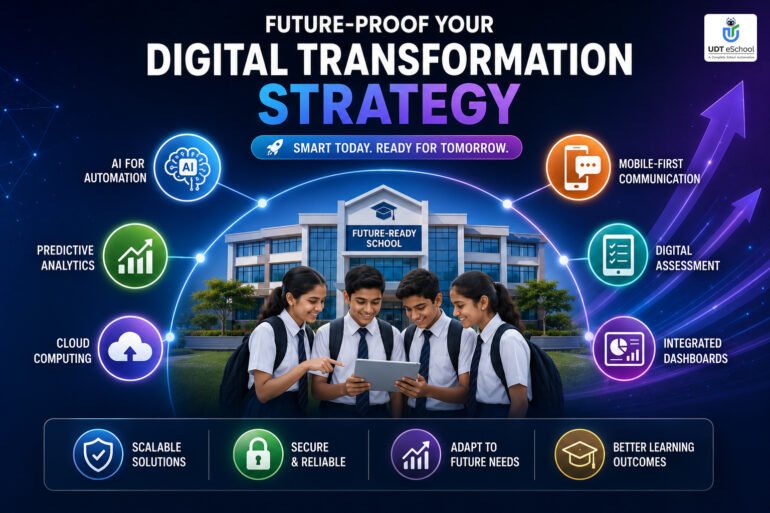
Future-ready schools increasingly leverage:
- Artificial Intelligence for administrative automation
- Predictive analytics for academic planning
- Cloud computing for secure access
- Mobile-first communication
- Digital assessment platforms
- Integrated reporting dashboards
Building a scalable digital ecosystem today ensures that schools remain prepared for tomorrow’s innovations while continuing to deliver high-quality education.
Schools interested in long-term assessment reforms can also explore How Schools Can Implement Holistic Progress Cards and PARAKH Report Card Explained to understand how technology supports competency-based education and continuous student development.
The Future of Digital Transformation in Schools
Digital transformation is no longer limited to digitising administrative processes or introducing smart classrooms. The next phase of school transformation is centred on creating intelligent, connected, and personalised learning ecosystems that continuously evolve with educational needs.
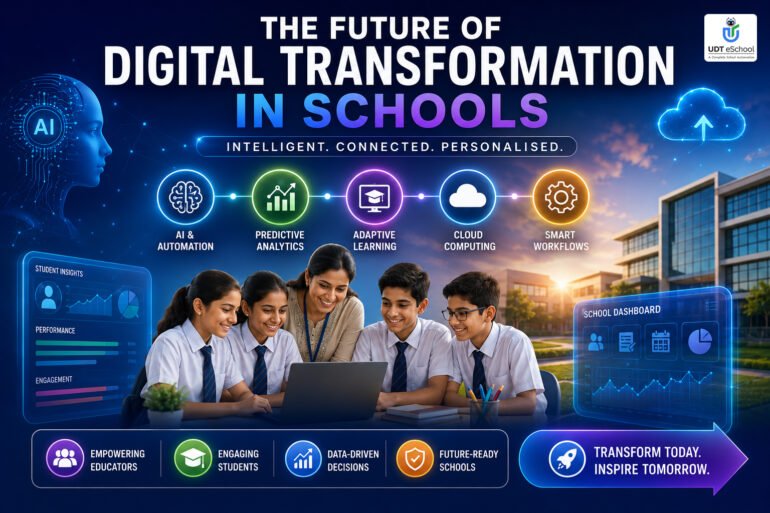
Emerging technologies such as Artificial Intelligence (AI), predictive analytics, adaptive learning platforms, cloud computing, and automation are reshaping how schools operate, how teachers teach, and how students learn. Schools that embrace these innovations today will be better positioned to prepare students for the skills and challenges of tomorrow.
Rather than replacing educators, technology serves as a powerful enabler—reducing administrative burdens, providing actionable insights, and allowing teachers to focus more on meaningful teaching and student development.
Emerging Trends That Will Shape Future-Ready Schools
School leaders should monitor these transformative trends as they plan their long-term digital strategy.
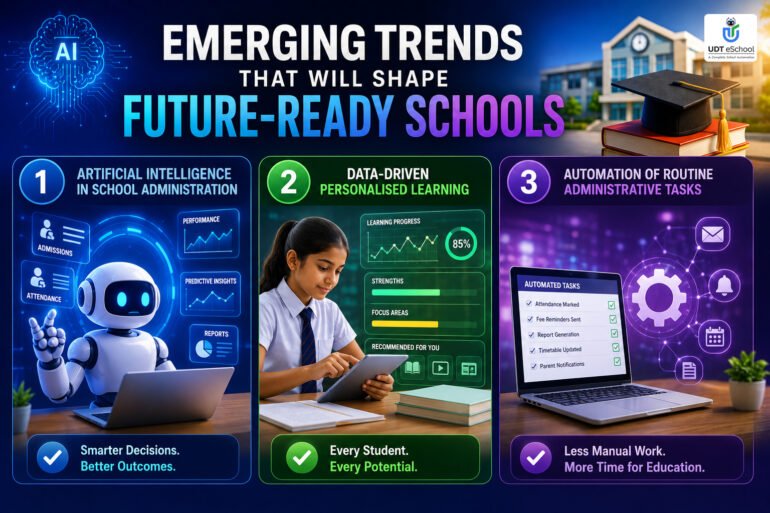
1. Artificial Intelligence in School Administration
AI is helping schools automate repetitive administrative tasks such as attendance tracking, timetable generation, report preparation, fee reminders, and performance analysis.
By reducing manual work, administrators can dedicate more time to academic planning, strategic initiatives, and student support.
Schools interested in this topic can explore AI in School Administration for practical implementation strategies.
2. Data-Driven Personalised Learning
Modern learning platforms analyse student performance and provide personalised recommendations based on individual strengths, weaknesses, and learning pace.
Personalised learning helps teachers:
- Identify learning gaps early.
- Provide targeted academic support.
- Improve student engagement.
- Enhance competency-based learning.
This approach complements the assessment strategies discussed in Competency-Based Assessment Examples.
Cloud-Based School Management
Cloud technology enables secure access to school information from anywhere while reducing dependence on on-premise infrastructure.
Benefits include:
- Remote accessibility
- Automatic software updates
- Secure data backup
- Improved collaboration
- Lower infrastructure costs
- Greater scalability
3. Automation of Routine Administrative Tasks
Automation simplifies repetitive processes such as:
- Attendance recording
- Fee reminders
- Report card generation
- Admission workflows
- Leave management
- Parent notifications
Reducing manual processes allows schools to improve operational efficiency while delivering faster services to students and parents.
- Artificial Intelligence for school administration
- Predictive analytics for academic planning
- Personalised learning powered by AI
- Cloud-based School ERP platforms
- Automation of repetitive administrative tasks
- Integrated mobile-first communication
- Real-time dashboards for school leadership
- Enhanced cybersecurity and data protection
Building a Sustainable Digital Transformation Strategy
Technology evolves rapidly, but successful schools focus on building adaptable systems rather than chasing every new innovation.
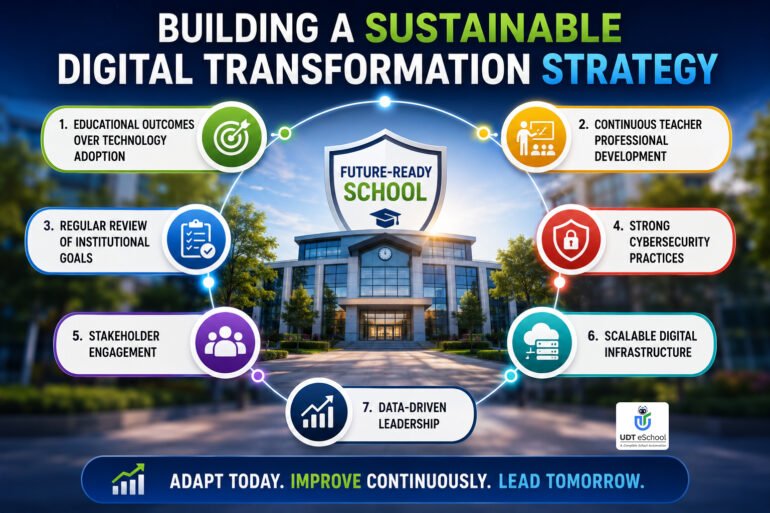
A sustainable digital transformation strategy should prioritise:
- Educational outcomes over technology adoption.
- Continuous teacher professional development.
- Regular review of institutional goals.
- Strong cybersecurity practices.
- Stakeholder engagement.
- Scalable digital infrastructure.
- Data-driven leadership.
Schools that continuously evaluate and improve their digital initiatives remain agile and better prepared to respond to future educational challenges.
- Assess your school’s current digital maturity.
- Define a long-term digital transformation vision.
- Prioritise investments based on educational impact.
- Implement an integrated School ERP platform.
- Strengthen teacher digital competencies.
- Monitor KPIs through analytics dashboards.
- Continuously review, improve, and scale digital initiatives.
Conclusion
Digital transformation is no longer an optional initiative—it is an essential strategy for building resilient, efficient, and future-ready schools. Institutions that embrace digital innovation thoughtfully are better equipped to improve learning experiences, streamline administration, strengthen parent engagement, and make informed decisions through data.
The journey does not begin with technology alone. It begins with visionary leadership, a clear roadmap, empowered educators, and a commitment to continuous improvement. By following a structured Digital Transformation Roadmap for Schools, educational institutions can create a connected ecosystem where teaching, learning, and school management work together to support long-term success.
Whether your school is taking its first steps toward digital adoption or refining an existing strategy, investing in integrated technologies, teacher development, and data-driven decision-making will ensure that your institution remains prepared for the evolving needs of students, parents, educators, and the broader education ecosystem.
Schools looking to strengthen their transformation journey should also explore How Schools Can Improve Parent Engagement, How Schools Can Implement Holistic Progress Cards, and PARAKH Report Card Explained to build a comprehensive, future-ready educational framework.
People Also Search For In Schools
Q. What is the difference between digital transformation and digitalisation in schools?
Digitalisation involves converting manual processes into digital formats, while digital transformation is a broader strategy that redesigns teaching, administration, communication, and decision-making using technology. Schools planning long-term change can also read Digital Transformation Roadmap for Schools.
Q. How does a School ERP support NEP 2020 implementation?
A School ERP simplifies competency-based assessment, attendance management, parent communication, academic planning, and administrative automation. These capabilities help schools align with the recommendations of the NEP 2020 Assessment Framework.
Q. What is competency-based assessment?
Competency-based assessment evaluates how effectively students apply their knowledge, skills, and critical thinking in real-world situations rather than relying solely on memorisation. Learn more in Competency-Based Assessment Examples.
Q. What is the PARAKH Report Card?
The PARAKH Report Card is a holistic assessment framework that focuses on academic achievement, skills, values, and overall student development instead of only examination scores. Read the complete guide in PARAKH Report Card Explained.
Q. Why is parent engagement important in modern schools?
Strong parent engagement improves student attendance, academic performance, communication, and collaboration between families and educators. Practical strategies are covered in How Schools Can Improve Parent Engagement.
Frequently Asked Questions (FAQs)
1. What is a Digital Transformation Roadmap for Schools?
A Digital Transformation Roadmap for Schools is a structured strategy that helps educational institutions integrate technology into teaching, administration, communication, assessment, and decision-making while aligning with long-term educational goals.
2. Why is digital transformation important for schools?
Digital transformation improves operational efficiency, enhances learning experiences, strengthens parent engagement, supports data-driven decision-making, and prepares schools for future educational challenges.
3. What is the first step in school digital transformation?
The first step is assessing the school’s current digital readiness and defining a clear vision that aligns technology investments with educational objectives.
4. How does a School ERP support digital transformation?
A School ERP integrates admissions, attendance, examinations, finance, HR, communication, and reporting into a single platform, improving efficiency, reducing manual work, and providing real-time insights.
5. What role does Artificial Intelligence play in school digital transformation?
Artificial Intelligence helps automate administrative processes, analyse academic data, personalise learning experiences, generate reports, and support better decision-making for school leaders.
6. How can schools measure the success of digital transformation?
Schools can measure success using KPIs such as student performance, teacher technology adoption, parent engagement, operational efficiency, financial management, and overall stakeholder satisfaction.
Official References
- NEP 2020 — Ministry of Education
- National Digital Education Architecture (NDEAR)
- CBSE official website
- NCERT
Ready to Transform Your School?
Empower your institution with an intelligent School ERP that streamlines administration, strengthens parent engagement, automates routine tasks, and helps school leaders make data-driven decisions with confidence.

✔ Reviewed & Published
UDT eSchool Editorial Team
This article has been researched, reviewed, and published by the UDT eSchool Editorial Team, specialists in School ERP Software, NEP 2020 implementation, CBSE reforms, AI in Education, Competency-Based Assessment, Holistic Progress Cards, Parent Engagement, and Digital School Transformation.
Editorial Standards
✔ Official CBSE Circulars
✔ Ministry of Education Guidelines
✔ NCERT Frameworks
✔ Education Industry Best Practices
✔ Reviewed Before Publication
✔ Updated as Policies Change
Editorial Expertise
School ERPNEP 2020CBSE ReformsHolistic Progress CardCompetency-Based AssessmentAI in EducationSchool Management
Digital Transformation
Article Information
| Content Type | Expert Educational Guide |
| Reviewed By | UDT eSchool Editorial Team |
| Fact Checked | ✔ Yes |
| Primary Sources | CBSE, NCERT, Ministry of Education & NEP 2020 |
| Published | July 2026 |
| Article Version | Version 1.0 |
| Updated | September 2026 |
| Article Version | Version 2.0 |

Education Technology Consultant at UDt eSchool with 10+ years of experience helping schools digitize operations and implement CBSE-aligned systems.