PARAKH Report Card Explained: A Complete Guide for CBSE Schools, Educators & Parents
Assessment in Indian schools is undergoing one of the most significant transformations in decades. With the implementation of the National Education Policy (NEP) 2020, the focus is steadily shifting away from judging students only by examination marks towards understanding how they learn, apply knowledge, collaborate, and grow as individuals.
At the heart of this transformation is PARAKH (Performance Assessment, Review and Analysis of Knowledge for Holistic Development), the National Assessment Centre established under NCERT. One of its key initiatives is the Holistic Progress Card (HPC)—a framework designed to make student assessment more comprehensive, competency-based, and meaningful.
This shift is particularly important for school principals, academic coordinators, teachers, and school management teams, who now need to rethink how student progress is recorded, communicated, and used to improve learning outcomes.
Parents, too, will notice a gradual change. Instead of receiving a report card that focuses primarily on marks and grades, they will increasingly receive richer insights into their child’s strengths, competencies, participation, creativity, communication, and overall development.
For schools, this change extends beyond academics. It influences teacher training, classroom assessment, parent communication, school operations, and the digital systems used to manage assessment data.
A useful distinction is important here: PARAKH is the national assessment centre, while the Holistic Progress Card (HPC) is one of the major assessment initiatives developed by PARAKH. In everyday school discussions, the terms “PARAKH Report Card” and “PARAKH Holistic Progress Card” are sometimes used interchangeably, but the official framework is referred to as the Holistic Progress Card.
At UDT eSchool, we’ve observed that many school leaders understand the vision of NEP 2020 but often ask practical questions such as:
- What exactly is the PARAKH Report Card?
- Is it mandatory for CBSE schools?
- How is it different from a traditional report card?
- What changes will teachers need to make?
- Can existing school systems support this transition?
This comprehensive guide answers those questions with practical insights, implementation strategies, and expert recommendations to help schools prepare confidently for competency-based assessment.
📘 What You Need to Know
Updated for NEP 2020 & PARAKH Framework
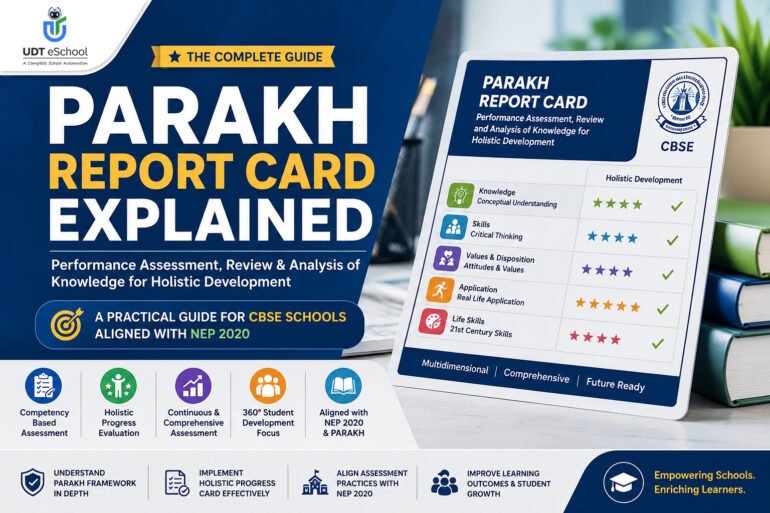
The Holistic Progress Card (HPC) is an assessment framework developed by PARAKH under NCERT to support competency-based and holistic assessment. PARAKH has developed stage-wise HPCs for the Foundational, Preparatory, Middle and Secondary stages. The framework brings together evidence of learner progress across curricular and developmental areas rather than relying only on examination marks.
Instead of evaluating students solely through examination marks, the HPC provides
a comprehensive picture of learning by combining academic performance with
classroom participation, competency achievement, projects, portfolios,
teacher observations, self-assessment, peer feedback, and social-emotional development.
This approach supports the vision of NEP 2020, which encourages continuous, holistic, and competency-based assessment.
For schools, implementing the PARAKH framework involves more than changing the report card format—it requires structured assessment practices, better evidence collection, meaningful parent communication, and effective use of digital tools to monitor student growth throughout the academic year.
📚 In this guide you’ll learn:
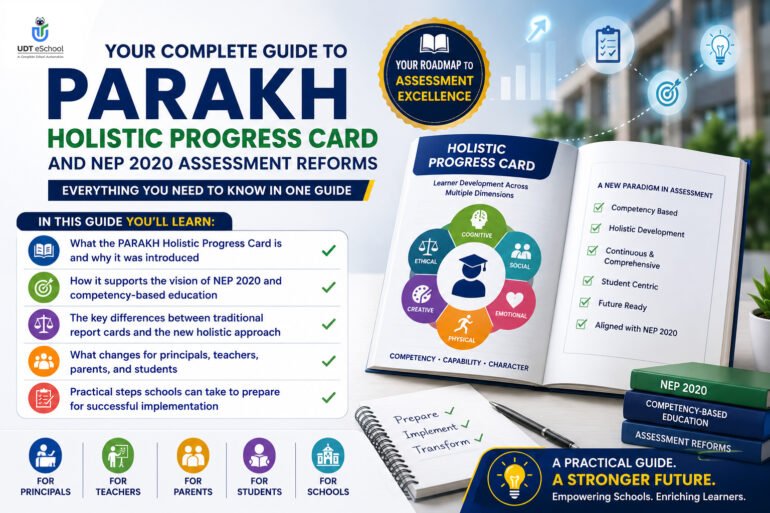
- ✔ What the PARAKH Holistic Progress Card is and why it was introduced
- ✔ How it supports the vision of NEP 2020 and competency-based education
- ✔ The key differences between traditional report cards and the new holistic approach
- ✔ What changes for principals, teachers, parents, and students
- ✔ Practical steps schools can take to prepare for successful implementation
PARAKH Report Card Explained – Key Takeaways
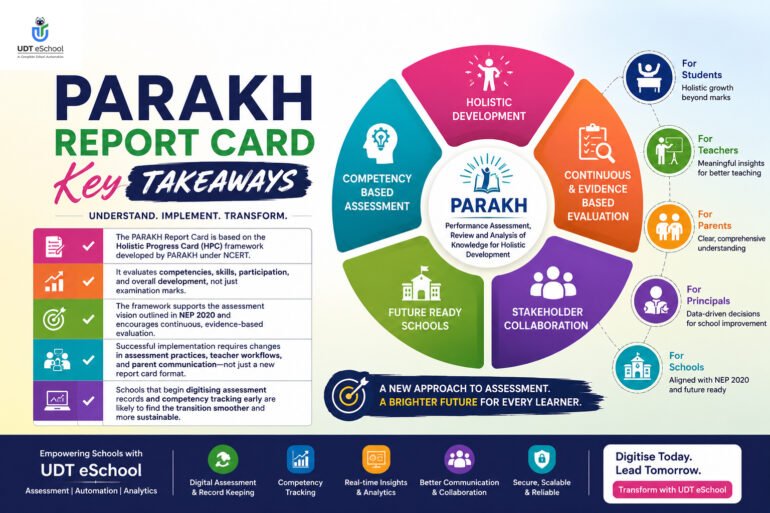
✔ The PARAKH Report Card is based on the Holistic Progress Card (HPC) framework developed by PARAKH under NCERT.
✔ It evaluates competencies, skills, participation, and overall development, not just examination marks.
✔ The framework supports the assessment vision outlined in NEP 2020 and encourages continuous, evidence-based evaluation.
✔ Successful implementation requires changes in assessment practices, teacher workflows, and parent communication—not just a new report card format.
✔ Schools that begin digitising assessment records and competency tracking early are likely to find the transition smoother and more sustainable.
What is PARAKH?
Before understanding the report card, it’s important to understand PARAKH itself.
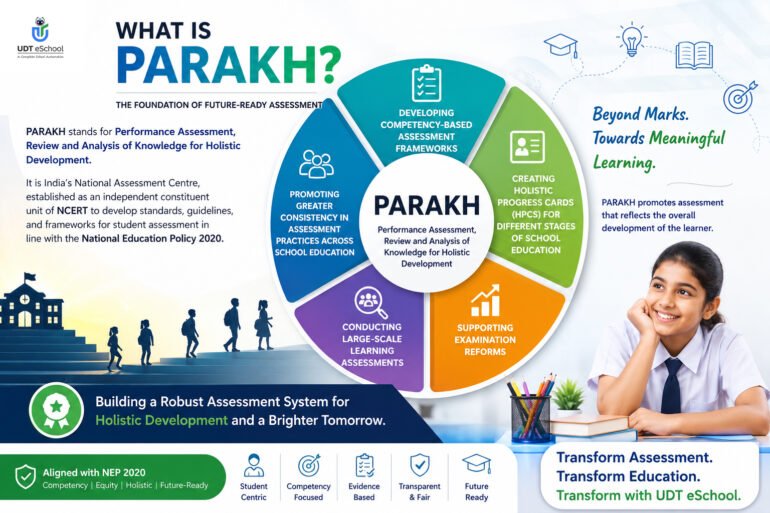
PARAKH stands for Performance Assessment, Review and Analysis of Knowledge for Holistic Development. It is India’s National Assessment Centre, established as an independent constituent unit of NCERT to develop standards, guidelines, and frameworks for student assessment in line with the National Education Policy 2020.
Its responsibilities extend beyond designing assessments. PARAKH also works on:
- Developing competency-based assessment frameworks.
- Creating Holistic Progress Cards (HPCs) for different stages of school education.
- Supporting examination reforms.
- Conducting large-scale learning assessments.
- Promoting greater consistency in assessment practices across school education.
Rather than encouraging schools to focus solely on test scores, PARAKH promotes assessment that reflects the overall development of the learner.
What Is the PARAKH Report Card?
The term “PARAKH Report Card” is commonly used to describe the Holistic Progress Card (HPC) developed by PARAKH. The HPC is designed to provide a broader picture of student progress by bringing together evidence related to competencies, learning, participation, reflection and other developmental areas. PARAKH has developed separate HPCs for the Foundational, Preparatory, Middle and Secondary stages because assessment needs differ across stages of school education.
For schools, the important point is that the HPC is more than a redesigned marksheet. It represents a broader approach to collecting and interpreting evidence of learning and development.
What Is the Full Form of PARAKH?
PARAKH stands for Performance Assessment, Review and Analysis of Knowledge for Holistic Development. It is India’s National Assessment Centre, established as an independent constituent unit of NCERT to support standards, guidelines and frameworks related to student assessment.
Why Was PARAKH Introduced?
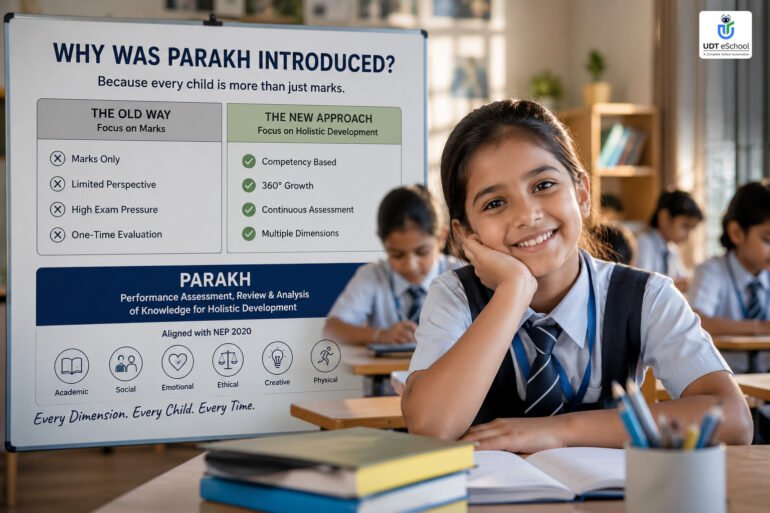
For many years, school report cards primarily answered one question:
“How many marks did the student score?”
While marks remain important, they tell only a small part of the story.
A student may demonstrate excellent teamwork, problem-solving, creativity, resilience, leadership, or communication skills—qualities that are difficult to capture through written examinations alone.
Recognising this limitation, NEP 2020 called for a shift towards competency-based, multidimensional assessment. PARAKH was established to help translate that vision into practical assessment frameworks that schools can adopt over time. One of the most visible outcomes of this work is the Holistic Progress Card, which captures learning across academic, social, emotional, ethical, creative, and physical dimensions rather than reducing progress to marks alone.
Traditional Report Card vs. PARAKH Holistic Progress Card
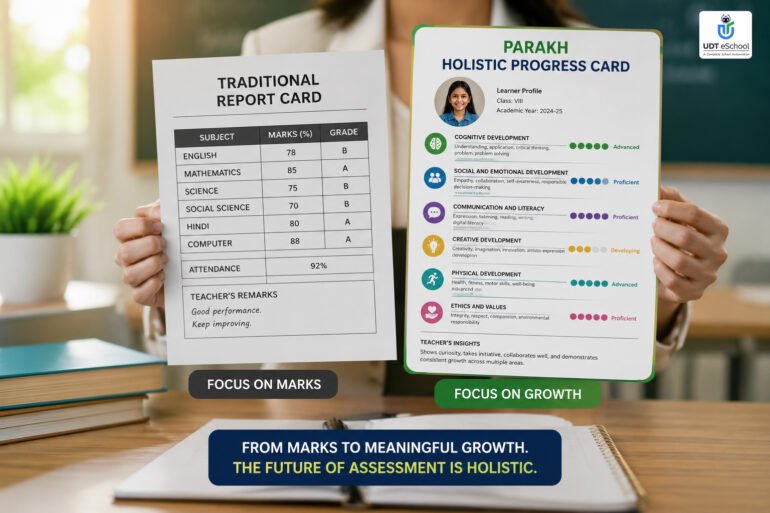
For decades, report cards in most Indian schools have followed a familiar pattern. They primarily recorded examination marks, grades, attendance, and a few brief remarks from teachers. While this approach offered a snapshot of academic performance, it often failed to answer a much more important question:
Is the student actually developing the knowledge, skills, attitudes, and competencies needed for lifelong learning?
Recognising this gap, the National Education Policy (NEP) 2020 introduced a broader vision of assessment—one that values not only what students know but also how they apply knowledge, solve problems, collaborate, communicate, and continue improving over time.
To support this vision, PARAKH (Performance Assessment, Review and Analysis of Knowledge for Holistic Development) has developed the Holistic Progress Card (HPC). Instead of acting as a replacement for academic performance, the HPC expands the report card into a more meaningful record of a student’s overall growth.
Simply put, the traditional report card answers “How did the student perform in exams?” while the Holistic Progress Card answers “How is the student growing as a learner?”
Comparison at a Glance
| Traditional Report Card | PARAKH Holistic Progress Card |
|---|---|
| Focuses mainly on marks and grades | Focuses on competencies, skills, and holistic development |
| Measures end-term performance | Encourages continuous assessment throughout the academic year |
| Primarily records teacher-assessed academic performance | Can incorporate teacher assessment along with self-assessment, peer feedback and other evidence where applicable |
| Limited qualitative feedback | Rich feedback supported by evidence and observations |
| Primarily academic | Includes cognitive, social, emotional, creative, and ethical development |
| Static record | Tracks learning progress over time |
| Parent discussions revolve around marks | Parent discussions focus on learning, strengths, and improvement areas |
Why This Shift Matters
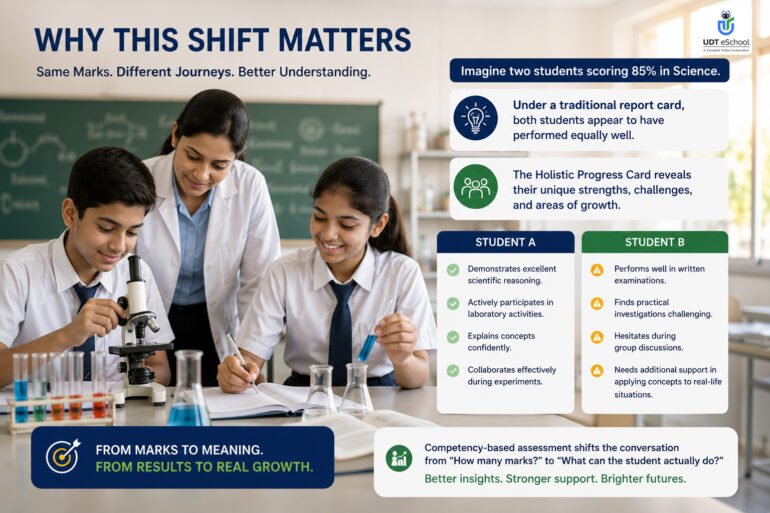
Imagine two students scoring 85% in Science.
Under a traditional report card, both students appear to have performed equally well.
However, classroom observations may reveal very different learning profiles:
Student A
- Demonstrates excellent scientific reasoning.
- Actively participates in laboratory activities.
- Explains concepts confidently.
- Collaborates effectively during experiments.
Student B
- Performs well in written examinations.
- Finds practical investigations challenging.
- Hesitates during group discussions.
- Needs additional support in applying concepts to real-life situations.
Although both students achieved similar marks, their learning journeys are different.
The Holistic Progress Card helps teachers, parents, and school leaders understand these differences, enabling more personalised academic support.
This is one of the biggest strengths of competency-based assessment—it shifts the conversation from “How many marks did the student score?” to “What can the student actually do?”
What Does the PARAKH Holistic Progress Card Include?
One of the most common misconceptions is that the Holistic Progress Card is simply a redesigned report card.
In reality, it represents a comprehensive assessment framework that brings together multiple sources of evidence collected throughout the academic year.
Rather than relying on a single examination, schools gather information from classroom experiences, projects, observations, assessments, and student reflections to build a richer understanding of each learner.
While individual schools may adapt the presentation to suit their academic systems, the overall framework is designed to capture continuous growth rather than isolated performance.
The exact structure and evidence captured within an HPC varies by stage. PARAKH’s stage-wise HPCs are designed around the developmental and assessment requirements of each stage rather than using one identical format for every learner. Across the framework, however, schools encounter multiple forms of evidence and participation, including competency-based activities, observations, reflection, feedback and other learning evidence.
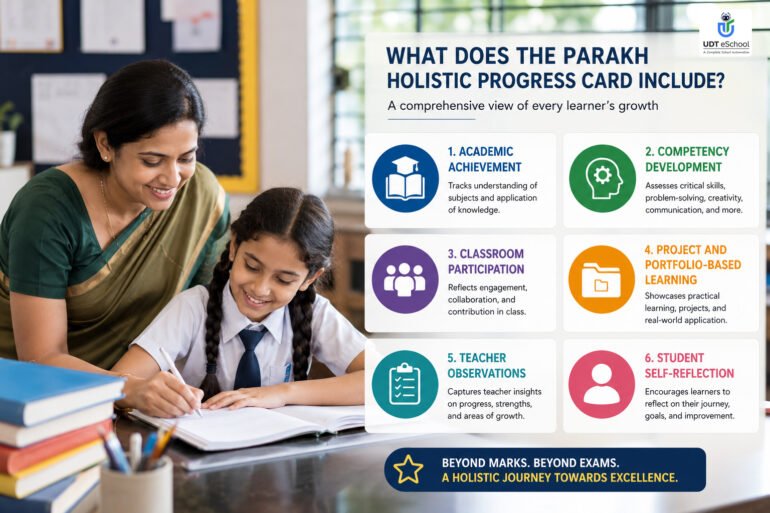
The following components form the foundation of a holistic progress card.
1. Academic Achievement
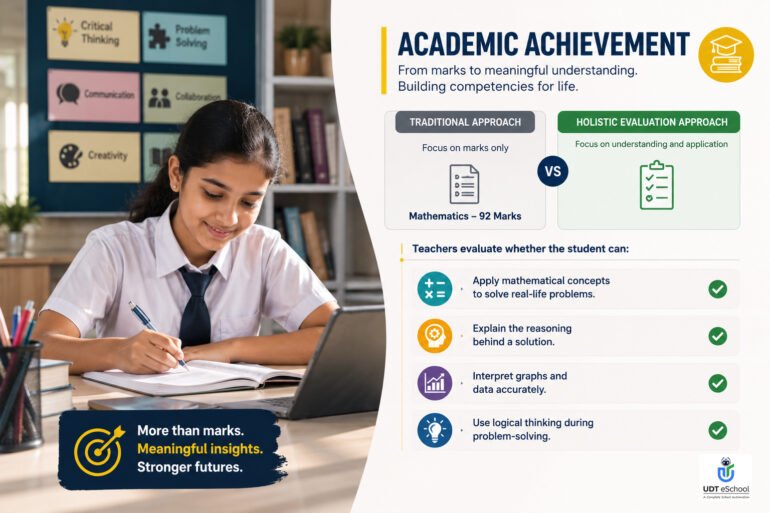
Academic learning continues to play an important role.
Students are still assessed in subjects such as Mathematics, Science, Languages, and Social Science.
However, instead of emphasising only examination scores, teachers also evaluate whether students have achieved the expected learning outcomes and competencies.
For example, instead of recording only:
Mathematics – 92 Marks
Teachers may additionally document whether the student can:
- Apply mathematical concepts to solve real-life problems.
- Explain the reasoning behind a solution.
- Interpret graphs and data accurately.
- Use logical thinking during problem-solving.
This provides parents with far more meaningful information than marks alone.
2. Competency Development
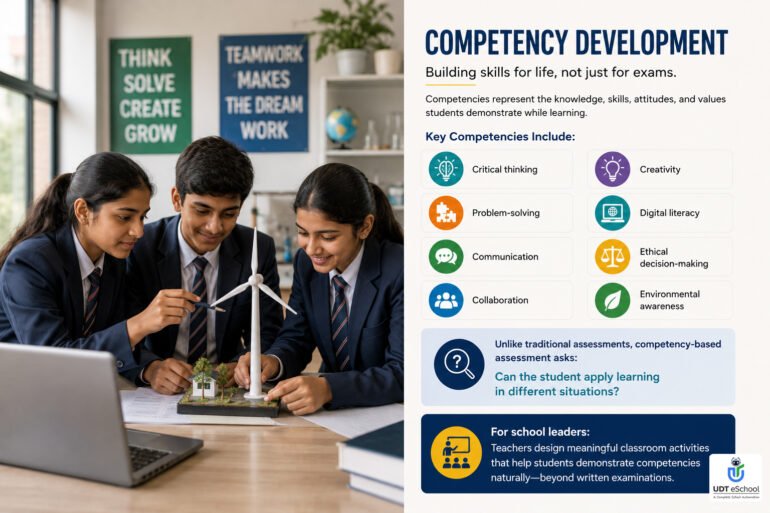
Competencies represent the knowledge, skills, attitudes, and values students demonstrate while learning.
These may include:
- Critical thinking
- Problem-solving
- Communication
- Collaboration
- Creativity
- Digital literacy
- Ethical decision-making
- Environmental awareness
Unlike traditional assessments, competency-based assessment asks:
Can the student apply learning in different situations?
For school leaders, this requires teachers to design classroom activities that allow students to demonstrate these competencies naturally rather than only through written examinations.
3. Classroom Participation
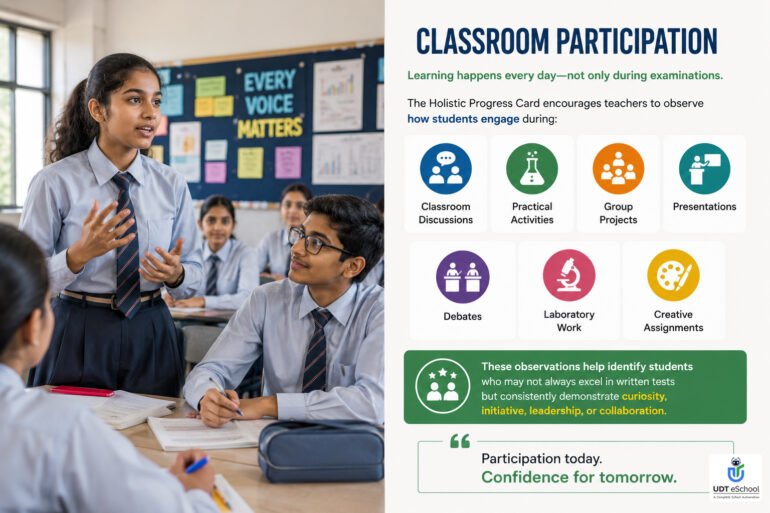
Learning happens every day—not only during examinations.
The Holistic Progress Card encourages teachers to observe how students engage during:
- Classroom discussions
- Practical activities
- Group projects
- Presentations
- Debates
- Laboratory work
- Creative assignments
These observations help identify students who may not always excel in written tests but consistently demonstrate curiosity, initiative, leadership, or collaboration.
4. Project and Portfolio-Based Learning
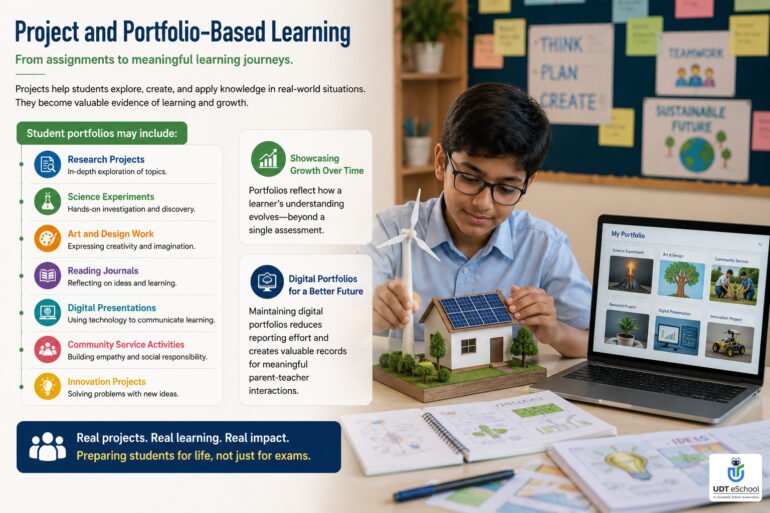
Under NEP 2020, projects are no longer viewed simply as homework submissions.
Instead, they become valuable evidence of learning.
Student portfolios may include:
- Research projects
- Science experiments
- Art and design work
- Reading journals
- Digital presentations
- Community service activities
- Innovation projects
Over time, these portfolios showcase how a learner’s understanding has evolved rather than providing only a single assessment snapshot.
For schools, maintaining digital portfolios can significantly reduce the effort involved in preparing holistic progress reports while also creating valuable records for parent-teacher interactions.
5. Teacher Observations
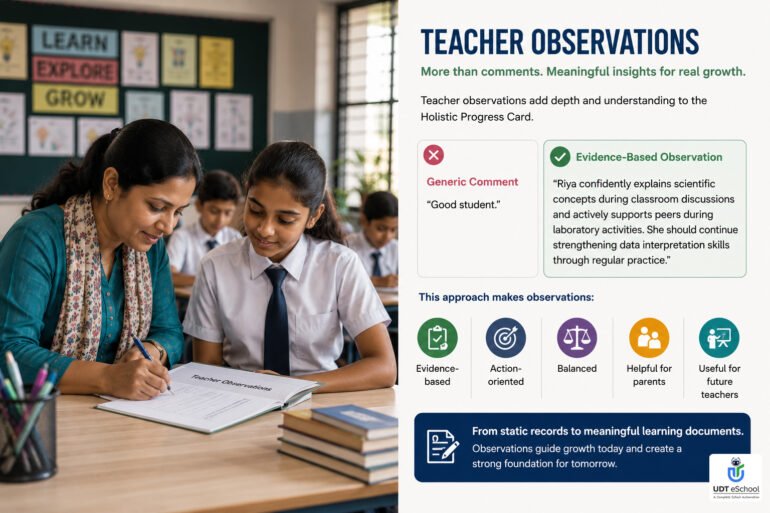
Teacher observations are one of the most valuable elements of the Holistic Progress Card.
Rather than writing generic comments such as:
“Good student.”
Teachers are encouraged to provide specific, evidence-based observations.
For example:
“Riya confidently explains scientific concepts during classroom discussions and actively supports peers during laboratory activities. She should continue strengthening data interpretation skills through regular practice.”
Notice the difference.
The comment is:
- Evidence-based
- Action-oriented
- Balanced
- Helpful for parents
- Useful for future teachers
This approach transforms report cards from static records into meaningful learning documents.
6. Student Self-Reflection
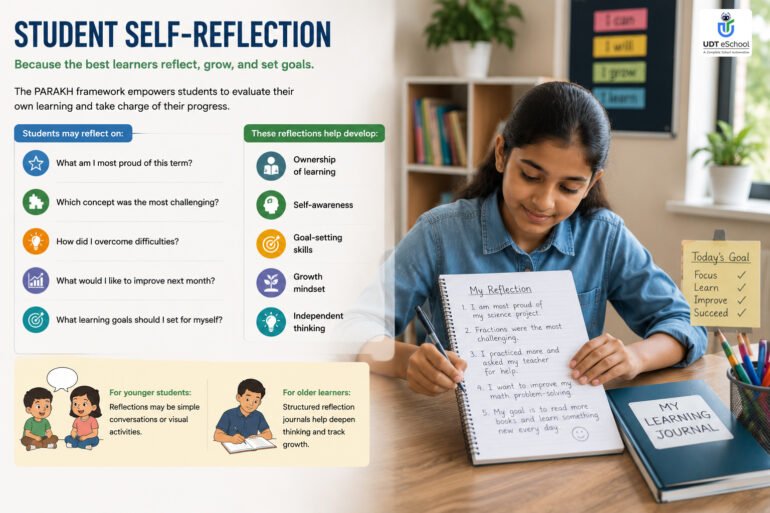
One of the most innovative aspects of the PARAKH framework is encouraging students to evaluate their own learning.
Students may reflect on questions such as:
- What am I most proud of this term?
- Which concept was the most challenging?
- How did I overcome difficulties?
- What would I like to improve next month?
- What learning goals should I set for myself?
These reflections help develop:
- Ownership of learning
- Self-awareness
- Goal-setting skills
- Growth mindset
- Independent thinking
For younger students, reflections may be simple conversations or visual activities, while older learners can complete structured reflection journals.
PARAKH Holistic Progress Card: Four Stages
PARAKH has developed four stage-wise Holistic Progress Cards because assessment needs change as learners progress through school education. The four stages are:
1. Foundational Stage
Bal Vatika to Grade 2
2. Preparatory Stage
Grades 3 to 5
3. Middle Stage
Grades 6 to 8
4. Secondary Stage
Grades 9 to 12
Each stage reflects the developmental and assessment requirements appropriate to that phase of learning. Schools should refer to the latest official PARAKH resources when implementing or interpreting the stage-specific HPC.
How the Holistic Progress Card Is Evolving
The Holistic Progress Card is not simply a static replacement for a traditional report card. PARAKH’s recent work continues to explore how the HPC can capture richer evidence of learning, including inquiry, reflection, socio-emotional development and learner identity.
Recent PARAKH guidance and publications illustrate how these dimensions can develop differently across the four stages of school education. For example, inquiry becomes progressively more structured as learners move from the Foundational Stage toward the Secondary Stage.
For schools, this reinforces an important principle: implementing HPC effectively is about improving assessment practice, not simply reproducing information in a new report-card template.
Understanding Competency-Based Assessment
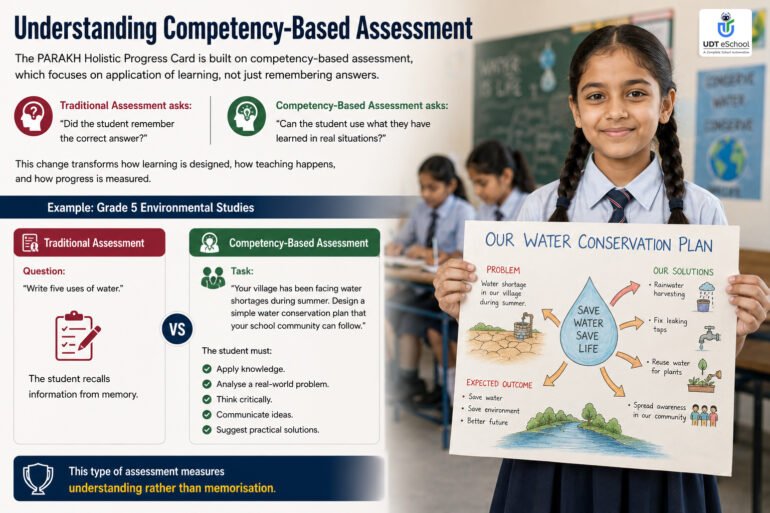
To fully understand the PARAKH Holistic Progress Card, it is essential to understand competency-based assessment, because the progress card is built around this philosophy.
Traditional assessment often asks:
“Did the student remember the correct answer?”
Competency-based assessment asks:
“Can the student use what they have learned in real situations?”
This seemingly small difference changes how learning is designed, how teaching takes place, and how progress is measured.
For example, in a Grade 5 Environmental Studies class:
Traditional Assessment
Question:
“Write five uses of water.”
The student recalls information from memory.
Competency-Based Assessment
Task:
“Your village has been facing water shortages during summer. Design a simple water conservation plan that your school community can follow.”
The student must:
- Apply knowledge.
- Analyse a real-world problem.
- Think critically.
- Communicate ideas.
- Suggest practical solutions.
This type of assessment measures understanding rather than memorisation.
💡 Expert Insight
One of the biggest misconceptions among schools is that competency-based assessment requires completely replacing traditional examinations. It does not.
Instead, it broadens the evidence used to understand student learning.
Written tests remain valuable, but they are complemented by classroom observations,
projects, practical tasks, discussions, portfolios, and reflective activities.
Schools that adopt this balanced approach often find that parent conversations become more meaningful, teacher feedback becomes more actionable, and students gain a clearer understanding of their own learning journey.
Beyond Marks: The Shared Responsibility in Holistic Assessment
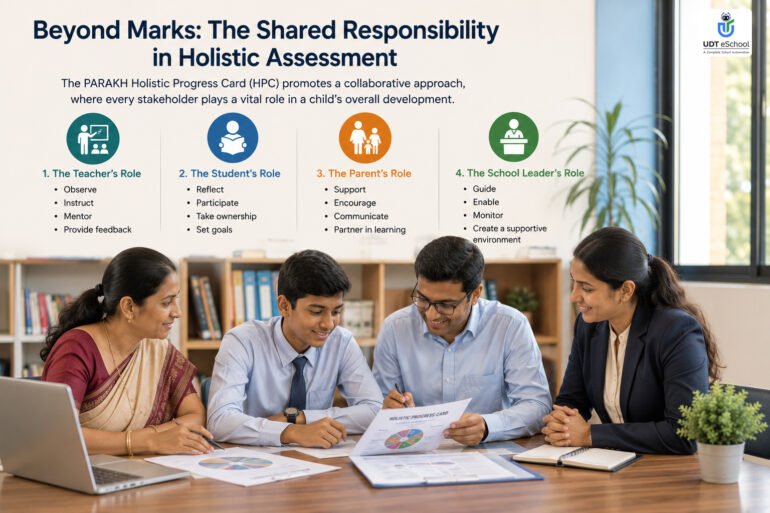
One of the defining features of the PARAKH Holistic Progress Card (HPC) is that assessment is no longer viewed as the sole responsibility of the class teacher. Instead, it becomes a collaborative process involving teachers, students, parents, and school leadership.
This shift reflects the philosophy of NEP 2020, which recognises that a child’s development cannot be accurately measured through examinations alone. Academic growth, life skills, behaviour, creativity, communication, and social-emotional development all contribute to a learner’s overall progress.
For schools, this means assessment evolves from a once-or-twice-a-year activity into an ongoing process supported by observations, meaningful feedback, and evidence collected throughout the academic year.
1. The Teacher’s Role
Teachers remain central to the assessment process, but their role expands beyond assigning marks.
Under the Holistic Progress Card framework, teachers become facilitators, mentors, and observers of student growth.
Their responsibilities may include:
- Designing competency-based classroom activities.
- Recording meaningful classroom observations.
- Assessing practical application of knowledge.
- Providing constructive and evidence-based feedback.
- Encouraging student reflection and goal setting.
- Maintaining assessment records throughout the academic year.
For many educators, this represents a significant shift in practice. Instead of focusing primarily on summative examinations, teachers increasingly use formative assessment strategies to understand how students learn over time.
Example
Rather than simply noting that a student scored 18 out of 20 in an English assignment, a teacher might also observe that the student:
- Expressed ideas confidently during group discussions.
- Demonstrated strong creative writing skills.
- Needed additional support in grammar accuracy.
- Responded positively to peer feedback.
Such observations help create a more balanced picture of learning and provide parents with actionable insights rather than just numerical scores.
2. The Student’s Role
The Holistic Progress Card encourages students to become active participants in their own learning journey.
Instead of waiting for teachers to evaluate their performance, students are encouraged to reflect on questions such as:
- What did I learn this month?
- Which activities helped me understand the topic better?
- What challenges did I face?
- Which competencies have I improved?
- What goals should I set for the next term?
This process develops important lifelong skills, including self-awareness, responsibility, resilience, and a growth mindset.
When students understand why they are learning and how they are progressing, they are more likely to take ownership of their education.
3. The Parent’s Role
Parents also become active partners in the assessment process.
Rather than discussing only examination marks during Parent-Teacher Meetings (PTMs), conversations become more meaningful and future-focused.
A Holistic Progress Card enables discussions around:
- Academic strengths and areas for improvement.
- Learning habits at home.
- Communication and collaboration skills.
- Emotional well-being.
- Attendance and participation.
- Personal interests and talents.
- Short-term learning goals.
Schools that already encourage structured parent engagement initiatives throughout the academic year often find this transition easier because parents are familiar with ongoing communication rather than receiving updates only during examination periods.
4. The School Leader’s Role
For principals, vice-principals, and academic coordinators, implementing the Holistic Progress Card is not simply an academic exercise—it is a school-wide change management initiative.
School leaders play a critical role in:
- Building teacher capacity through professional development.
- Establishing clear assessment guidelines.
- Ensuring consistency across grades and subjects.
- Monitoring documentation and assessment quality.
- Encouraging collaboration among teachers.
- Communicating changes effectively to parents.
Strong leadership ensures that competency-based assessment becomes part of the school’s culture rather than an additional administrative task.
Common Challenges Schools May Face During Implementation
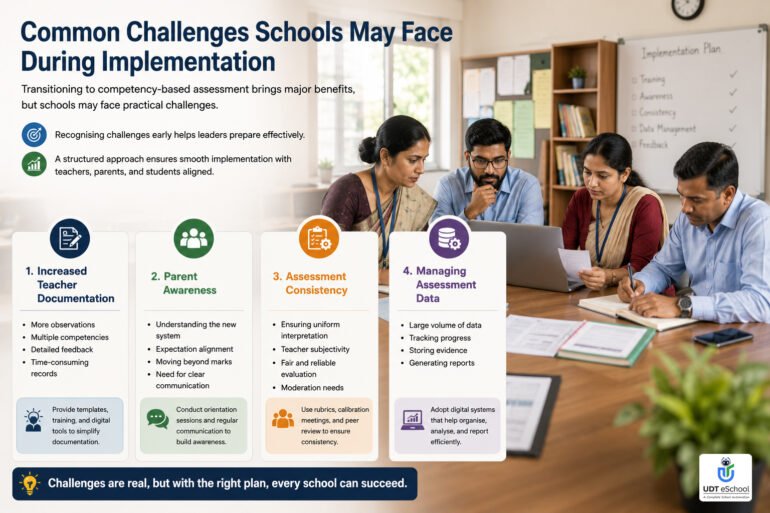
Transitioning from traditional report cards to competency-based assessment requires thoughtful planning. While the benefits are significant, schools may encounter several practical challenges during the implementation phase of Holistic Progress Card.
Recognising these challenges early enables school leaders to prepare more effectively.
Adopting a structured implementation approach helps schools introduce competency-based assessment gradually while keeping teachers, parents, and students aligned throughout the academic year.
1. Increased Teacher Documentation
Teachers may initially feel that competency-based assessment requires more documentation than traditional examinations.
Classroom observations, project assessments, competency tracking, and reflective feedback all require structured record-keeping.
Practical Recommendation
Develop standard observation templates and digital assessment records to reduce repetitive paperwork while maintaining consistency.
2. Parent Awareness
Parents who are accustomed to evaluating progress mainly through marks may find the new reporting format unfamiliar.
Without proper communication, they may question why traditional scores appear alongside qualitative feedback and competency observations.
Practical Recommendation
Conduct orientation sessions, workshops, or PTMs explaining how holistic assessment supports children’s long-term development.
Schools that already follow an annual parent engagement calendar can integrate PARAKH orientation sessions into their existing parent communication schedule, reducing confusion and improving participation.
3. Assessment Consistency
Different teachers may interpret competencies differently if common assessment criteria are not established.
This can lead to inconsistent reporting across classrooms.
Practical Recommendation
Create school-wide competency rubrics, moderation meetings, and shared assessment guidelines to improve consistency.
4. Managing Assessment Data
Collecting observations from multiple teachers throughout the academic year can become difficult if schools rely entirely on paper-based records.
Searching for evidence during report card preparation often increases workload and the likelihood of missing important information.
Practical Recommendation
Schools should consider digitising assessment records so that observations, competencies, portfolios, and feedback can be captured throughout the year rather than being compiled at the end of the term.
This approach not only improves efficiency but also supports more meaningful conversations with parents during PTMs.
📌 Principal’s Perspective
Successfully implementing the Holistic Progress Card (HPC) is not simply about introducing a new report card format. It requires a shift in how schools assess, document, and support student learning throughout the academic year.
School leaders who begin preparing early by investing in teacher training, competency-based assessment practices, standardised rubrics, structured parent communication, and digital documentation are better positioned to ensure a smooth and sustainable transition.
Rather than viewing PARAKH as an additional compliance requirement, forward-thinking schools treat it as an opportunity to strengthen teaching quality, improve assessment consistency, enhance parent trust, and build a more student-centred learning environment.
Why Digital Transformation Matters for PARAKH Implementation
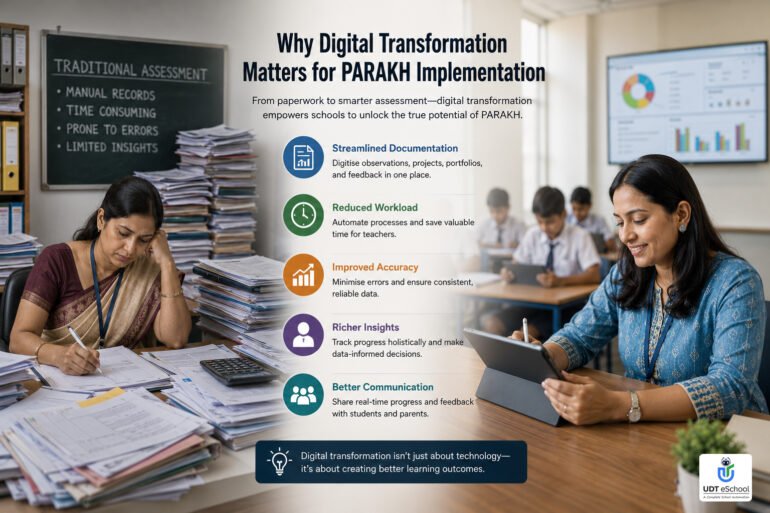
Implementing the PARAKH Holistic Progress Card (HPC) is not simply an academic reform—it also requires schools to rethink how they collect, manage, analyse, and communicate assessment data.
In a traditional assessment system, teachers often compile marks manually at the end of each term. However, competency-based assessment involves collecting evidence throughout the academic year, including classroom observations, project work, portfolios, practical activities, student reflections, and continuous feedback.
As the volume of assessment data increases, relying solely on spreadsheets or paper-based records can become both time-consuming and prone to errors.
This is why digital transformation plays a critical role in supporting successful PARAKH implementation. By digitising assessment processes, schools can streamline documentation, reduce administrative workload, improve data accuracy, and provide richer insights into student progress.
As schools continue aligning with competency-based education, many are also reviewing their broader digital transformation roadmap to ensure that assessment, communication, and school operations evolve together.
How School ERP Systems Can Support Holistic Assessment
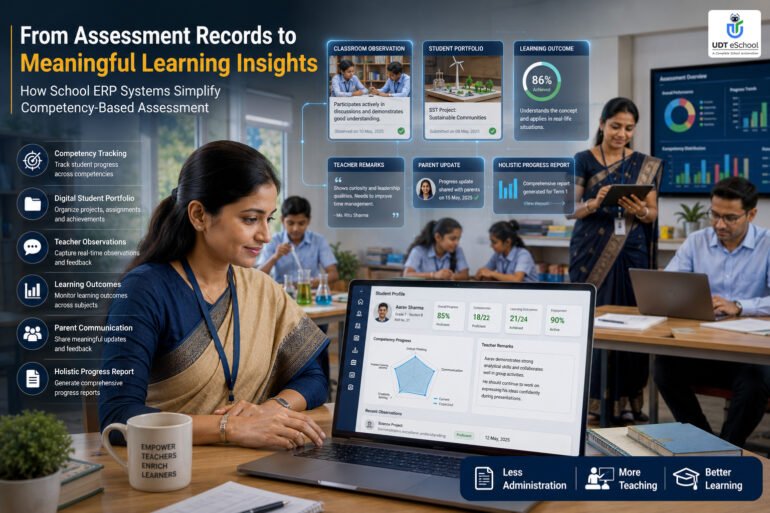
One of the biggest operational challenges schools face is managing assessment information from multiple teachers across different classes and subjects.
A well-designed School ERP does not replace educational judgement; rather, it simplifies the administrative processes that support effective assessment.
For example, digital assessment management can help schools:
- Record competency observations throughout the academic year.
- Maintain digital student portfolios.
- Track learning outcomes across subjects.
- Generate comprehensive progress reports.
- Document teacher remarks systematically.
- Share meaningful progress updates with parents.
- Maintain historical student records for future reference.
This allows teachers to spend less time compiling records manually and more time focusing on student learning.
At UDT eSchool, we’ve observed that schools adopting digital workflows often find it easier to maintain consistency in documentation, especially when multiple teachers contribute to the same student’s holistic assessment.
🚀 Digital Transformation Insight
Digital transformation should never be viewed as replacing teachers with technology.
Instead, it empowers educators by reducing repetitive administrative work so they can dedicate more time to meaningful teaching, personalised support, and student development.
When assessment records, competency tracking, student portfolios, classroom observations, and parent communication are managed through structured digital systems, schools can implement competency-based assessment more efficiently while improving consistency, transparency, and collaboration across the school.
Rather than replacing educational expertise, digital tools support teachers and school leaders with better documentation, data-driven insights, streamlined workflows, and informed decision-making—allowing schools to focus on what matters most: improving student learning outcomes.
Administrative Challenges Schools Commonly Face
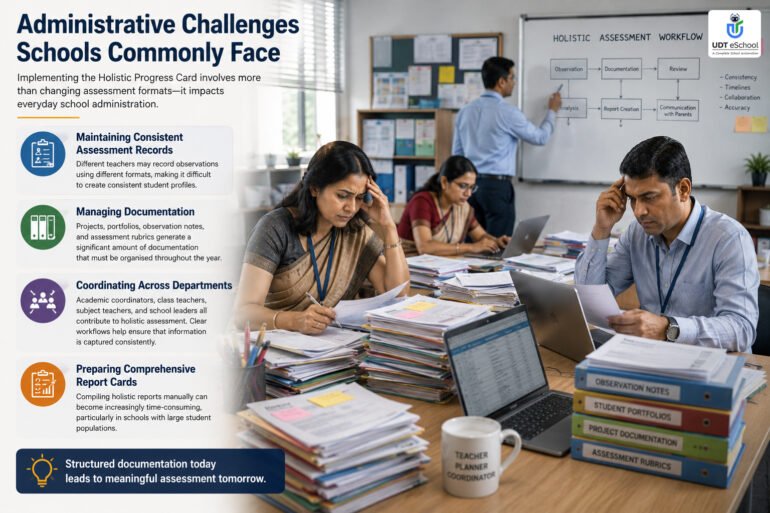
Introducing the Holistic Progress Card involves more than changing assessment formats—it also affects day-to-day school administration.
Some common administrative challenges include:
Maintaining Consistent Assessment Records
Different teachers may record observations using different formats, making it difficult to create consistent student profiles.
Managing Documentation
Projects, portfolios, observation notes, and assessment rubrics generate a significant amount of documentation that must be organised throughout the year.
Coordinating Across Departments
Academic coordinators, class teachers, subject teachers, and school leaders all contribute to holistic assessment. Clear workflows help ensure that information is captured consistently.
Preparing Comprehensive Report Cards
Compiling holistic reports manually can become increasingly time-consuming, particularly in schools with large student populations.
Schools that establish structured documentation processes early often experience a smoother transition to competency-based assessment.
Teacher Challenges During PARAKH Implementation
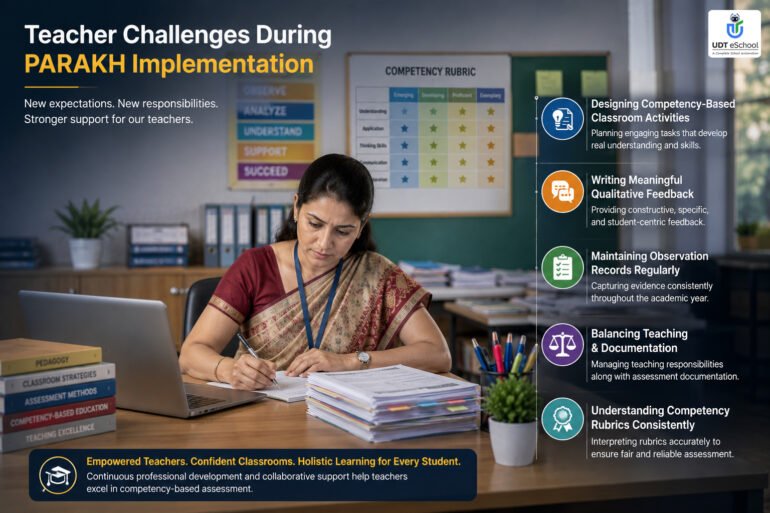
Teachers are at the heart of successful implementation, but they also face new expectations.
Common challenges include:
- Designing competency-based classroom activities.
- Writing meaningful qualitative feedback.
- Maintaining observation records regularly.
- Balancing teaching responsibilities with documentation.
- Understanding competency rubrics consistently.
Professional development plays an important role in helping teachers build confidence with these new assessment practices.
👩🏫 Teacher Tip
Classroom Best Practice
Rather than recording observations only during examinations, teachers can spend just
two or three minutes at the end of selected classroom activities documenting the key competencies demonstrated by students.
These brief observations may include collaboration, communication, critical thinking,
creativity, problem-solving, or classroom participation—providing valuable evidence of student learning beyond examination scores.
Small, regular observations are often more accurate, manageable, and less stressful than trying to reconstruct evidence at the end of the term. Over time, they create a richer, more reliable picture of each student’s progress while making the preparation of the Holistic Progress Card significantly easier.
Parent Engagement Remains Essential
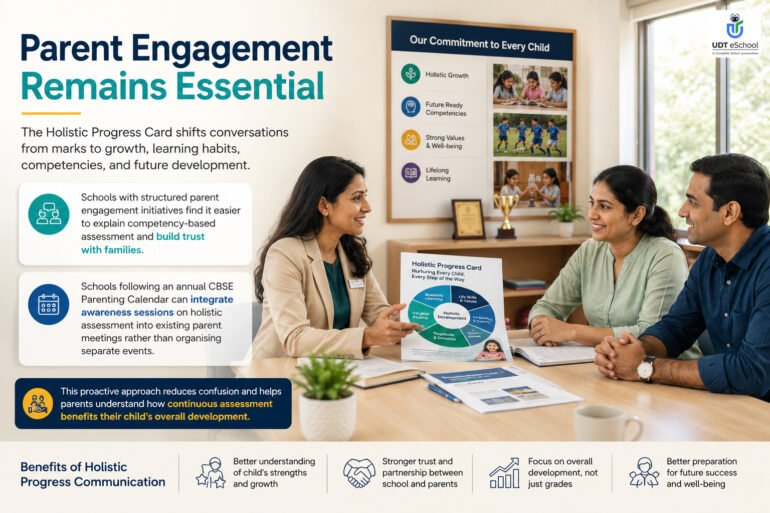
Parents often associate report cards with marks and grades because that has traditionally been the primary measure of academic performance.
The Holistic Progress Card creates an opportunity to shift these conversations toward student growth, learning habits, competencies, and future development.
➡ Schools that already conduct structured parent engagement initiatives throughout the academic year often find it easier to explain competency-based assessment and build trust with families.
➡ Similarly, schools that follow an annual CBSE Parenting Calendar can integrate awareness sessions on holistic assessment into existing parent meetings rather than organising separate events.
This proactive approach reduces confusion and helps parents understand how continuous assessment benefits their child’s overall development.
Compliance and Policy Readiness
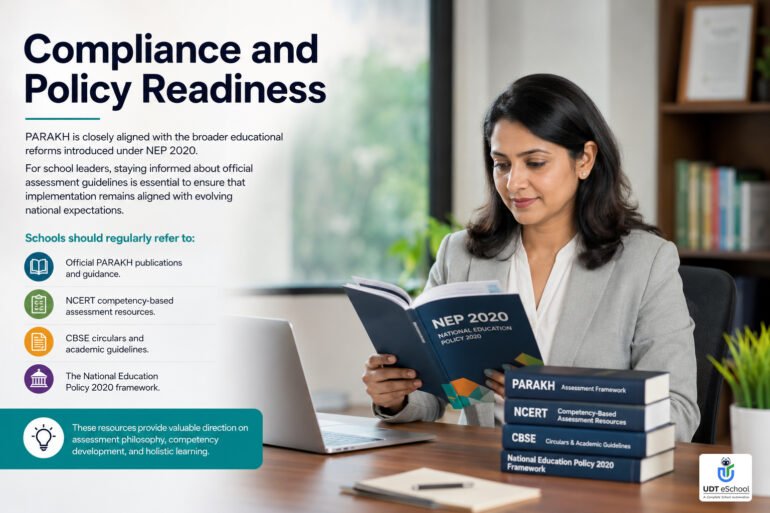
Schools should distinguish between the broader assessment direction established through NEP 2020 and PARAKH’s frameworks, and specific implementation requirements communicated through official CBSE or other applicable authorities. The Holistic Progress Card is part of PARAKH’s competency-based assessment work, but schools should always refer to the latest official circulars, guidelines and stage-specific resources before treating a particular format or process as mandatory.
PARAKH is closely aligned with the broader educational reforms introduced under NEP 2020.
For school leaders, staying informed about official assessment guidelines is essential to ensure that implementation remains aligned with evolving national expectations.
Schools should regularly refer to:
- Official PARAKH publications and guidance.
- NCERT competency-based assessment resources.
- CBSE circulars and academic guidelines.
- The National Education Policy 2020 framework.
These resources provide valuable direction on assessment philosophy, competency development, and holistic learning.
📋 Implementation Checklist
Before implementing the PARAKH Holistic Progress Card (HPC), school leaders should ensure the following foundational steps are in place to support a smooth and sustainable transition.
✔ School Readiness Checklist
- ✅ Train teachers on competency-based assessment.
- ✅ Develop standardised competency rubrics.
- ✅ Introduce classroom observation templates.
- ✅ Build digital student portfolios.
- ✅ Orient parents before implementation.
- ✅ Review assessment policies.
- ✅ Establish moderation processes.
- ✅ Digitise assessment documentation wherever possible.
Why it matters:
Schools that prepare these foundations early are more likely to implement competency-based assessment consistently, reduce administrative workload, and provide parents with more meaningful insights into student learning.
⚠️ Common Mistake
Assessment Reform
One of the most common mistakes schools make is treating the Holistic Progress Card (HPC) as simply a redesigned report card.
In reality, the report card is only the final outcome of a much broader assessment process.
The real transformation takes place throughout the academic year through
competency-based classroom assessment, teacher observations, student self-reflection, evidence collection, project work, portfolios, and meaningful parent communication.
Schools that focus only on changing the report card format often miss the broader objectives of competency-based education and the long-term vision of NEP 2020. Sustainable implementation begins with improving assessment practices—not just redesigning the final report.
Why it matters:
Schools that prioritise strong assessment practices before changing report formats are more
likely to improve teaching quality, ensure consistent competency evaluation, and build greater
confidence among teachers, parents, and students.
✅ Best Practice
Assessment Reform
Before redesigning the report card, schools should first strengthen the
assessment practices that support it.
Focus on building a culture of
continuous classroom observation, competency-based assessment, structured teacher feedback, student self-reflection, project-based learning, and meaningful parent communication.
Once these practices become part of everyday teaching, the Holistic Progress Card naturally becomes an accurate reflection of each student’s learning journey.
Schools that adopt this phased approach often experience smoother implementation, greater teacher confidence, improved assessment consistency, and stronger parent engagement throughout the academic year.
Why it matters:
Strong assessment practices create reliable evidence of student learning, making the Holistic Progress Card more meaningful, reducing last-minute documentation, and supporting long-term implementation of competency-based education.
🏫 Principal’s Perspective
Leadership & Strategy
Successfully implementing the PARAKH Holistic Progress Card (HPC) is rarely the result of a single initiative. It requires a long-term commitment to strengthening assessment practices, building teacher capacity, and creating a shared understanding of holistic learning across the school community.
Sustainable implementation depends on continuous teacher development, informed school leadership, meaningful parent partnerships, well-organised assessment processes, and consistent competency-based classroom practices. These elements work together to create a culture where assessment supports learning rather than simply measuring performance.
Schools that adopt a phased implementation strategy are generally better prepared to manage change, maintain teaching quality, reduce administrative complexity, and build confidence among teachers, parents, and students.
Why it matters:
Lasting assessment reform is achieved through strong leadership, consistent implementation, and collaboration across the entire school community—not by changing the report card alone.
📘 Digital Transformation Insight
Implementing competency-based assessment is not just about adopting a new report card format—it requires structured documentation, continuous assessment, effective parent communication, and efficient school operations.
At UDT eSchool, we regularly share practical guidance to help CBSE schools navigate digital transformation, assessment reforms, parent engagement, and school management with confidence.
Conclusion
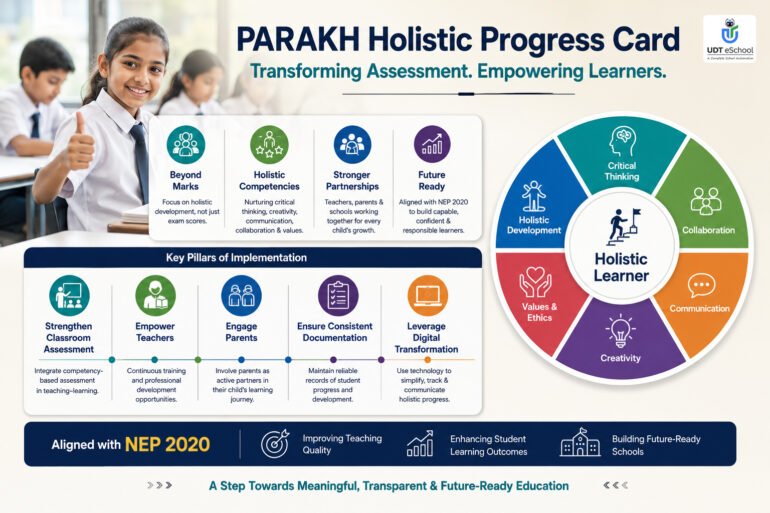
The introduction of the PARAKH Holistic Progress Card (HPC) represents a significant step towards transforming how student learning is understood and assessed in Indian schools. Instead of focusing primarily on examination scores, the framework encourages schools to recognise a broader range of competencies, including critical thinking, collaboration, communication, creativity, values, and overall student development.
For CBSE schools, implementing the Holistic Progress Card is not simply about adopting a new report card format. It involves strengthening classroom assessment practices, supporting teachers through continuous professional development, engaging parents as learning partners, and establishing consistent systems for documenting student progress.
Schools that approach this transition through careful planning, structured implementation, and ongoing collaboration are better positioned to align with the vision of NEP 2020 while improving both teaching quality and student learning outcomes.
As educational reforms continue to evolve, schools that embrace competency-based assessment alongside thoughtful digital transformation will be better equipped to create meaningful, transparent, and future-ready learning environments.
👨👩👧 Parent Insight
Parent Engagement
Parents play a vital role in the successful implementation of the PARAKH Holistic Progress Card (HPC). Schools that regularly communicate student progress, explain competency-based assessment practices, and involve families throughout the academic year are more likely to build stronger trust, encourage meaningful collaboration, and improve student learning outcomes.
Rather than limiting Parent-Teacher Meetings to discussions about examination marks, schools can use these interactions to explore a child’s competencies, strengths, areas for improvement, and future learning goals. Schools that already implement
structured parent engagement initiatives throughout the academic year
often find it easier to introduce competency-based assessment because parents are already accustomed to ongoing communication.
Similarly, schools can integrate awareness sessions on holistic assessment into their
CBSE Parenting Calendar activities, making parent orientation a natural part of existing school engagement programmes rather than a separate initiative.
If your school is looking to strengthen home-school collaboration, explore practical strategies in our guide on improving parent engagement in schools,
where we share actionable ideas for building stronger partnerships with families.
Why it matters:
When parents understand how competency-based assessment works and receive regular, meaningful updates about their child’s progress, they become active partners in learning rather than passive recipients of report cards. This collaboration strengthens student outcomes and builds greater trust between schools and families.
Official Resources and References
PARAKH — Holistic Progress Cards
PARAKH’s official HPC resource provides information about the four stage-wise Holistic Progress Cards and their assessment approach.
Official resource: PARAKH — Holistic Progress Cards
PARAKH — About
Official information about PARAKH’s role in competency-based assessment and the development and dissemination of HPCs.
Official resource: About PARAKH
Ministry of Education — PARAKH
Use the Ministry’s official PARAKH resource for the broader policy context.
Official resource: PARAKH
CBSE — Official Website
Use CBSE’s official website for the latest school-level circulars and applicable assessment guidance.
Official resource: CBSE
NEP 2020
Use the Ministry of Education’s official NEP resource for the broader assessment-policy context.
Official resource: NEP 2020
PARAKH Report Card Explained FAQs
Q. What Is the Full Form of PARAKH?
PARAKH stands for Performance Assessment, Review and Analysis of Knowledge for Holistic Development. It is the National Assessment Centre established as an independent constituent unit of NCERT.
Q. How Many Holistic Progress Cards Has PARAKH Developed?
A. PARAKH has developed four stage-wise Holistic Progress Cards: Foundational, Preparatory, Middle and Secondary. Each reflects the assessment requirements of its respective stage.
Q. What is the PARAKH Holistic Progress Card?
A. The PARAKH Holistic Progress Card (HPC) is a competency-based student assessment framework developed to align with the vision of NEP 2020. It evaluates not only academic achievement but also skills, values, behaviour, creativity, and overall student development.
Q. Is the Holistic Progress Card mandatory for CBSE schools?
A. Schools should follow the latest official CBSE, PARAKH and NCERT guidance applicable to their stage and institutional context. PARAKH has developed stage-wise Holistic Progress Cards as part of its competency-based assessment work, while specific school-level implementation should be guided by the latest applicable official instructions.
Q. How is the PARAKH Report Card different from a traditional report card?
A. Unlike traditional report cards that primarily display marks and grades, the PARAKH Holistic Progress Card combines quantitative results with qualitative feedback, competency evaluation, classroom observations, and evidence of holistic development.
Q. What does competency-based assessment mean?
A. Competency-based assessment evaluates how effectively students apply their knowledge, skills, and understanding in real-life situations instead of measuring memorisation alone.
Q. Why is parent participation important in holistic assessment?
A. Parents provide valuable support by reinforcing learning at home, encouraging positive habits, and participating in meaningful discussions about student progress beyond examination scores.
Q. How can schools prepare teachers for PARAKH implementation?
A. Schools should invest in teacher training, competency rubrics, formative assessment practices, classroom observation techniques, and collaborative moderation processes.
Q. Can technology support Holistic Progress Card implementation?
A. Yes. Digital assessment systems help schools manage competency records, student portfolios, teacher observations, parent communication, and progress reporting more efficiently.
Q. How does PARAKH support NEP 2020?
A. PARAKH operationalises several NEP 2020 recommendations by promoting competency-based education, continuous assessment, holistic development, and improved assessment quality across schools.
Related Questions Schools Often Ask
Q. How should schools explain the Holistic Progress Card to parents?
A. Clear communication through orientation sessions, Parent-Teacher Meetings, newsletters, and practical examples helps parents understand that competency-based assessment complements academic achievement rather than replacing it.
Q. What challenges do teachers face while implementing competency-based assessment?
A. Teachers often need additional support in classroom observation, competency mapping, documentation, and providing evidence-based feedback. Regular professional development can ease this transition.
Q. Can small schools implement PARAKH effectively?
A. Yes. Schools can adopt a phased approach by introducing competency-based practices gradually, beginning with selected grades or subjects before scaling implementation across the school.
Q. Does competency-based assessment increase teacher workload?
A. Initially, teachers may spend additional time adapting to new assessment practices. However, structured workflows and digital documentation can significantly improve efficiency over time.
Q. How can principals ensure consistent assessment across classrooms?
A. School leaders should establish common competency rubrics, organise moderation meetings, monitor assessment quality, and provide ongoing academic mentoring.
Q. Why are student portfolios important?
A. Student portfolios provide evidence of learning over time and help teachers, students, and parents understand growth beyond examination marks.
Q. How often should parents receive progress updates?
A. Regular communication throughout the academic year supports stronger partnerships than relying solely on end-term report cards.
Q. How can digital school management systems support assessment reforms?
A. Integrated digital platforms simplify assessment management, improve documentation, strengthen communication, and help schools maintain accurate academic records.

Editorial Team
About UDT eSchool
Practical guidance for school leaders navigating educational transformation.
UDT eSchool publishes research-backed resources that help schools embrace
CBSE reforms, NEP 2020, PARAKH, competency-based assessment, digital transformation,
parent engagement, compliance management, and future-ready school operations.
Our editorial team combines educational expertise with practical implementation guidance to help principals, school owners, administrators, academic coordinators, and teachers make informed decisions that improve learning outcomes while simplifying day-to-day school management.
Our Areas of Expertise
CBSEPARAKHNEP 2020School LeadershipParent EngagementSchool ERPDigital Transformation
📚 Continue Your Assessment Reform Journey
- PARAKH Report Card Explained (Current Guide) – Updated August 2026
- Competency-Based Assessment Examples
- How Schools Can Implement Holistic Progress Card
- NEP 2020 Assessment Framework
Trusted School Resource
Explore More Expert Resources
Discover practical guides, implementation strategies and expert insights that help schools confidently navigate CBSE reforms, assessment innovation, digital transformation and future-ready school operations.

Education Technology Consultant at UDt eSchool with 10+ years of experience helping schools digitize operations and implement CBSE-aligned systems.