Competency-Based Assessment Examples: Practical Strategies Every School Can Use
Competency-Based Assessment Examples are becoming increasingly important as schools shift from measuring what students remember to evaluating what they can actually do with their knowledge. With the growing emphasis on competency-based education through NEP 2020, CBSE reforms, and PARAKH, educators are looking for practical ways to assess critical thinking, problem-solving, creativity, collaboration, and real-world application in everyday classrooms.
While many schools understand the concept, implementing competency-based assessment effectively often raises important questions. What kinds of classroom activities truly measure competencies? How can teachers assess skills fairly? What evidence should schools collect to support holistic student development?
Building on our previous guide explaining the PARAKH Report Card, this article explores practical, classroom-ready competency-based assessment examples across different subjects and grade levels. You’ll also discover implementation strategies, common challenges, and how digital assessment tools can help schools make competency-based evaluation more consistent, efficient, and meaningful.
What Are Competency-Based Assessment Examples?
Competency-based assessment examples are classroom activities and assessment tasks that measure how well students can apply knowledge, demonstrate skills, solve problems, communicate ideas, collaborate, and use learning in meaningful situations. Examples include projects, experiments, presentations, case studies, portfolios, role plays, group tasks, observations, reflective journals, practical demonstrations, and real-world problem-solving activities.
Unlike assessments focused mainly on recall, competency-based assessment looks for observable evidence of what students can do with what they have learned. Effective tasks are linked to clear learning outcomes, supported by appropriate assessment criteria, and followed by meaningful feedback.
In This Guide You’ll Learn
- Practical competency-based assessment examples
- Subject-wise classroom activities
- Teacher-friendly assessment techniques
- How CBSE and NEP 2020 support competency-based learning
- Common implementation challenges and solutions
- How digital tools simplify assessment management
- Best practices for school-wide implementation
Competency-Based Assessment Examples Key Takeaways
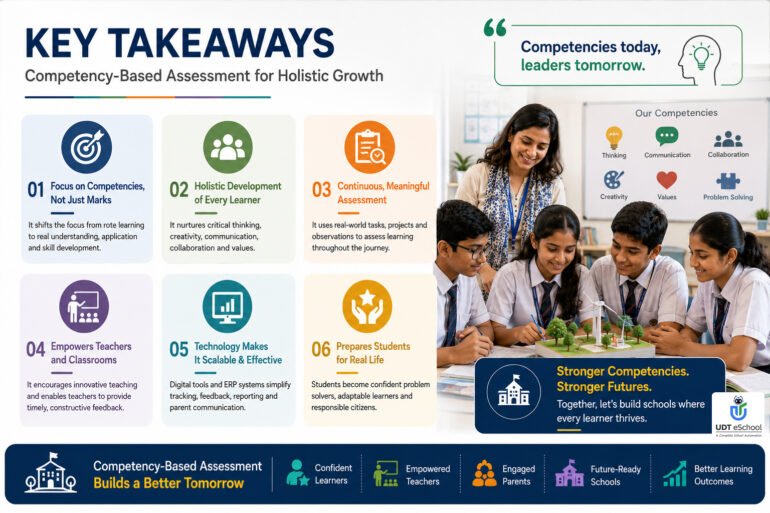
- Competency-based assessment measures students’ ability to apply learning in meaningful contexts rather than simply recalling information.
- Classroom projects, presentations, experiments, portfolios, and real-world tasks provide authentic evidence of competency development.
- Effective implementation requires clear learning outcomes, transparent rubrics, and regular formative feedback.
- Competency-based assessment supports the goals of NEP 2020, CBSE reforms, and PARAKH by encouraging higher-order thinking and holistic development.
- Teachers benefit from structured assessment strategies that reduce subjectivity and improve consistency across classrooms.
- School leaders can strengthen implementation by combining professional development with digital assessment management tools.
- When thoughtfully integrated into everyday teaching, competency-based assessment creates richer insights into student progress and future readiness.
What Is Competency-Based Assessment?

Competency-Based Assessment (CBA) is an approach to evaluating students based on their ability to apply knowledge, demonstrate skills, and exhibit positive attitudes in meaningful situations, rather than simply recalling facts during an examination.
Instead of asking, “Can the student remember this chapter?”, competency-based assessment asks a more meaningful question:
“Can the student use what they have learned to solve a problem, make informed decisions, communicate effectively, or create something valuable?”
This shift reflects the broader vision of India’s education reforms under NEP 2020, which encourage schools to move beyond rote memorization and foster deeper understanding, critical thinking, creativity, collaboration, and real-world application of learning. It also aligns with the competency-focused direction promoted by PARAKH and the evolving assessment practices recommended by CBSE.
For teachers, this means designing learning experiences where students actively demonstrate understanding. For school leaders, it means creating an assessment culture that values continuous growth over one-time performance. For parents, it provides a more complete picture of a child’s strengths, progress, and areas for improvement.
Unlike traditional examinations that often measure only academic recall, competency-based assessment gathers evidence from multiple sources throughout the learning journey. These may include classroom discussions, practical demonstrations, projects, presentations, reflective journals, collaborative tasks, observations, and student portfolios. Together, these provide a richer and more balanced understanding of student achievement.
One of the most important aspects of competency-based assessment is that it is evidence-driven rather than exam-driven. Students are encouraged to demonstrate learning in different ways, allowing teachers to assess not only what they know, but also how they think, communicate, collaborate, and apply concepts in authentic contexts.
As discussed in our previous guide on PARAKH Report Card Explained, holistic reporting becomes meaningful only when schools collect diverse and reliable evidence of learning. Competency-based assessment provides the classroom practices that make such reporting possible, turning policy expectations into everyday teaching and learning.
Schools looking at how this evidence can ultimately contribute to broader student reporting can also explore our guide to Holistic Progress Card with AI.
Competency-Based Assessment in CBSE Schools
CBSE’s assessment approach has increasingly emphasised the application of knowledge, conceptual understanding, critical thinking, problem-solving and competency development rather than relying only on recall-based questions. This direction is consistent with the broader assessment reforms outlined under NEP 2020 and the work of PARAKH.
For CBSE schools, competency-based assessment does not mean replacing every examination or traditional assessment method. Instead, schools can broaden the evidence used to understand student learning by combining written assessments with projects, practical activities, case-based questions, presentations, observations, portfolios and other appropriate tasks.
The practical shift is from asking only:
“What does the student remember?”
to also asking:
“What can the student do with what they have learned?”
Schools should refer to the latest CBSE circulars, curriculum documents and assessment guidance when designing grade- and subject-specific assessment practices.
How PARAKH Supports Competency-Based Assessment
PARAKH’s work on assessment supports the broader shift toward competency-based and holistic approaches to evaluating student learning. Its stage-wise Holistic Progress Cards (HPCs) are designed to capture a broader picture of learner development rather than relying solely on examination results.
For schools, this creates an important connection between classroom assessment and holistic reporting: competency-based activities generate evidence of learning, while a holistic reporting framework can help organise and communicate that evidence.
For a deeper explanation, see our guide to [PARAKH Report Card Explained].
This is an important internal-link bridge.
Expert Insight
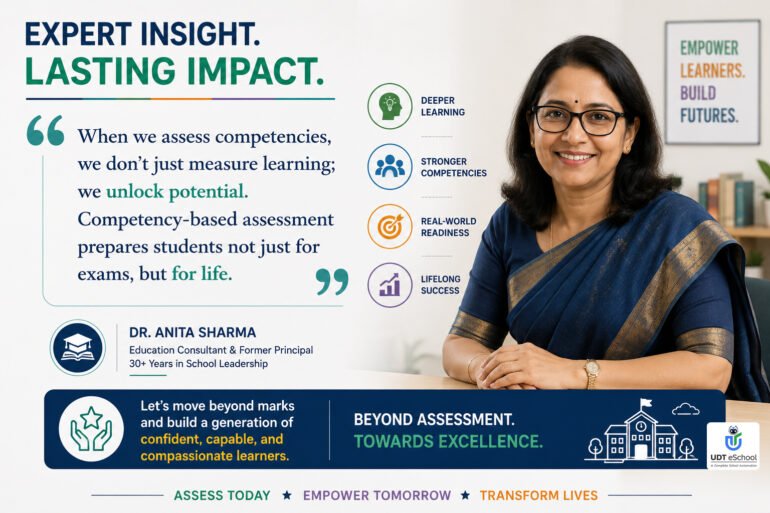
One of the biggest misconceptions about competency-based assessment is that it replaces examinations altogether. In reality, it broadens the evidence used to evaluate student learning. Written tests continue to play an important role, but they are complemented by projects, practical tasks, observations, presentations, peer collaboration, reflective activities, and ongoing formative assessments. This balanced approach provides a more accurate picture of each student’s capabilities.
Why Competency-Based Assessment Matters
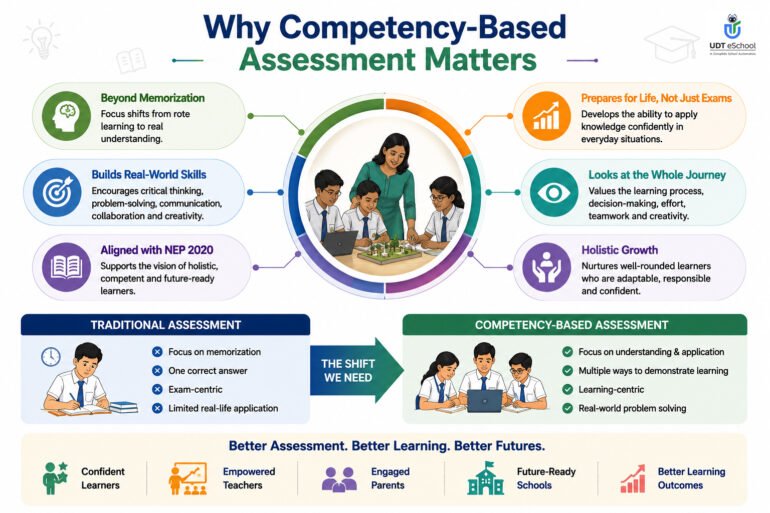
Assessment has always influenced how students learn. When success is measured primarily through memorization, students naturally focus on remembering information for examinations. When assessment rewards inquiry, application, communication, and problem-solving, students develop the skills needed beyond the classroom.
This is why competency-based assessment has become a central element of educational reform worldwide. In India, NEP 2020 envisions an education system that nurtures well-rounded learners who can think critically, collaborate effectively, adapt to new situations, and apply knowledge confidently in everyday life. Competency-based assessment is one of the key mechanisms for achieving that vision.
For schools, the shift is not simply about changing question papers—it is about redefining what success looks like. Instead of evaluating only the final answer, teachers also observe the learning process, decision-making, teamwork, communication, and creativity demonstrated along the way.
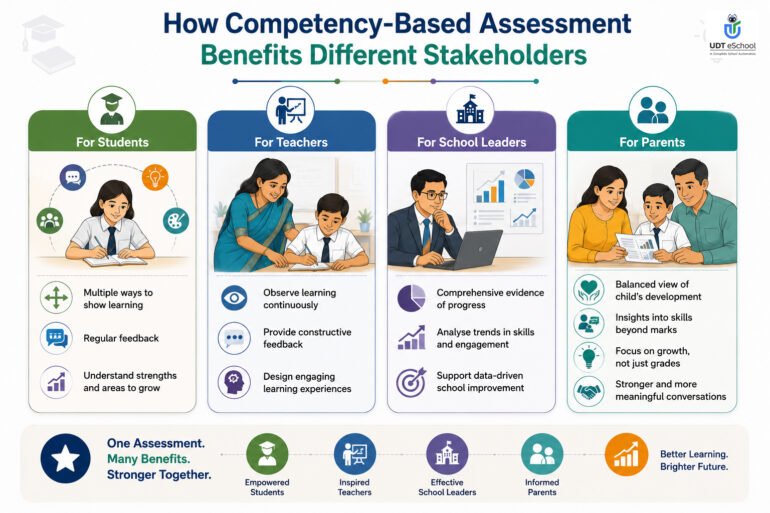
How Competency-Based Assessment Benefits Different Stakeholders
For Students
Students gain opportunities to demonstrate learning in multiple ways, reducing the pressure of relying solely on high-stakes examinations. They receive regular feedback that helps them understand both their strengths and the specific areas where they can improve.
For Teachers
Teachers move beyond grading correct and incorrect answers. They become facilitators who continuously observe learning, provide constructive feedback, and design engaging classroom experiences that encourage higher-order thinking.
For School Leaders
School leaders obtain more comprehensive evidence of teaching effectiveness and student progress. Rather than reviewing only examination scores, they can analyse trends in skill development, classroom engagement, and learning outcomes to support school improvement initiatives.
For Parents
Parents receive a more balanced understanding of their child’s development. Instead of seeing only marks, they gain insights into communication skills, collaboration, creativity, responsibility, problem-solving, and overall growth, making parent-teacher discussions more meaningful and action-oriented.
From Knowledge Acquisition to Knowledge Application
The following comparison illustrates how the focus of assessment changes when schools adopt a competency-based approach:
Competency-based assessment is best understood as an expansion of assessment evidence, not as a simple replacement of examinations.
This transformation encourages students to become active participants in their own learning rather than passive recipients of information.
Competency-based assessment should not be viewed as an additional workload for teachers. Many effective classroom activities—such as group discussions, science experiments, project presentations, debates, and reflective writing—already provide valuable assessment evidence. The key is to evaluate these activities systematically using clearly defined learning outcomes and assessment rubrics.
Building on This Foundation
Understanding what competency-based assessment is and why it matters naturally leads to the next question:
What does competency-based assessment actually look like in the classroom?
In the next section, we’ll explore the core principles of effective competency-based assessment, followed by practical subject-wise examples in English, Mathematics, Science, and Social Science that teachers can implement immediately in CBSE and other Indian school classrooms. These examples will demonstrate how competencies can be assessed consistently, fairly, and meaningfully across different grade levels.
Core Principles of Effective Competency-Based Assessment
Understanding the concept of competency-based assessment is only the first step. The real impact comes from how assessments are designed, conducted, and interpreted in the classroom.
Many schools make the mistake of replacing traditional questions with activity-based tasks while continuing to evaluate students using the same mark-centric approach. True competency-based assessment goes much deeper. It aligns learning objectives, teaching strategies, assessment methods, and feedback into a continuous cycle of improvement.
Below are the core principles that help schools implement competency-based assessment effectively.
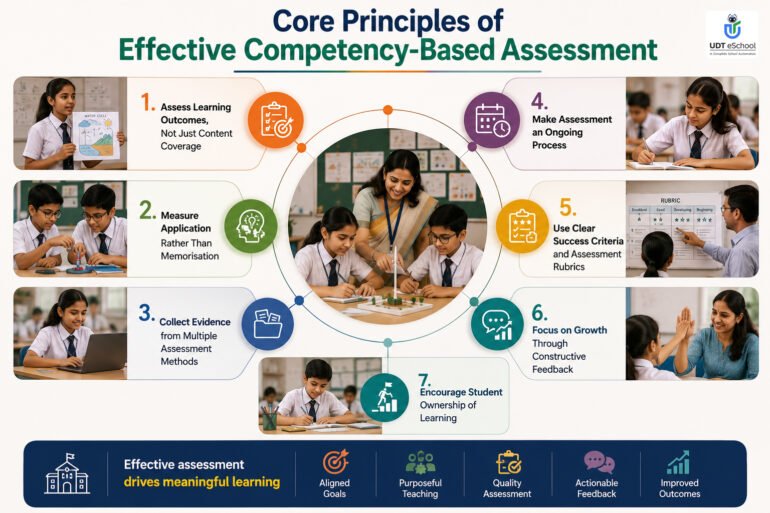
1. Assess Learning Outcomes, Not Just Content Coverage
Traditional assessments often ask whether a chapter has been completed. Competency-based assessment asks whether students have achieved the intended learning outcomes.
For example, instead of testing whether students remember the steps of the water cycle, a competency-based task may ask them to explain how changes in local weather affect the water cycle in their own community. This evaluates conceptual understanding, application, and communication simultaneously.
Teachers should therefore begin lesson planning by identifying what students should be able to demonstrate, not simply what they should study.
2. Measure Application Rather Than Memorisation
Knowledge becomes meaningful only when learners can use it in new situations.
A student who memorises mathematical formulas may perform well in a written examination. However, a competency-based assessment explores whether the same student can apply those formulas to solve practical budgeting, measurement, or planning problems encountered in everyday life.
Similarly, in language subjects, students should demonstrate the ability to communicate ideas clearly instead of merely recalling grammar rules.
This shift encourages deeper learning and long-term retention.
3. Collect Evidence from Multiple Assessment Methods
No single assessment activity can capture every aspect of a student’s learning.
Effective competency-based assessment combines evidence collected through multiple classroom experiences, such as:
- Individual assignments
- Group projects
- Classroom discussions
- Laboratory investigations
- Presentations
- Portfolios
- Practical demonstrations
- Reflective journals
- Teacher observations
- Peer and self-assessment
Using varied evidence helps reduce bias while providing a more comprehensive understanding of student development.
4. Make Assessment an Ongoing Process
Competencies develop gradually through continuous learning experiences.
Instead of waiting until the end of a term, teachers observe student progress throughout the academic year, providing timely feedback that helps learners improve before the final evaluation.
This continuous assessment approach enables teachers to identify learning gaps early and adjust instructional strategies accordingly.
For students, assessment becomes part of learning rather than something that happens only after learning.
5. Use Clear Success Criteria and Assessment Rubrics
Students perform better when they understand what quality work looks like.
Before beginning an assessment task, teachers should clearly communicate:
- the learning objective
- expected competencies
- assessment criteria
- performance indicators
- feedback process
Assessment rubrics make evaluation more transparent, consistent, and fair while reducing subjectivity across different classrooms and teachers.
As schools expand competency-based assessment practices, common rubrics also promote greater consistency across grade levels and departments.
6. Focus on Growth Through Constructive Feedback
Competency-based assessment values progress as much as performance.
Rather than simply assigning marks, teachers provide specific feedback that answers three important questions:
- What has the student done well?
- What needs improvement?
- What should the student do next?
This approach encourages a growth mindset, helping students view assessment as an opportunity to improve rather than a judgement of their abilities.
Meaningful feedback also strengthens communication between teachers, students, and parents by making learning expectations more transparent.
7. Encourage Student Ownership of Learning
An important characteristic of competency-based assessment is that students actively participate in evaluating their own learning.
Through self-reflection, goal setting, peer review, and learning portfolios, students gradually develop the ability to:
- monitor their own progress
- identify strengths
- recognise improvement areas
- take responsibility for future learning
This builds independent learners who are better prepared for higher education and lifelong learning.
Is Your School Ready for Competency-Based Assessment?
- ☐ Learning outcomes are clearly defined before teaching begins.
- ☐ Teachers design activities that assess application of knowledge.
- ☐ Multiple assessment methods are used throughout the year.
- ☐ Students receive continuous, constructive feedback.
- ☐ Common assessment rubrics are available across departments.
- ☐ Teachers receive regular professional development on assessment practices.
- ☐ Parents understand how competencies are evaluated.
- ☐ Student progress is documented systematically for holistic reporting.
Traditional Assessment vs Competency-Based Assessment
The transition to competency-based assessment is not about abandoning examinations. Instead, it expands the purpose of assessment from measuring what students remember to understanding how effectively they can apply their learning.
The table below highlights the key differences.
| Aspect | Traditional Assessment | Competency-Based Assessment |
|---|---|---|
| Primary Focus | Knowledge recall | Application of knowledge and skills |
| Learning Evidence | Written examinations | Projects, observations, portfolios, presentations, discussions, practical tasks |
| Feedback | Mostly after examinations | Continuous and improvement-focused |
| Student Role | Answer questions | Demonstrate learning through authentic experiences |
| Teacher Role | Examiner and evaluator | Facilitator, observer, mentor and assessor |
| Purpose | Measure academic achievement | Support continuous growth and competency development |
🏫 School Leadership Insight
Successful implementation of competency-based assessment depends less on changing question papers and more on building a shared assessment culture across the school. Principals and academic leaders should ensure that teachers collaboratively design learning outcomes, develop common rubrics, review student work together, and use assessment data to improve teaching practices. Consistency across classrooms is often the difference between isolated innovation and sustainable school-wide transformation.
Natural Transition to the Next Section
Now that we’ve established the principles behind competency-based assessment, the next logical question is:
How can teachers apply these principles in everyday classroom teaching across different subjects?
In the next section, we’ll explore practical competency-based assessment examples for English, Mathematics, Science, and Social Science, complete with classroom scenarios, assessment evidence, teacher observations, and implementation tips that schools can adopt immediately.
What Makes a Competency-Based Assessment High Quality?
Not every project, presentation or classroom activity automatically becomes a competency-based assessment. A high-quality assessment is intentionally designed around a learning outcome, requires students to demonstrate a competency, produces observable evidence, and uses clear criteria to evaluate performance.
Building upon the core principles discussed earlier, the next step is understanding what makes a competency-based assessment truly effective.
Not every classroom activity automatically qualifies as a competency-based assessment. A project, presentation, or group discussion only becomes competency-based when it is intentionally designed to measure clearly defined learning outcomes and supported by transparent evaluation criteria.
High-quality competency-based assessments share several common characteristics. These characteristics help schools maintain consistency, fairness, and educational value while aligning with the learner-centred vision of NEP 2020, CBSE, and PARAKH.
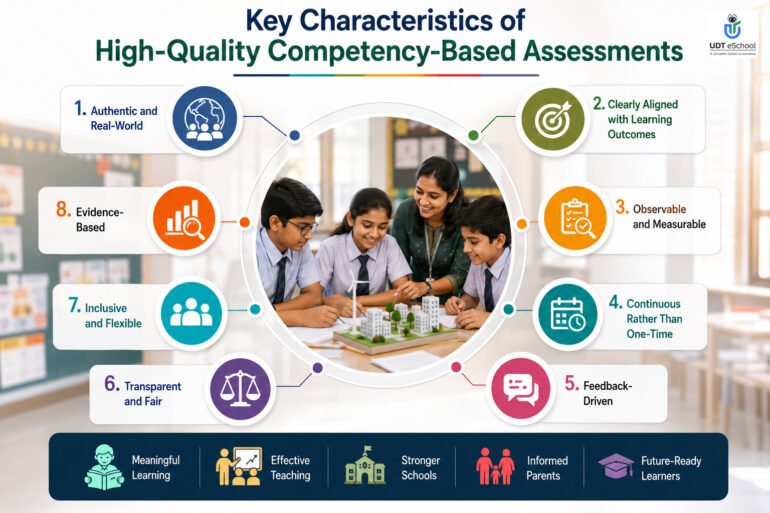
1. Authentic and Real-World
Competency-based assessments should connect learning with situations students are likely to encounter beyond the classroom.
Rather than solving isolated textbook questions, students apply concepts to meaningful problems, analyse real-life scenarios, make decisions, and justify their thinking.
Example:
Instead of asking students to define pollution, a teacher may ask them to:
Identify an environmental issue in their neighbourhood, investigate its causes, propose practical solutions, and present their recommendations to the class.
This single activity simultaneously assesses:
- Critical thinking
- Research skills
- Communication
- Collaboration
- Problem-solving
- Environmental awareness
The learning becomes meaningful because students experience how classroom knowledge applies to everyday life.
2. Clearly Aligned with Learning Outcomes
Every competency-based assessment begins with a clearly defined learning outcome.
Teachers should first ask:
“What should students be able to demonstrate after completing this lesson?”
Only after identifying the expected competency should they design the assessment activity.
For example:
Why it matters: In competency-based assessment, the learning outcome determines the assessment design. Rather than asking students to simply recall information, teachers create authentic tasks that require learners to apply knowledge, demonstrate skills, and communicate their understanding in meaningful contexts.
When assessments align with learning outcomes, both teaching and evaluation become more focused and purposeful.
3. Observable and Measurable
Competencies must be demonstrated through behaviours or products that teachers can observe and evaluate.
For example, “critical thinking” is not assessed by asking students whether they can think critically. Instead, teachers observe how students:
- Analyse information
- Compare alternatives
- Justify conclusions
- Evaluate evidence
- Make reasoned decisions
This makes assessment more objective and evidence-based.
4. Continuous Rather Than One-Time
Competencies develop over time through repeated practice and feedback.
A student’s communication skills, collaboration, or creativity cannot be accurately measured in a single classroom activity.
Instead, teachers gather evidence across multiple learning experiences throughout the academic year.
Examples include:
- Classroom discussions
- Weekly assignments
- Project work
- Practical activities
- Student reflections
- Oral presentations
- Peer reviews
- Teacher observations
Continuous assessment provides a more reliable picture of student growth than isolated examinations.
5. Feedback-Driven
One of the defining characteristics of competency-based assessment is the quality of feedback it provides.
Instead of telling students only whether an answer is right or wrong, teachers explain:
- what was done well
- which competency has been demonstrated
- where improvement is needed
- practical next steps
This transforms assessment into an ongoing learning conversation rather than a judgement.
Students become more confident because they understand how to improve instead of simply seeing marks on a report card.
6. Transparent and Fair
Students should know before the assessment begins how their work will be evaluated.
Clear expectations reduce anxiety and encourage learners to focus on quality rather than guessing what the teacher wants.
Transparent assessments usually include:
- Learning objectives
- Success criteria
- Assessment rubrics
- Examples of high-quality work
- Feedback guidelines
This also promotes consistency when multiple teachers assess similar tasks.
7. Inclusive and Flexible
Every classroom includes learners with different strengths, interests, and learning styles.
Competency-based assessment recognises this diversity by allowing students to demonstrate learning through multiple formats whenever appropriate.
For example, students may communicate their understanding through:
- Written reports
- Oral presentations
- Models
- Posters
- Videos
- Digital portfolios
- Demonstrations
- Infographics
Providing multiple pathways enables schools to assess competencies without limiting students to a single mode of expression.
8. Evidence-Based
High-quality competency-based assessment relies on documented evidence, not assumptions.
Teachers maintain records such as:
- Observation notes
- Assessment rubrics
- Student portfolios
- Project artefacts
- Reflection journals
- Performance checklists
- Digital assessment records
This evidence supports fair grading, meaningful parent communication, and holistic progress reporting.
It also strengthens consistency across classes and academic sessions.
📘 Characteristics of High-Quality Competency-Based Assessment
The Eight Characteristics of Effective Competency-Based Assessment
| Characteristic | Why It Matters |
|---|---|
| Authentic | Connects classroom learning with real-life situations. |
| Outcome-Aligned | Measures clearly defined learning outcomes. |
| Observable | Allows teachers to collect measurable evidence. |
| Continuous | Tracks student growth throughout the academic year. |
| Feedback-Driven | Supports continuous improvement rather than one-time judgement. |
| Transparent | Builds fairness through clear success criteria and rubrics. |
| Inclusive | Provides multiple opportunities for students to demonstrate learning. |
| Evidence-Based | Relies on documented observations and assessment records. |
What Evidence Should Schools Collect?
Competency-based assessment becomes meaningful when schools collect evidence that shows how students demonstrate a competency over time.
Depending on the subject and learning outcome, evidence may include:
- Student work and assignments
- Project outputs
- Practical demonstrations
- Presentations
- Teacher observations
- Rubric-based evaluations
- Student reflections
- Peer feedback
- Portfolios
- Performance tasks
- Written assessments
- Real-world problem-solving activities
The goal is not to collect as much evidence as possible. It is to collect relevant, reliable and meaningful evidence that helps teachers understand student progress.
🚀 Digital Transformation Insight
As schools adopt competency-based assessment across multiple grades and subjects, managing assessment evidence manually becomes increasingly challenging. Digital assessment platforms can streamline rubric-based evaluation, maintain student portfolios, track competency progression over time, and generate holistic reports that support teachers, school leaders, and parents. Technology should simplify assessment workflows while allowing educators to focus on improving learning outcomes rather than administrative tasks.
Practical Competency-Based Assessment Examples Across Different Subjects
Understanding the principles of competency-based assessment is important, but successful implementation depends on translating those principles into everyday classroom practice. Regardless of the subject, effective assessments should encourage students to apply knowledge, think critically, communicate ideas, solve problems, and reflect on their learning rather than simply reproduce memorised information.
The following examples illustrate how teachers can design competency-based assessments across different subjects while aligning with learning outcomes, continuous assessment practices, and holistic student development.
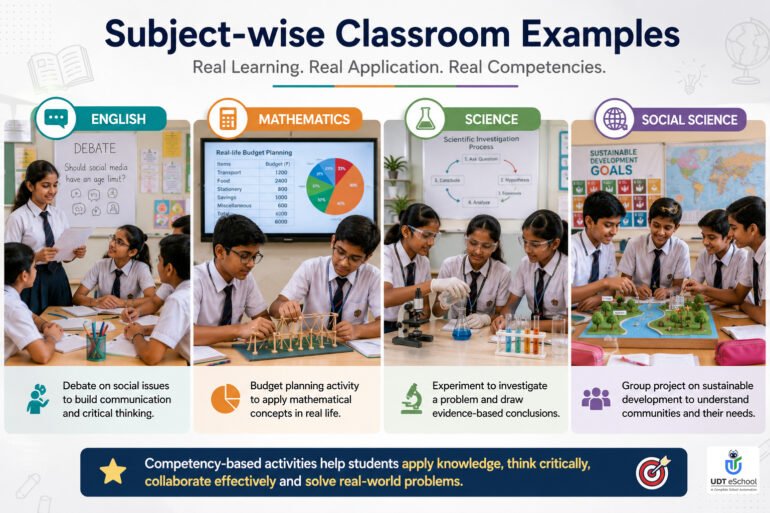
English: Assessing Communication and Critical Thinking
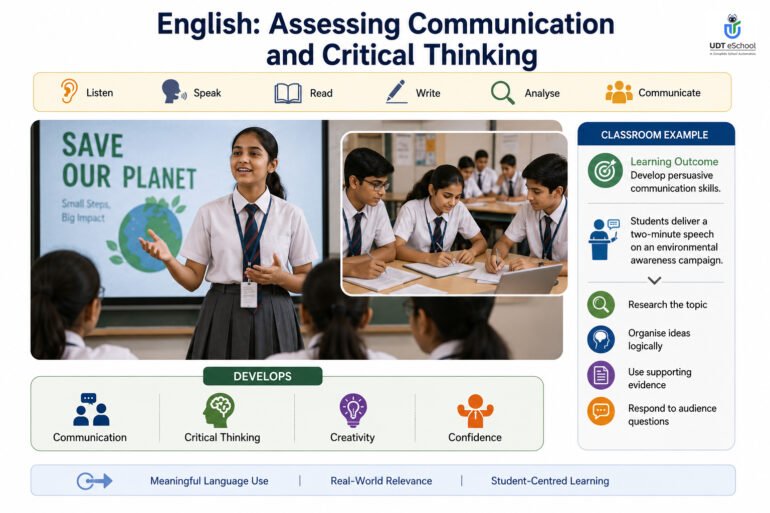
English competency-based assessment extends beyond grammar and textbook comprehension. It focuses on how effectively students listen, speak, read, write, analyse, and communicate ideas in authentic situations.
Instead of asking students to memorise answers, teachers can create opportunities where learners express opinions, interpret information, and communicate with confidence.
Classroom Example
Learning Outcome: Develop persuasive communication skills.
Students prepare and deliver a two-minute speech encouraging classmates to support a local environmental awareness campaign. They research the topic, organise ideas logically, use supporting evidence, and respond to audience questions.
This activity evaluates communication, critical thinking, creativity, and confidence while promoting meaningful language use.
📊 English Competency-Based Assessment Example
| Learning Outcome | Classroom Activity | Competency Assessed | Evidence Collected | Assessment Tool | Teacher Tip |
|---|---|---|---|---|---|
| Persuasive Communication | Deliver a two-minute speech on a community issue. | Communication, reasoning, confidence | Speech, observation notes, peer feedback | Rubric | Assess clarity of ideas rather than memorised content. |
👩🏫 Teacher Tip
Encourage students to maintain a speaking portfolio by recording presentations throughout the academic year. Comparing recordings over time helps both teachers and learners recognise improvements in communication skills.
🚀 Digital Assessment Opportunity
Schools can digitally store presentation rubrics, teacher observations, and student recordings within their assessment management system, creating valuable evidence for holistic progress reporting.
Mathematics: Assessing Problem-Solving and Logical Reasoning
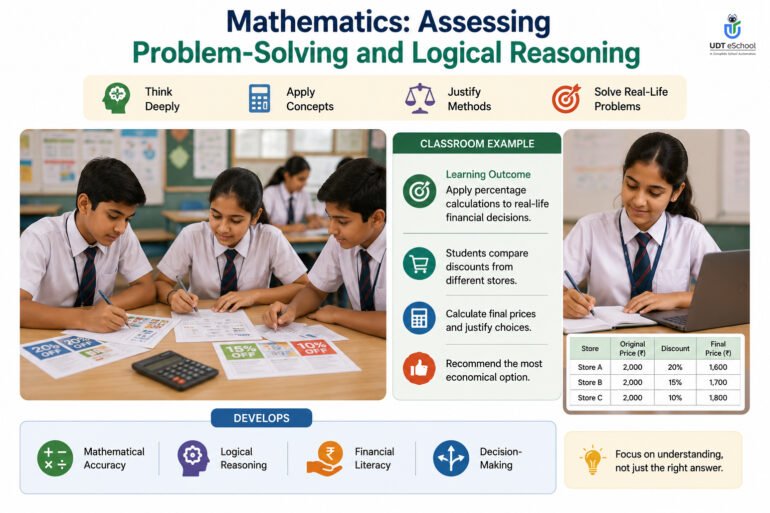
Competency-based mathematics assessment evaluates how students think, not just whether they arrive at the correct answer. Learners should demonstrate reasoning, justify their methods, and apply mathematical concepts to practical situations.
Classroom Example
Learning Outcome: Apply percentage calculations to real-life financial decisions.
Students receive a family shopping budget and compare discounts offered by different stores. They calculate final prices, justify their choices, and recommend the most economical option.
This activity integrates mathematical accuracy with financial literacy and decision-making.
📊 Mathematics Competency-Based Assessment Example
| Learning Outcome | Classroom Activity | Competency Assessed | Evidence Collected | Assessment Tool | Teacher Tip |
|---|---|---|---|---|---|
| Apply percentages in daily life | Compare shopping discounts and recommend the best purchase option. | Problem-solving, reasoning, application | Worksheet, calculations, explanation | Rubric + Observation Checklist | Evaluate the reasoning process, not only the final answer. |
👩🏫 Teacher Tip
Ask students to explain why they selected a particular solution. Oral explanations often reveal conceptual understanding that written calculations alone cannot capture.
🚀 Digital Assessment Opportunity
Digital assessment platforms can record rubric scores for conceptual understanding, reasoning, and application separately, enabling teachers to identify patterns in student learning and provide targeted support.
Building on These Examples
English and Mathematics demonstrate how competency-based assessment transforms everyday classroom activities into meaningful evidence of learning. The same principles apply across all disciplines, although the competencies being assessed naturally differ according to subject objectives.
In the next section, we’ll explore practical competency-based assessment examples for Science and Social Science, focusing on inquiry, investigation, evidence-based reasoning, collaboration, and real-world problem-solving.
Science: Assessing Inquiry, Investigation, and Scientific Thinking
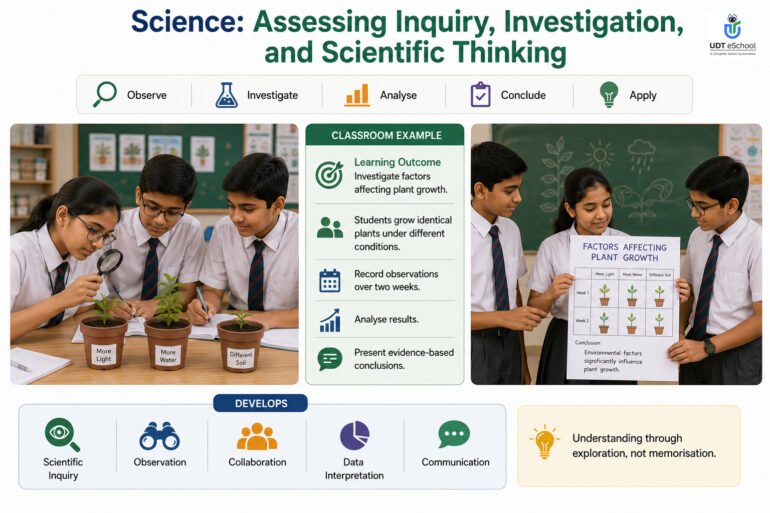
Science competency-based assessment encourages students to observe, investigate, analyse evidence, draw conclusions, and apply scientific concepts to real-world situations. Instead of memorising definitions or formulas, students demonstrate their understanding through experimentation and inquiry-based learning.
Classroom Example
Learning Outcome: Investigate factors affecting plant growth.
Students work in small groups to grow identical plants under different conditions (light, water, or soil type). They record observations over two weeks, analyse the results, and present evidence-based conclusions explaining how environmental factors influence plant growth.
This activity assesses scientific inquiry, observation, collaboration, data interpretation, and communication.
📊 Science Competency-Based Assessment Example
| Learning Outcome | Classroom Activity | Competency Assessed | Evidence Collected | Assessment Tool | Teacher Tip |
|---|---|---|---|---|---|
| Investigate plant growth | Conduct a simple experiment by changing one growth condition and recording observations. | Scientific inquiry, observation, analysis | Observation journal, experiment report, presentation | Rubric + Observation Checklist | Assess investigation skills and conclusions, not just the final result. |
👩🏫 Teacher Tip
Encourage students to maintain a science investigation journal where they record predictions, observations, challenges, and reflections. This provides valuable evidence of learning over time.
🚀 Digital Assessment Opportunity
Schools can maintain digital experiment records, photographs, observation notes, and assessment rubrics to build comprehensive student science portfolios and monitor competency development across the academic year.
Social Science: Assessing Research, Analysis, and Civic Understanding
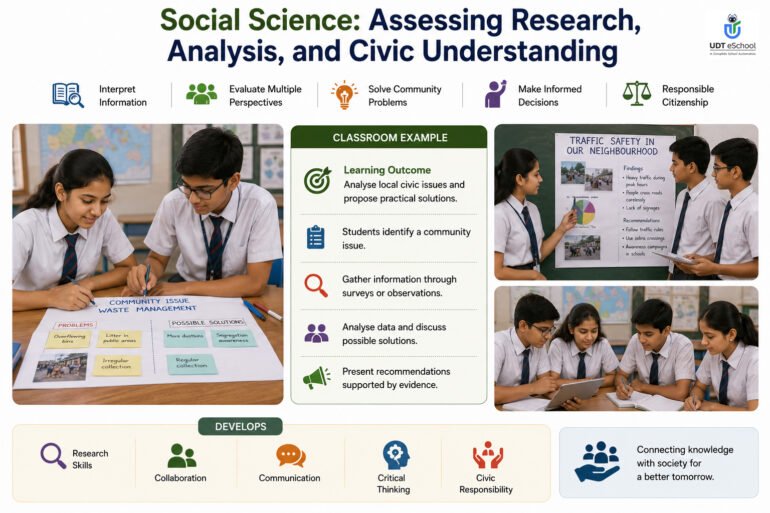
Competency-based assessment in Social Science focuses on students’ ability to interpret information, evaluate multiple perspectives, solve community problems, and make informed decisions. It encourages learners to connect classroom knowledge with society and responsible citizenship.
Classroom Example
Learning Outcome: Analyse local civic issues and propose practical solutions.
Students identify a community issue such as waste management or traffic safety, gather information through surveys or observations, and present recommendations supported by evidence.
This activity develops research skills, collaboration, communication, critical thinking, and civic responsibility.
📊 Social Science Competency-Based Assessment Example
| Learning Outcome | Classroom Activity | Competency Assessed | Evidence Collected | Assessment Tool | Teacher Tip |
|---|---|---|---|---|---|
| Analyse a local civic issue | Research a community problem and present practical recommendations. | Research, collaboration, critical thinking | Project report, presentation, peer feedback | Project Rubric | Reward evidence-based reasoning rather than memorised facts. |
👩🏫 Teacher Tip
Encourage students to support their recommendations with reliable data, local observations, or government reports. This strengthens analytical thinking and evidence-based decision-making.
🚀 Digital Assessment Opportunity
Digital portfolios can combine project reports, presentations, teacher feedback, and student reflections, giving parents and school leaders a holistic view of competency development beyond examination marks.
How to Create a Competency-Based Assessment Task
A strong competency-based task begins with the competency or learning outcome—not with the activity itself.
Schools can use this five-step process:
1. Identify the learning outcome
Define what students should be able to demonstrate.
2. Identify the competency
Determine the skill or capability being assessed, such as problem-solving, communication, analysis, collaboration or application.
3. Design an authentic task
Create a task that requires students to use their learning rather than simply recall information.
4. Define the evidence
Decide what students will produce or demonstrate and what the teacher will observe.
5. Establish assessment criteria
Use clear success criteria or rubrics so students and teachers understand what quality performance looks like.
Teacher Tip: Start with the question “What should the student be able to demonstrate?” and work backwards to the activity. This prevents schools from confusing activity-based learning with genuine competency-based assessment.
This is a high-value practical section and also targets long-tail searches around how to create competency-based assessments.
💡 Expert Insight
Although classroom activities vary across subjects, the goal of competency-based assessment remains the same: to collect authentic evidence of what students know, understand, and can apply. Effective assessments focus on the learning process, encourage meaningful feedback, and provide multiple opportunities for students to demonstrate growth throughout the academic year.
How Schools Can Successfully Implement Competency-Based Assessment
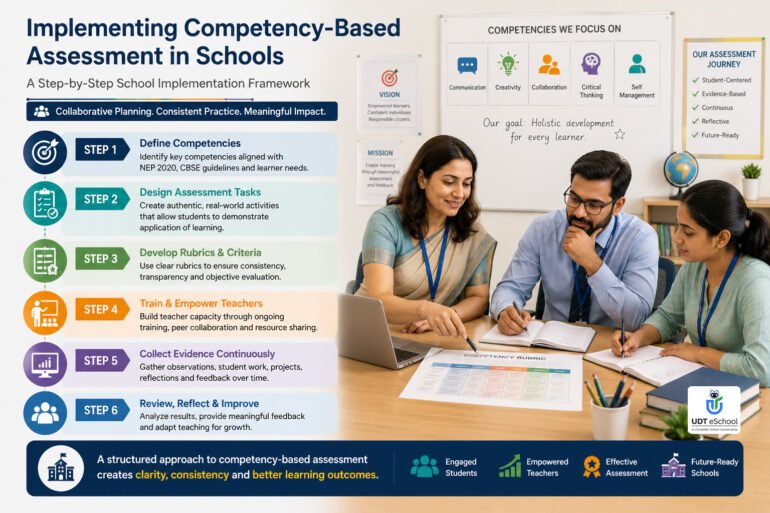
Understanding competency-based assessment is only the first step. The real transformation begins when schools integrate it into everyday teaching, assessment, reporting, and decision-making.
Successful implementation is not about replacing examinations overnight. Instead, it involves gradually embedding competency-focused practices into classroom instruction while ensuring alignment with CBSE guidelines, NEP 2020, and the vision of PARAKH.
Schools that adopt a structured implementation approach often experience improved student engagement, richer classroom discussions, and more meaningful assessment data to support academic planning.
A Practical Five-Step Implementation Framework
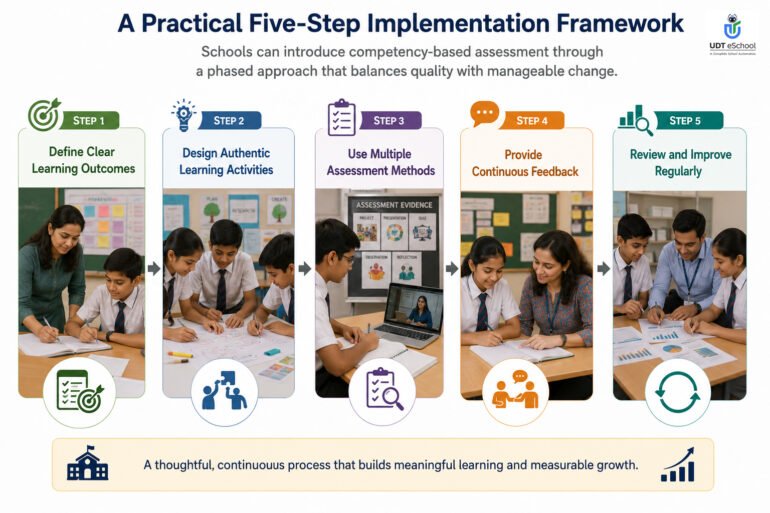
Schools can introduce competency-based assessment through a phased approach that balances educational quality with manageable change.
Step 1: Define Clear Learning Outcomes
Every lesson should begin by identifying what students should know, understand, and be able to do by the end of the learning experience.
Clearly defined outcomes help teachers design meaningful assessment activities instead of relying solely on textbook questions.
Step 2: Design Authentic Learning Activities
Create classroom experiences that encourage students to apply knowledge rather than memorise information.
Examples include:
- Project-based learning
- Group investigations
- Presentations
- Case studies
- Experiments
- Role plays
- Real-world problem-solving tasks
The objective is to observe how students apply their learning in meaningful contexts.
Step 3: Use Multiple Assessment Methods
A single examination rarely captures every competency.
Schools should combine various assessment approaches, such as:
- Classroom observation
- Oral presentations
- Practical activities
- Portfolios
- Peer assessment
- Self-assessment
- Quizzes
- Written assignments
Using multiple sources of evidence creates a more comprehensive picture of student progress.
Step 4: Provide Continuous Feedback
Feedback should be timely, specific, and actionable.
Instead of simply awarding marks, teachers can explain:
- What the student has done well.
- Which competency has been demonstrated.
- Areas requiring improvement.
- Practical suggestions for future learning.
Continuous feedback helps students view assessment as part of the learning process rather than a final judgment.
Step 5: Review and Improve Regularly
Competency-based assessment should evolve through regular reflection.
School leaders can periodically review:
- Assessment quality
- Student engagement
- Teacher experiences
- Parent feedback
- Competency progression
These reviews help schools refine assessment practices while maintaining consistency across grades and subjects.
📋 Implementation Checklist
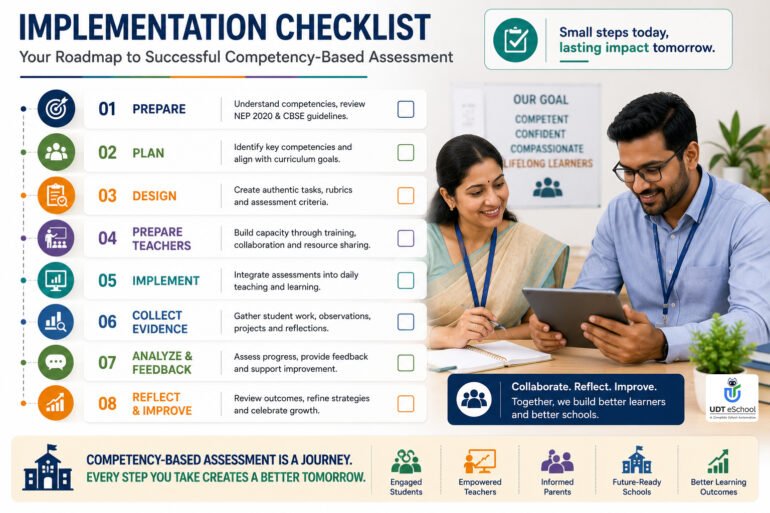
- ✔ Define competency-based learning outcomes.
- ✔ Design authentic classroom activities.
- ✔ Use assessment rubrics consistently.
- ✔ Collect evidence from multiple learning experiences.
- ✔ Provide timely and constructive feedback.
- ✔ Maintain student portfolios.
- ✔ Review assessment practices regularly.
- ✔ Engage parents in understanding competency development.
Common Challenges Schools Face—and Practical Solutions
Implementing competency-based assessment often brings questions and challenges. With proper planning and collaboration, these challenges can become opportunities for continuous improvement.
Why it matters: Every school faces implementation challenges during educational change. Identifying these challenges early and adopting practical, collaborative solutions helps create a smoother transition to competency-based assessment while ensuring consistency, fairness, and improved learning outcomes for every student.
💡 School Leadership Insight
Successful implementation depends not only on classroom practices but also on school-wide collaboration. Principals, academic coordinators, and teachers should establish common assessment expectations, provide regular mentoring, and review assessment quality to ensure consistency across grades and subjects.
The Role of Digital Transformation in Competency-Based Assessment
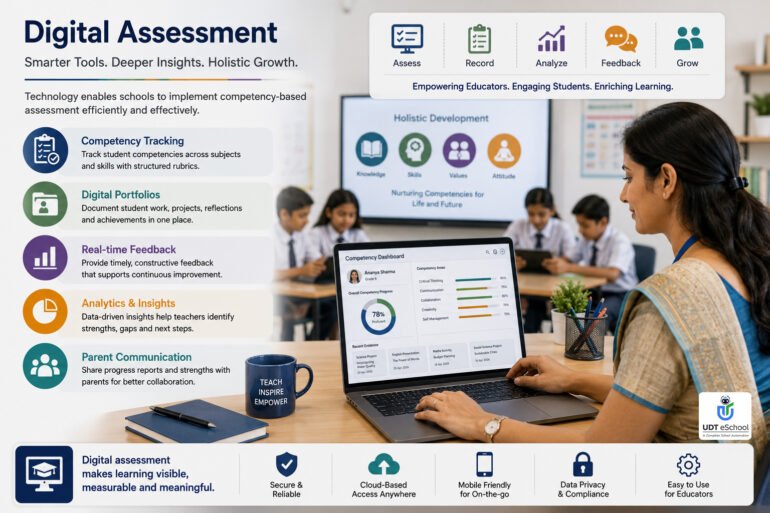
As competency-based assessment expands across classrooms, manually managing assessment records, feedback, and student portfolios can become increasingly complex.
Digital assessment platforms help schools:
- Record competency-wise performance.
- Store assessment rubrics and evidence.
- Generate holistic progress reports.
- Track student growth over time.
- Share meaningful feedback with parents.
- Reduce administrative workload.
- Support data-driven academic planning.
This is where an integrated School ERP can act as an enabler rather than simply a record-keeping system.
For example, assessment management modules in platforms such as UDT eSchool can help schools organise competency evidence, monitor learning progress, and simplify reporting while allowing educators to spend more time supporting student learning.
Technology does not make an assessment competency-based; the learning outcome, task design, evidence and assessment criteria do. Digital tools simply make it easier for schools to record, organise, analyse and communicate that evidence at scale.
🚀 Digital Transformation Insight
Technology should support educators—not replace them. Digital assessment systems simplify evidence collection, automate reporting, and provide actionable insights into student competency development, enabling teachers and school leaders to focus on improving learning outcomes.
Competency-Based Assessment: Perspectives from the School Community
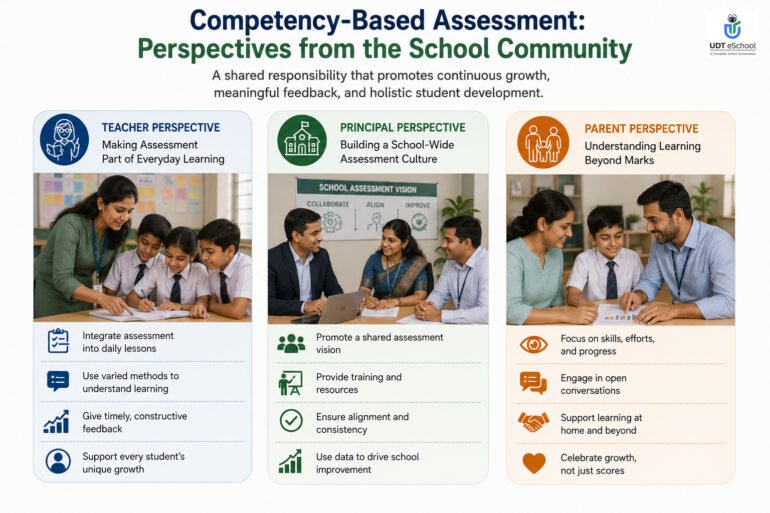
Competency-based assessment delivers the greatest impact when it becomes a shared responsibility rather than a classroom initiative. Teachers, school leaders, parents, and administrators each play a distinct role in creating an assessment culture that values continuous growth, meaningful feedback, and holistic student development.
Understanding these perspectives helps schools implement competency-based assessment more effectively while ensuring alignment with the learner-centred vision of NEP 2020, CBSE, and PARAKH.
👩🏫 Teacher Perspective: Making Assessment Part of Everyday Learning
For teachers, competency-based assessment represents a shift from evaluating only final answers to observing how students think, apply concepts, collaborate, and improve over time.
This approach encourages teachers to:
- Design authentic learning experiences.
- Use clear assessment rubrics.
- Observe classroom participation.
- Provide timely, constructive feedback.
- Collect evidence from multiple learning activities.
Although the transition may initially require additional planning, many educators find that competency-based assessment provides a deeper understanding of student learning than traditional examinations alone.
👩🏫 Teacher Tip
Instead of creating separate assessment activities every week, integrate competency assessment into regular classroom lessons. Everyday discussions, projects, presentations, and practical tasks often provide valuable evidence of student learning with minimal additional workload.
🏫 Principal Perspective: Building a School-Wide Assessment Culture
For school leaders, competency-based assessment is not simply an instructional change—it is an organisational transformation.
Principals play a key role in:
- Establishing common assessment expectations.
- Supporting teacher professional development.
- Encouraging collaborative lesson planning.
- Reviewing assessment quality across departments.
- Communicating assessment reforms to parents.
- Monitoring implementation through academic reviews.
When leadership provides consistent guidance and resources, teachers are more confident in adopting competency-based practices.
👨👩👧👦 Parent Perspective: Understanding Learning Beyond Marks
Parents often associate academic success with examination scores. Competency-based assessment expands this understanding by highlighting the broader skills students develop throughout the learning process.
Through meaningful feedback and holistic progress reporting, parents gain insights into competencies such as:
- Critical thinking
- Communication
- Creativity
- Collaboration
- Problem-solving
- Responsibility
- Self-management
Regular communication between schools and families helps parents appreciate that these competencies contribute significantly to long-term academic and personal success.
📌 Parent Engagement Insight
Schools can strengthen parent confidence by sharing assessment rubrics, competency descriptors, and examples of student work during parent-teacher meetings. When parents understand how competencies are assessed, conversations shift from “How many marks did my child score?” to “How is my child progressing as a learner?”
School ERP Integration: Supporting Competency-Based Assessment Through Technology
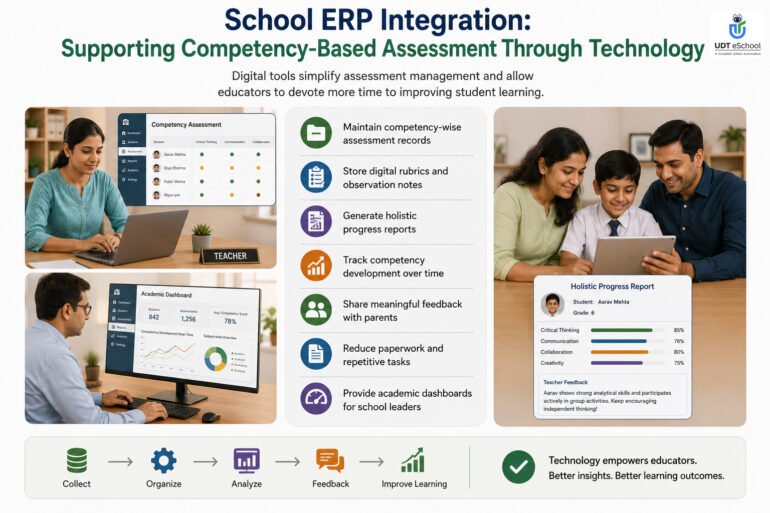
Implementing competency-based assessment across a school becomes increasingly complex as the volume of assessment evidence grows. Teachers may be working with rubrics, observations, projects, portfolios, feedback records and competency indicators across multiple classes.
A school ERP can help organise this information into a structured digital workflow. The purpose is not to automate teacher judgement, but to reduce repetitive administrative work and make assessment evidence easier to maintain, review and communicate.
As schools adopt competency-based assessment across multiple grades and subjects, managing assessment records manually becomes increasingly complex.
A modern School ERP can support implementation by helping schools:
- Maintain competency-wise assessment records.
- Store digital rubrics and observation notes.
- Generate holistic progress reports.
- Track competency development over time.
- Share meaningful feedback with parents.
- Reduce paperwork and repetitive administrative tasks.
- Provide academic dashboards for school leaders.
Rather than replacing teachers, digital tools simplify assessment management and allow educators to devote more time to improving student learning.
🚀 Digital Transformation Insight
Schools implementing competency-based assessment often manage thousands of observations, rubrics, projects, and feedback records throughout the academic year. Digital assessment management helps organise this information, improve reporting accuracy, and provide school leaders with meaningful academic insights.
Preparing Schools for the Future with Competency-Based Assessment
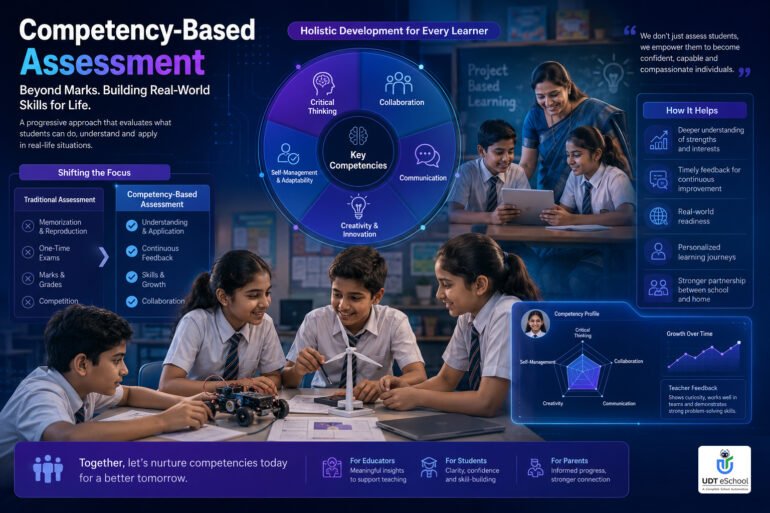
Competency-based assessment represents a meaningful shift from measuring what students remember to understanding what they can actually do with their learning. By focusing on application, critical thinking, collaboration, and continuous improvement, schools create richer learning experiences that prepare students for future academic, professional, and personal success.
Successful implementation does not require abandoning traditional assessments overnight. Instead, it involves gradually integrating authentic learning experiences, clear assessment criteria, meaningful feedback, and continuous reflection into everyday classroom practice.
Aligned with the vision of NEP 2020, CBSE, and PARAKH, competency-based assessment enables schools to move beyond marks and support the holistic development of every learner.
How Schools Can Begin Their Competency-Based Assessment Journey
🎯 Moving Towards Competency-Based Assessment?
Implementing competency-based assessment becomes easier when schools combine strong educational practices with effective digital systems. From assessment planning and competency tracking to holistic progress reporting and parent communication, a structured approach helps educators focus more on student learning and less on administrative complexity.
Explore practical strategies, collaborate with your teaching teams, and adopt digital solutions that support long-term educational improvement while remaining aligned with CBSE and NEP 2020 expectations.
📞 See How UDT eSchool Supports Competency-Based Assessment
UDT eSchool helps schools simplify assessment management through digital rubrics, competency tracking, holistic progress reporting, academic dashboards, and parent communication tools—enabling educators to focus on meaningful learning rather than paperwork.
Competency-Based Assessment Examples FAQs
Q. What are competency-based assessment examples?
A. Competency-based assessment examples are classroom activities that evaluate how well students apply their knowledge, skills, and understanding in real-world situations. Examples include science experiments, project-based learning, presentations, debates, case studies, portfolios, role plays, and collaborative problem-solving tasks rather than relying solely on traditional written examinations.
Q. How is competency-based assessment different from traditional assessment?
A. Traditional assessment primarily measures how much students remember through examinations and tests. Competency-based assessment evaluates how effectively students can apply concepts, think critically, communicate, collaborate, and solve real-life problems using multiple forms of evidence collected throughout the learning process.
Q. Why is competency-based assessment important in CBSE schools?
A. CBSE promotes competency-based assessment to encourage conceptual understanding, higher-order thinking, and application-based learning. It supports the objectives of NEP 2020 by helping schools move beyond rote memorisation and focus on holistic student development.
Q. What are some examples of competency-based assessment in Mathematics?
A. Mathematics competency-based assessment may include budgeting activities, analysing data using graphs, measuring classroom objects, solving real-life mathematical problems, or designing projects that require logical reasoning and mathematical application.
Q. How do teachers assess competencies in the classroom?
A. Teachers assess competencies through classroom observations, projects, presentations, practical activities, group discussions, portfolios, quizzes, self-assessment, peer assessment, and structured rubrics that measure both the learning process and the final outcome.
Q. How does competency-based assessment benefit students?
A. It helps students develop critical thinking, creativity, communication, collaboration, problem-solving, and self-reflection. Continuous feedback also encourages improvement and builds confidence by recognising learning as an ongoing process rather than a single examination result.
Q. Can competency-based assessment replace traditional examinations?
A. Competency-based assessment is designed to complement rather than completely replace traditional examinations. Schools often use a balanced approach that combines written assessments with practical activities, projects, and continuous evaluation to provide a more comprehensive picture of student learning.
Q. How can School ERP software support competency-based assessment?
A. School ERP software helps educators manage assessment rubrics, maintain digital portfolios, record competency-wise observations, generate holistic progress reports, and share timely feedback with parents, making competency-based assessment more efficient and consistent across the school.
Q. What Is the Difference Between Competency-Based Assessment and Activity-Based Learning?
A. Activity-based learning involves students learning through activities and experiences. Competency-based assessment goes one step further by intentionally using a task to collect evidence of whether a defined competency or learning outcome has been demonstrated.
Q. What Are the Main Competencies Schools Can Assess?
A. Depending on the learning context, schools can assess competencies such as communication, critical thinking, problem-solving, collaboration, creativity, application of knowledge, analysis, decision-making and reflection. The specific competencies should be linked to the relevant curriculum and learning outcomes.
Related Questions Schools Often Ask
Q. What competencies should schools assess besides academic knowledge?
A. Schools should assess competencies such as critical thinking, creativity, communication, collaboration, problem-solving, digital literacy, ethical decision-making, leadership, adaptability, and self-management. These skills prepare students for higher education, future careers, and responsible citizenship.
Q. How often should competency-based assessments be conducted?
A. Competency-based assessment is most effective when integrated into everyday classroom learning. Instead of being limited to term-end examinations, evidence can be collected continuously through activities, observations, projects, discussions, and practical tasks throughout the academic year.
Q. What role do assessment rubrics play in competency-based assessment?
A. Assessment rubrics provide transparent evaluation criteria by describing different levels of student performance. They help teachers assess consistently, support constructive feedback, and enable students to understand expectations and identify areas for improvement.
Q. How can parents support competency development at home?
A. Parents can encourage curiosity, reading, problem-solving, communication, and independent decision-making through everyday conversations, household responsibilities, educational games, and project-based activities while focusing on learning rather than only examination marks.
Q. Is competency-based assessment suitable for all subjects?
A. Yes. Competency-based assessment can be adapted for every subject by designing activities that encourage students to apply their learning. Whether in languages, mathematics, science, social science, or arts, the focus remains on demonstrating understanding through meaningful tasks.
Q. What challenges do schools face when implementing competency-based assessment?
A. Common challenges include teacher preparedness, parent awareness, consistent assessment practices, documentation, and managing assessment data. These challenges can be addressed through professional development, clear assessment frameworks, and digital assessment management tools.
Q. How does competency-based assessment align with NEP 2020?
A. NEP 2020 encourages learner-centred education, experiential learning, critical thinking, and holistic development. Competency-based assessment directly supports these objectives by evaluating students’ ability to apply knowledge and develop essential life skills.
Q. How can school leaders ensure consistent competency-based assessment across classrooms?
A. School leaders can establish common assessment policies, standardised rubrics, moderation meetings, teacher training programmes, periodic reviews, and digital assessment systems to maintain consistency and fairness across grades and subjects.
Official Resources and References
For schools implementing competency-based assessment, the following official resources provide useful policy and assessment context:
- CBSE — curriculum, academic and assessment-related resources
- PARAKH, NCERT — assessment frameworks and competency-based assessment resources
- National Education Policy 2020 — broader education and assessment reform framework
- Ministry of Education — national policy and assessment-related updates

UDT eSchool Editorial Team
The UDT eSchool Editorial Team consists of education technology specialists, school leadership advisors, curriculum experts, and content strategists dedicated to helping schools navigate educational transformation. Our articles are developed through careful study of CBSE guidelines, NEP 2020 recommendations, PARAKH initiatives, and emerging best practices in school leadership, assessment, and digital transformation.
Our mission is to provide practical, research-informed guidance that supports principals, teachers, school administrators, and parents in creating future-ready learning environments. Every article combines educational expertise with real-world implementation strategies to help schools strengthen academic excellence, improve operational efficiency, and enhance student outcomes through thoughtful use of technology and innovative school management practices.
Areas of Expertise: CBSE Reforms • NEP 2020 • PARAKH • Competency-Based Assessment • Holistic Progress Cards • School Leadership • Parent Engagement • School ERP • AI in Education • Digital Transformation • Assessment Management

Education Technology Consultant at UDt eSchool with 10+ years of experience helping schools digitize operations and implement CBSE-aligned systems.