Ultimate School ERP Software Guide 2026 for Smart Schools
Schools today manage a wide range of academic and administrative activities every day. From student admissions and attendance tracking to examinations, fee management, and communication with parents, handling everything manually can quickly become inefficient.
This is where School ERP Software becomes essential.
A School ERP system integrates all school operations into a centralized digital platform. It helps administrators, teachers, students, and parents stay connected while automating routine administrative tasks.
With the rapid digital transformation in education, ERP platforms are becoming a critical part of modern school management.
A powerful School ERP Software helps institutions:
-
Automate administrative processes
-
Improve communication between teachers and parents
-
Manage student records efficiently
-
Streamline fee and financial management
-
Monitor academic performance through analytics
Modern ERP platforms like UDT eSchool are designed to help schools simplify operations while improving transparency and efficiency.
What is School ERP Software?
School ERP Software is an integrated school management system that helps educational institutions manage academic and administrative operations through a single digital platform.
Instead of managing different tasks through manual records or multiple software tools, ERP systems combine everything into one centralized system.
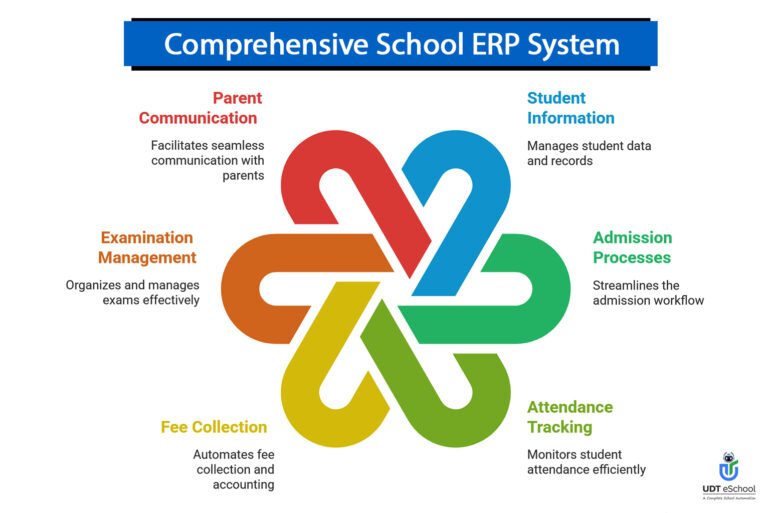
A typical ERP platform can manage:
-
Student information and records
-
Admission processes
-
Attendance tracking
-
Fee collection and accounting
-
Examination management
-
Parent communication
By digitizing these processes, schools reduce paperwork and improve operational efficiency.
Why Schools Need ERP Software in 2026
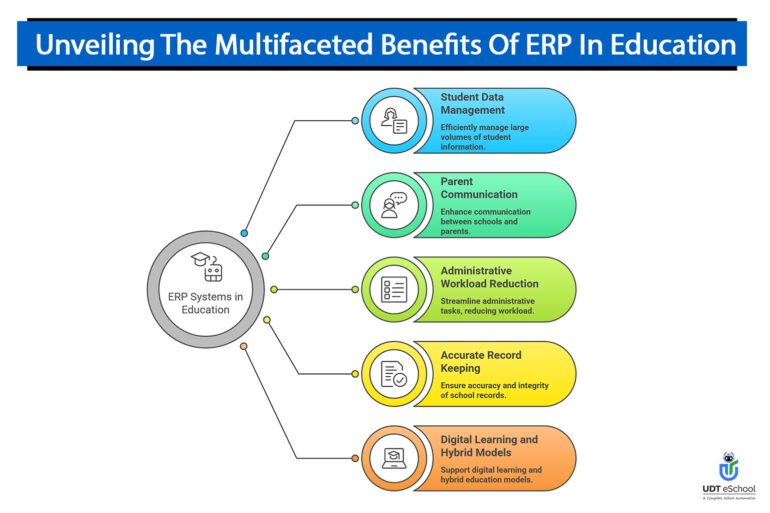
Education systems are evolving rapidly, and schools must adopt digital solutions to remain efficient and competitive.
Modern schools require ERP systems to:
-
Handle large volumes of student data
-
Improve parent communication
-
Reduce administrative workload
-
Maintain accurate records
-
Enable digital learning and hybrid education models
The push toward digital education is also supported by initiatives like the National Education Policy (NEP) 2020, which emphasizes technology integration in education.
Learn more at: https://www.education.gov.in/
A modern School ERP Software enables schools to operate efficiently while providing real-time access to information for administrators, teachers, and parents.
Key Features of School ERP Software
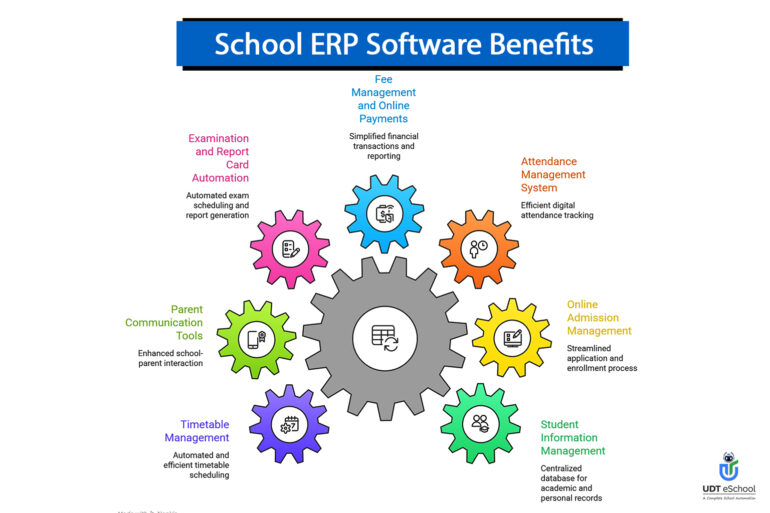
1. Student Information Management
A centralized student database allows schools to store academic records, personal details, attendance history, and communication data securely.
This ensures quick access to accurate student information.
2. Online Admission Management
ERP platforms streamline the admission process by allowing schools to manage:
-
Online application forms
-
Document uploads
-
Application tracking
-
Admission reports
This reduces manual workload and simplifies enrollment.
3. Attendance Management System
Digital attendance tracking helps teachers record attendance efficiently and maintain accurate records.
Many ERP platforms allow attendance entry through mobile devices or biometric integrations.
👉 Learn more about digital attendance systems here:
https://udteschool.com/attendance-management-system-for-schools/
4. Fee Management and Online Payments
ERP systems simplify school finance management by enabling:
-
Online fee payments
-
Automated reminders
-
Digital receipts
-
Financial reporting
This improves financial transparency and efficiency.
5. Examination and Report Card Automation
Examination management modules allow schools to generate exam schedules, record marks digitally, and create automated report cards.
These systems also help track student performance through analytics.
6. Parent Communication Tools
Effective communication between schools and parents is essential.
ERP platforms offer communication tools such as:
-
Mobile apps for parents
-
SMS and email notifications
-
Homework updates
-
School announcements
7. Timetable Management
Creating school timetables manually can be complex. ERP systems automate timetable scheduling and help manage teacher workloads efficiently.
Benefits of School ERP Software
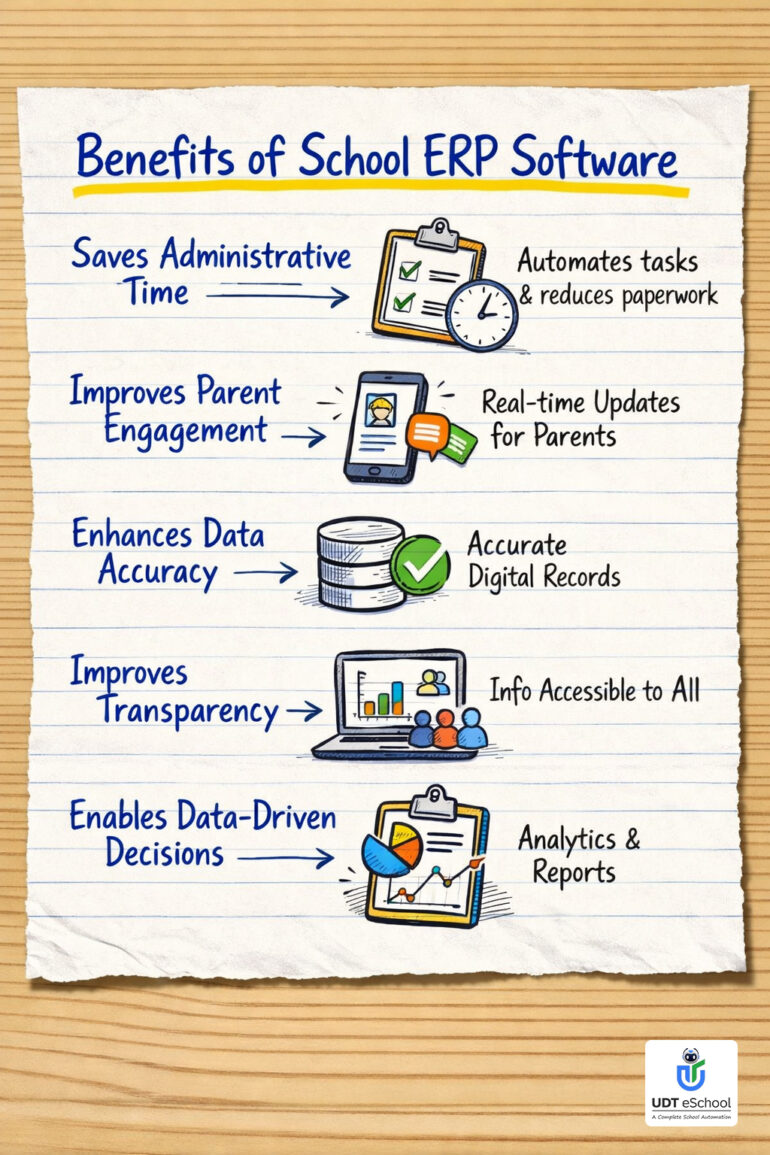
1. Saves Administrative Time
Automation eliminates repetitive administrative tasks and reduces paperwork.
2. Improves Parent Engagement
Parents receive real-time updates regarding attendance, homework, and academic performance.
3. Enhances Data Accuracy
Centralized digital systems minimize the chances of human errors in data entry and reporting.
4. Improves Transparency
All stakeholders can access relevant information instantly through the ERP platform.
5. Enables Data-Driven Decisions
ERP analytics tools allow school administrators to monitor academic trends and institutional performance.
School ERP Software vs Traditional School Management
| Feature | Traditional School Management | School ERP Software |
|---|---|---|
| Student Records | Paper files or spreadsheets | Centralized digital database |
| Attendance | Manual registers | Automated attendance tracking |
| Fee Management | Manual receipts and records | Online payment system with automated reports |
| Parent Communication | Phone calls and notices | Mobile apps, SMS, and instant notifications |
| Examination Results | Manual result preparation | Automated report cards and analytics |
| Data Access | Limited office access | Cloud-based access anytime |
| Reporting | Manual reports | Real-time dashboards and analytics |
This comparison highlights how School ERP Software helps schools replace manual administrative processes with a centralized digital management system.
Platforms like UDT eSchool help schools transition from manual systems to fully digital school management.
Top 10 School ERP Software Features Every School Must Have in 2026
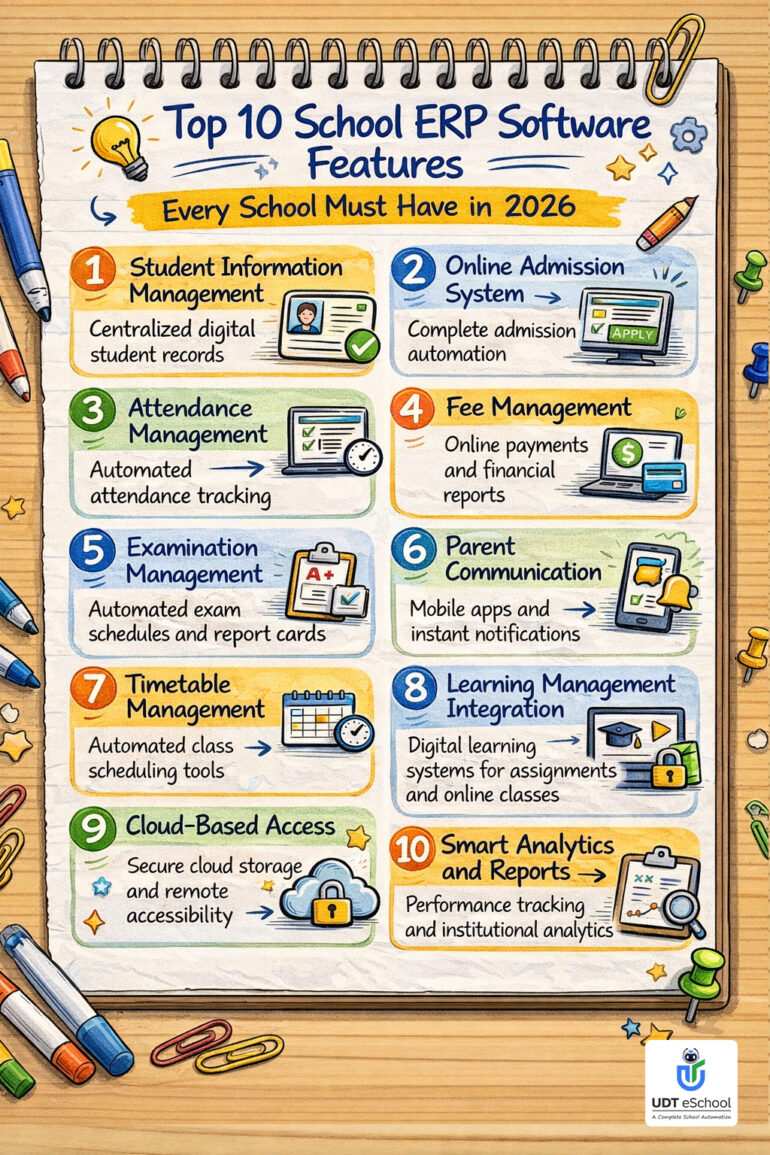
1. Student Information Management
Centralized digital student records.
2. Online Admission System
Complete admission automation.
3. Attendance Management
Automated attendance tracking.
4. Fee Management
Online payments and financial reports.
5. Examination Management
Automated exam schedules and report cards.
6. Parent Communication
Mobile apps and instant notifications.
7. Timetable Management
Automated class scheduling tools.
8. Learning Management Integration
Digital learning systems for assignments and online classes.
Learn about digital education trends here:
https://udteschool.com/ai-in-education-2026/
9. Cloud-Based Access
Secure cloud storage and remote accessibility.
10. Smart Analytics and Reports
Performance tracking and institutional analytics.
Step-by-Step Guide to Implement School ERP Software
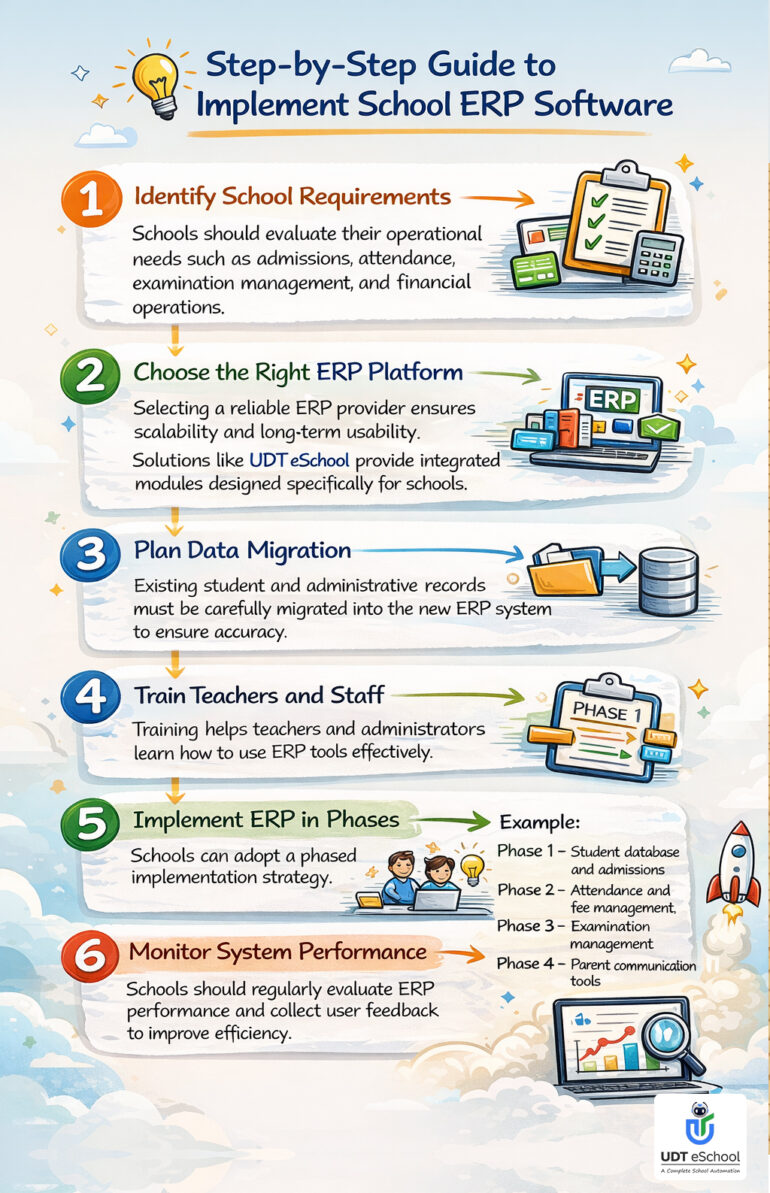
Step 1 Identify School Requirements
Schools should evaluate their operational needs such as admissions, attendance, examination management, and financial operations.
Step 2 Choose the Right ERP Platform
Selecting a reliable ERP provider ensures scalability and long-term usability.
Solutions like UDT eSchool provide integrated modules designed specifically for schools.
Step 3 Plan Data Migration
Existing student and administrative records must be carefully migrated into the new ERP system to ensure accuracy.
Step 4 Train Teachers and Staff
Training helps teachers and administrators learn how to use ERP tools effectively.
Step 5 Implement ERP in Phases
Schools can adopt a phased implementation strategy.
Example:
Phase 1 – Student database and admissions
Phase 2 – Attendance and fee management
Phase 3 – Examination management
Phase 4 – Parent communication tools
Step 6 Monitor System Performance
Schools should regularly evaluate ERP performance and collect user feedback to improve efficiency.
Why UDT eSchool is a Smart School ERP Solution
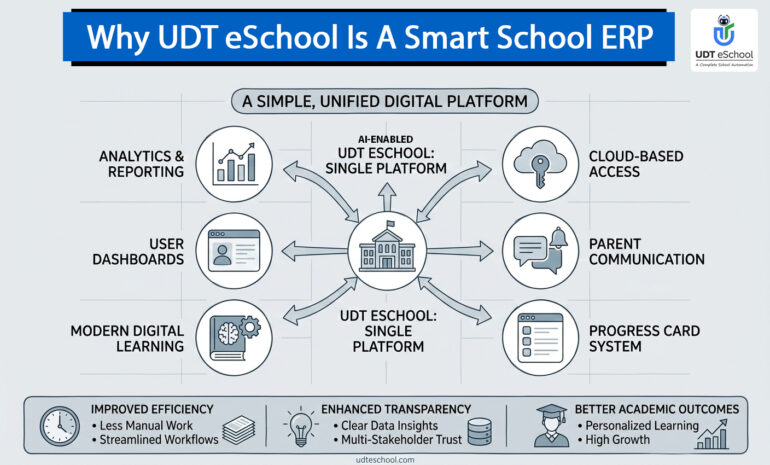
While many ERP platforms exist, schools require solutions that are powerful yet simple to use.
UDT eSchool provides a comprehensive digital platform designed specifically for educational institutions.
Key advantages include:
-
Complete school automation
-
User-friendly dashboards
-
Cloud-based access
-
Real-time parent communication
-
Smart analytics and reporting
It also integrates modern digital learning features aligned with tools like Holistic Progress Card systems used in modern education frameworks:
https://udteschool.com/holistic-progress-card-with-ai/
By combining multiple school management modules into a single platform, UDT eSchool helps schools improve efficiency, transparency, and academic outcomes.
Ready to Transform Your School with ERP?
If your institution is planning to modernize administrative and academic operations, adopting a reliable School ERP Software is a critical step.
Modern solutions like UDT eSchool help schools automate operations, improve communication, and enhance educational management through powerful digital tools.
Implementing an ERP system today can help schools build a smarter and more efficient educational ecosystem.
People Also Ask About School ERP Software
What is School ERP Software?
School ERP software is a digital platform that automates school operations such as admissions, attendance, examinations, fee management, and communication between parents and teachers.
Why do schools need ERP software?
ERP systems streamline administrative processes, reduce paperwork, improve data accuracy, and enhance communication among stakeholders.
What features should School ERP Software have?
A modern ERP system should include attendance management, fee management, examination modules, communication tools, and cloud access.
How does ERP help teachers?
Teachers can track attendance, manage assignments, evaluate performance, and communicate with parents through one centralized platform.
Is School ERP cloud based?
Most modern ERP platforms are cloud-based, allowing secure access to school data from anywhere.
What are the benefits of ERP for parents?
Parents receive real-time updates about attendance, homework, exam results, and school announcements.
Can small schools use ERP software?
Yes. Many ERP solutions offer scalable modules suitable for small schools and large institutions.
What is the difference between School ERP and School Management Software?
ERP integrates all departments of a school into one system, while basic school management software may only handle limited tasks.
Which is the best School ERP software?
The best ERP software offers comprehensive modules, security, and ease of use. Platforms like UDT eSchool provide integrated solutions for modern schools.
Conclusion
School ERP Software has become a key technology for modern educational institutions.
By automating administrative operations, improving communication, and enabling data-driven decisions, ERP systems allow schools to function more efficiently.
Solutions like UDT eSchool empower schools to embrace digital transformation and create a more connected and transparent learning environment.
Frequently Asked Questions About School ERP Software
What is School ERP Software?
School ERP software is a digital platform that helps schools manage admissions, attendance, examinations, fee management, and communication through a centralized system.
Why do schools need ERP software?
ERP systems help schools automate administrative processes, reduce paperwork, improve record management, and enhance communication between teachers and parents.
What are the main modules in School ERP Software?
Common ERP modules include student information management, admission management, attendance tracking, fee management, examination systems, timetable management, and communication tools.
How does ERP help teachers?
Teachers can record attendance, track student performance, manage assignments, and communicate with parents through a single digital platform.
Is School ERP cloud based?
Most modern ERP systems are cloud-based, allowing secure access to school data from anywhere.
Can small schools use School ERP Software?
Yes, ERP systems are scalable and can be used by both small schools and large educational institutions.
What are the benefits of ERP for parents?
Parents receive real-time updates about attendance, homework, examination results, and school announcements.
How secure is School ERP Software?
Modern ERP platforms use encrypted data storage, cloud security, and role-based access to protect school data.
What is the difference between ERP and school management software?
ERP integrates all departments into one platform, while basic school management software may only handle limited tasks.
Why choose UDT eSchool for School ERP?
UDT eSchool offers a comprehensive ERP platform with integrated modules for admissions, attendance, examinations, communication, and data analytics.
🚀 Upgrade Your School’s Assessment System Today
The future of student evaluation lies in data-driven, holistic assessment models aligned with NEP 2020 and PARAKH guidelines.
Schools that adopt smart assessment systems today will be better prepared for the next generation of education standards.
✅ AI-enabled progress tracking
✅ NEP-aligned holistic report cards
✅ Easy teacher & admin management