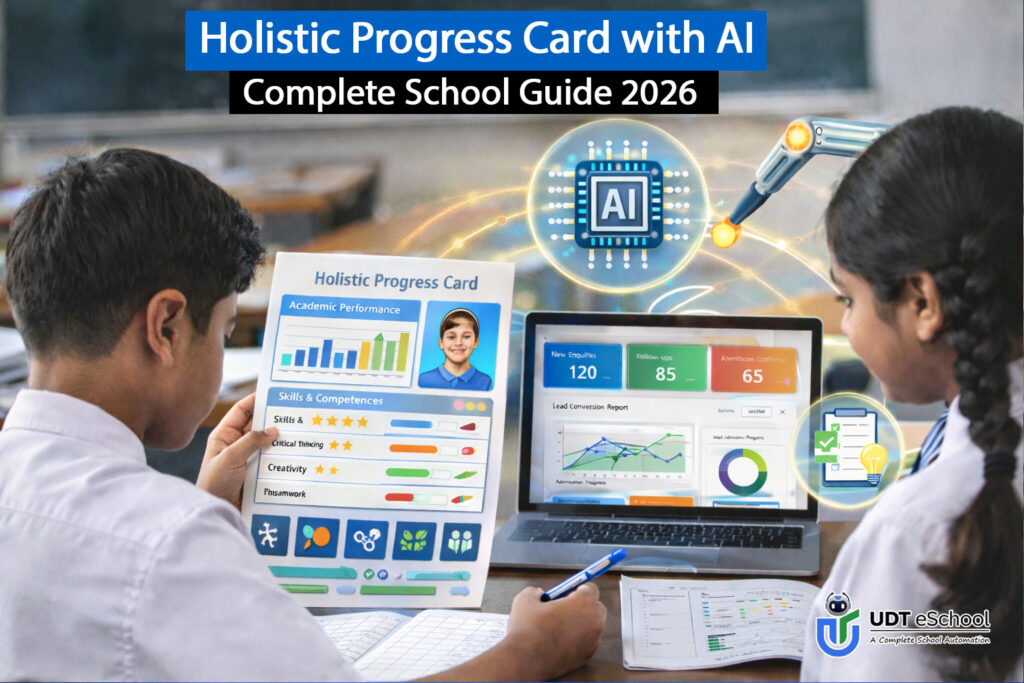
Holistic Progress Card with AI in Schools – A 2026 Implementation Guide
A Holistic Progress Card (HPC) is a 360-degree assessment framework designed to capture a student’s academic progress, competencies, skills, participation and broader development—not just examination marks. Developed under the PARAKH assessment framework and aligned with the vision of CBSE (Central Board of Secondary Education) and NEP 2020 (National Education Policy 2020) the HPC represents a shift toward more comprehensive and competency-based student assessment.
For schools, the challenge is turning this framework into a practical day-to-day assessment process. This is where digital systems and carefully applied AI can help schools organise evidence, track competencies, generate meaningful reports and communicate student progress more effectively.
What Is a Holistic Progress Card?
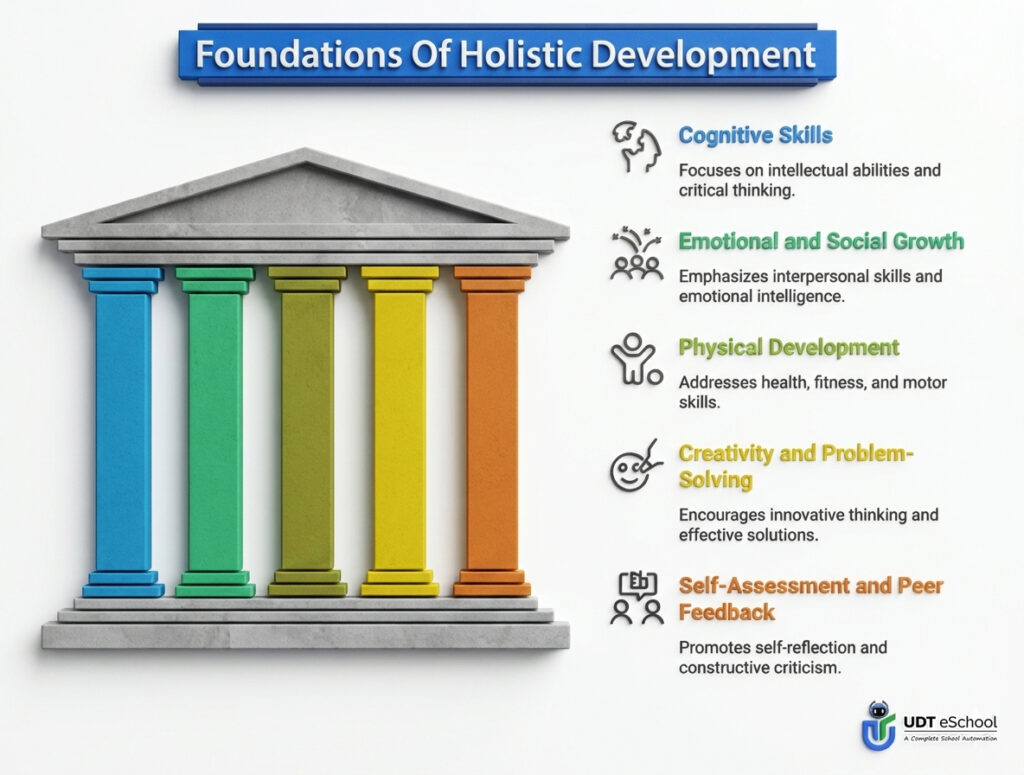
The holistic progress card with AI enables schools to assess both academic and non-academic development in a unified and structured format.
A Holistic Progress Card (HPC) provides a 360-degree evaluation of student performance. Instead of focusing only on exam marks, it includes:
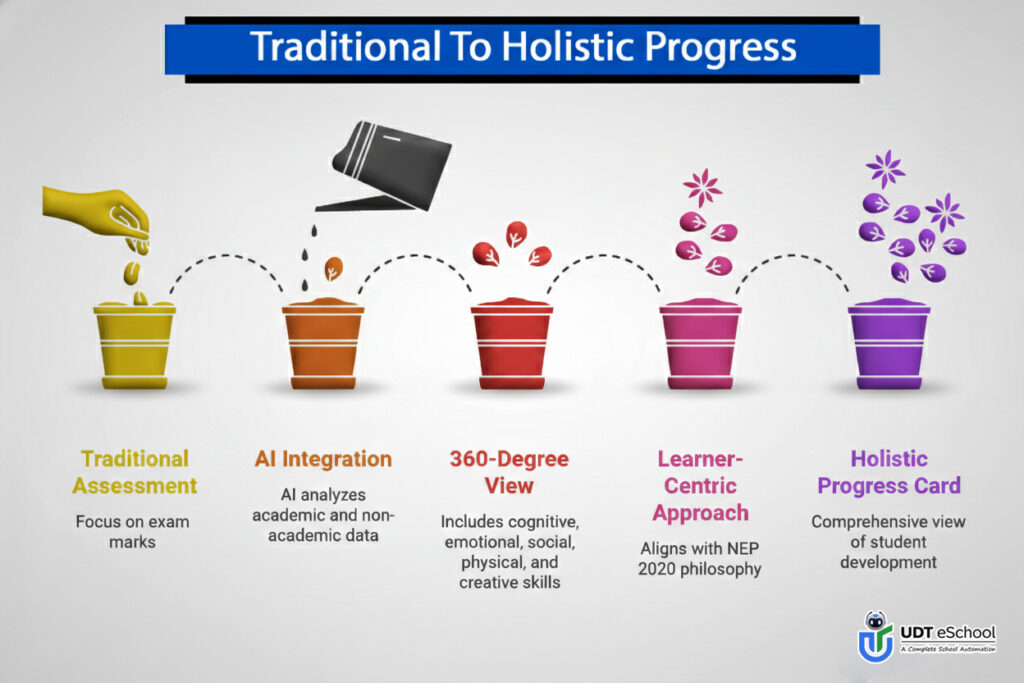
- Cognitive skills
- Emotional and social development
- Physical growth
- Creativity and problem-solving
- Self-assessment and peer feedback
This model reflects the learner-centric vision of NEP 2020 and is widely adopted by CBSE schools moving toward competency-based assessment systems.
👉 Common searches this section answers:
- “what is holistic progress card in CBSE”
- “360 degree assessment NEP meaning”
This approach mirrors the learner-centric philosophy of the National Education Policy (NEP) 2020.
What Does HPC Mean in School Education?
HPC stands for Holistic Progress Card in school education. It is a comprehensive assessment approach that looks beyond marks and grades to capture a student’s overall progress across academic learning, competencies, skills, participation, and other developmental areas. The Holistic Progress Card is designed to give schools, teachers, students, and parents a broader understanding of learning and development rather than relying only on examination results.
Why Schools Must Adopt HPC in 2026
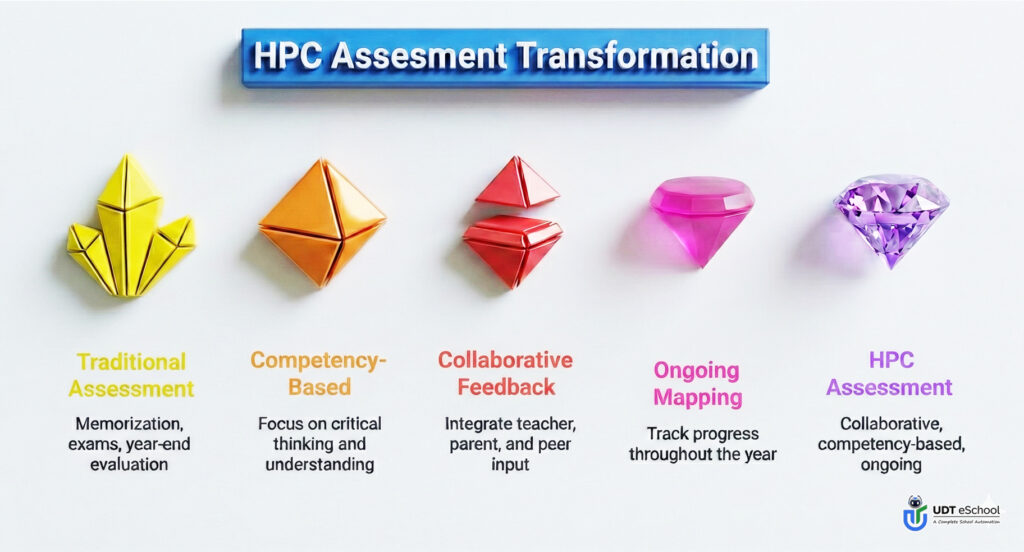
📊 Moves Beyond Marks
HPC shifts evaluation from memorization-based exams to competency-based learning, improving conceptual understanding and critical thinking.
👨👩👧 Integrates Teacher, Parent & Peer Feedback
HPC incorporates multiple perspectives, making assessment more collaborative, transparent, and accurate.
📅 Ongoing Development Mapping
Instead of year-end results, HPC tracks student progress continuously, helping schools improve long-term learning outcomes.
Core Features Of Holistic Progress Cards
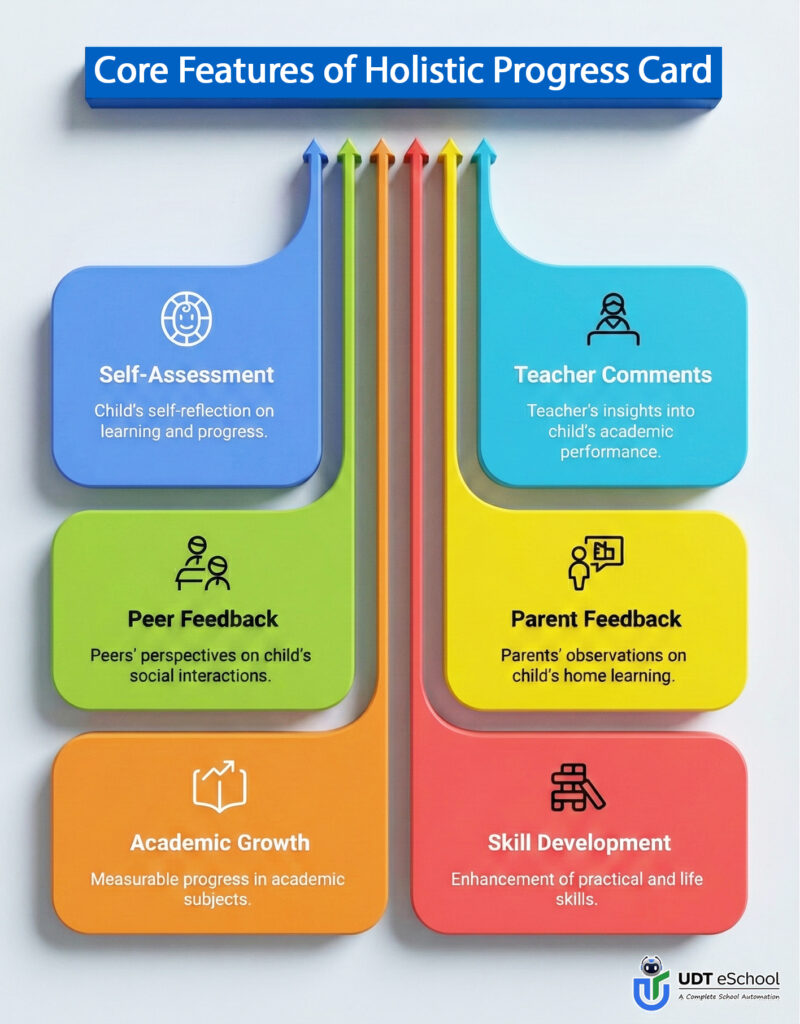
Holistic Progress Cards are designed to provide a detailed and meaningful understanding of student development.
They typically include:
- Self-assessment and reflection
- Teacher observations and qualitative feedback
- Peer and parent inputs
- Academic performance indicators
- Skill and competency tracking
- Co-curricular and activity records
These elements ensure that student evaluation goes beyond marks and reflects real learning progress.
How AI Can Support Holistic Progress Card Implementation
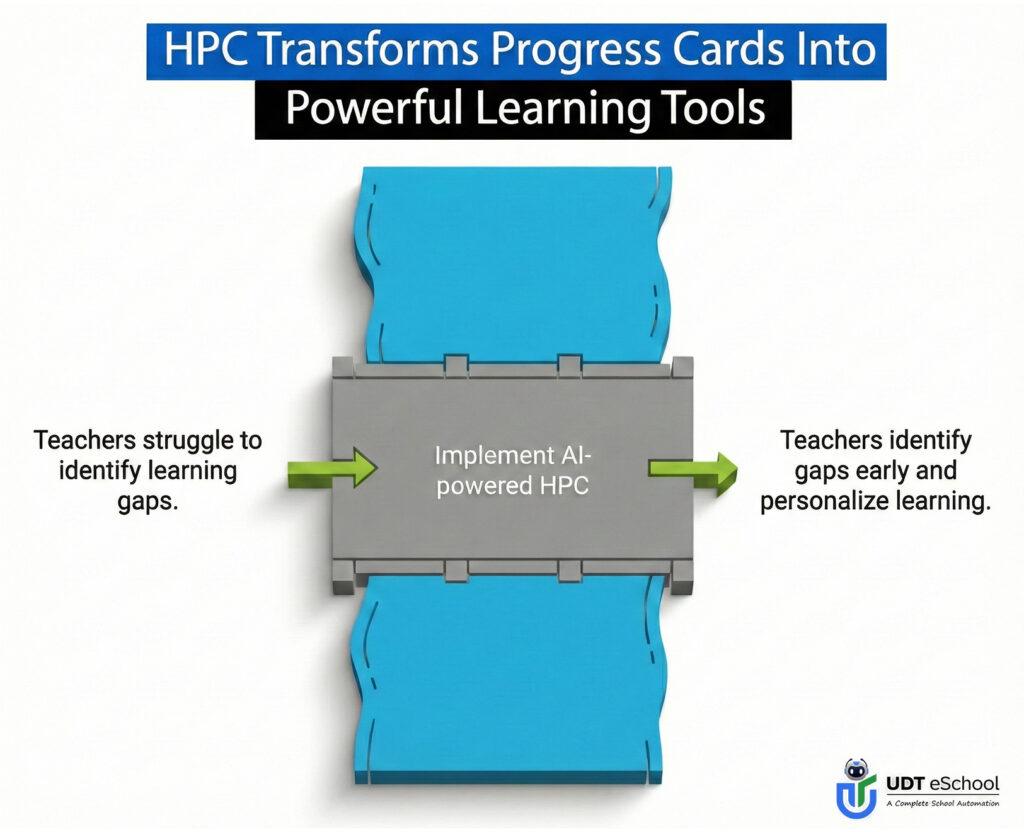
Implementing a Holistic Progress Card with AI does not mean allowing technology to make decisions about a student’s development. The role of AI should be to support teachers and school leaders by organising information, reducing repetitive administrative work and making assessment data easier to interpret.
When used responsibly, AI can support several parts of the HPC workflow.
1. Organising Assessment Evidence
Teachers may collect information from classroom activities, projects, assessments, observations and other learning experiences. AI-enabled systems can help organise this information so that relevant evidence is easier to review and maintain.
2. Identifying Patterns in Student Progress
AI can help analyse structured assessment data to identify recurring patterns, such as areas where a student is consistently performing well or where additional academic support may be required.
These insights can help teachers focus their attention, but the final interpretation should remain with the teacher or academic team.
3. Supporting Competency Tracking
A digital system can connect assessment records with relevant competencies and learning outcomes. AI can assist in organising this information and highlighting areas that may require further review.
This can be particularly useful when schools are managing assessment information for large numbers of students.
4. Reducing Repetitive Reporting Work
Preparing progress reports can involve significant administrative effort. AI-assisted systems can help organise existing assessment information into structured reporting formats, reducing repetitive data-entry and consolidation work.
Teachers can then review, edit and approve the information before it is shared.
5. Supporting Meaningful Feedback
AI can help schools organise feedback and generate structured suggestions based on available assessment information. Teachers can use these suggestions as a starting point while applying their own professional judgement and understanding of the student.
6. Improving Parent Communication
A Holistic Progress Card can contain more information than a traditional marks-based report. Digital systems can help schools present this information in a clearer and more accessible format, making it easier for parents to understand their child’s strengths, progress and areas for improvement.
7. Keeping Teachers at the Centre
The most important principle is that AI should assist assessment—not replace the teacher.
Teachers understand the classroom context, student behaviour, learning journey and individual circumstances that may not be fully represented in digital data. AI can organise information and surface patterns, but professional judgement remains essential when interpreting student progress and deciding appropriate support.
Teacher Tip: Use AI to reduce administrative workload and organise assessment evidence, but always allow teachers to review, interpret and approve the information before it becomes part of a student’s formal progress record.
According to UNESCO, digital assessment tools significantly improve learning outcomes when applied effectively.
Benefits of AI-Enabled HPC Implementation
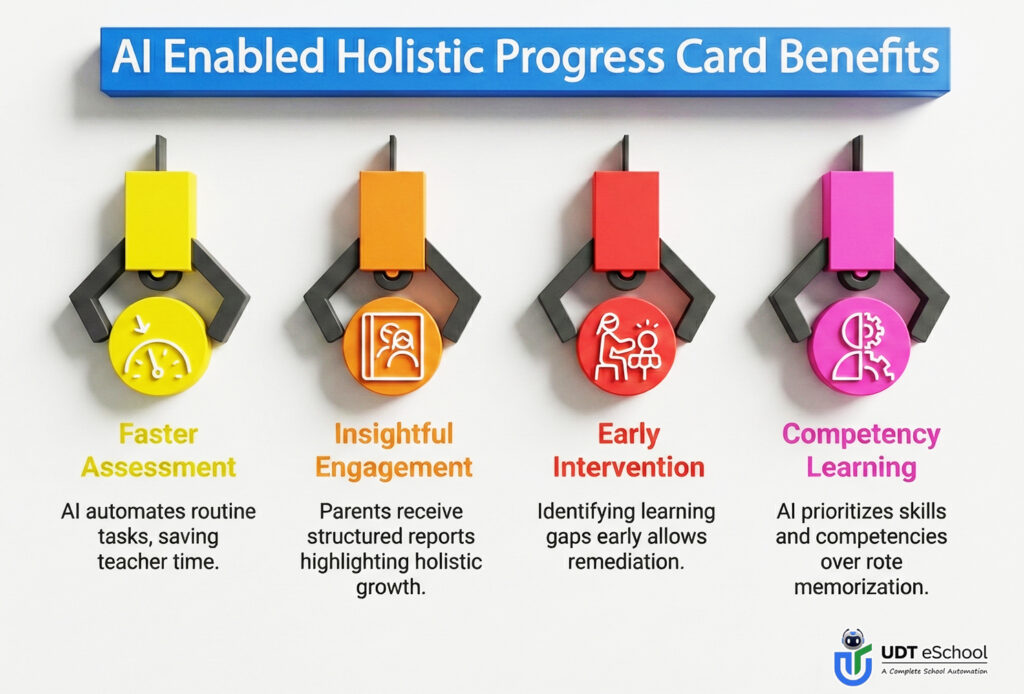
AI-powered HPC systems offer clear advantages for schools, teachers, and parents.
🚀 Faster, Better Assessment
Automates evaluation tasks, reducing manual workload and saving time.
📈 Insightful Parent Engagement
Provides structured, easy-to-understand progress reports for parents.
📌 Early Intervention
Helps identify learning gaps early, enabling timely corrective actions.
🧠 Competency-Driven Learning
Supports skill-based education aligned with NEP 2020 goals.
Challenges Schools Face Without AI
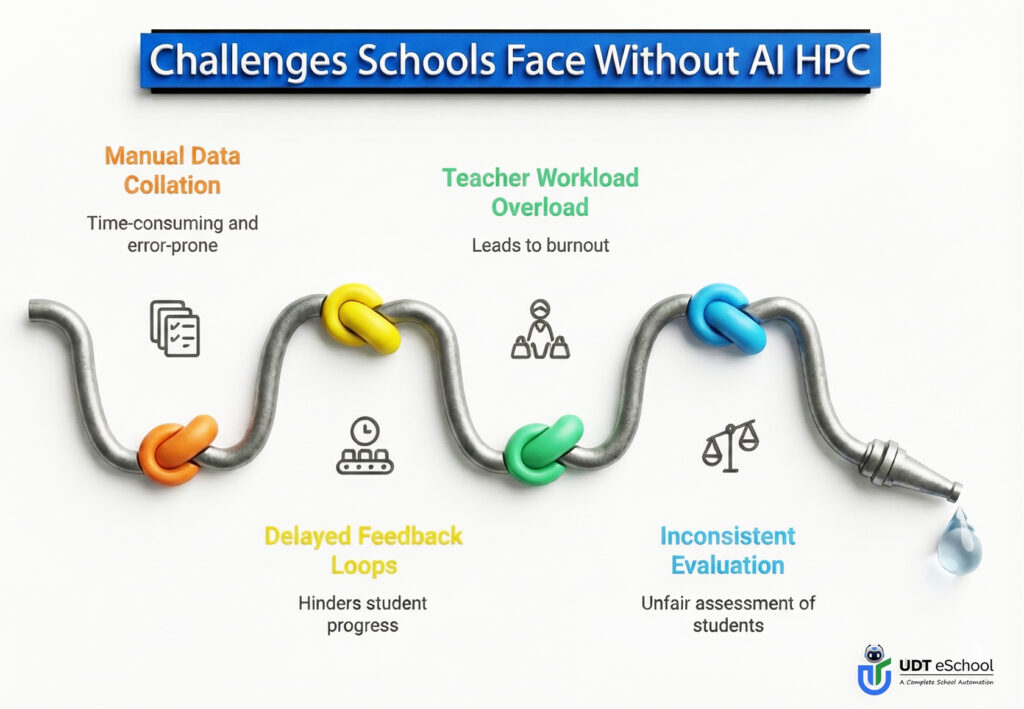
Without AI and digital systems, implementing HPC becomes complex and inefficient.
Common challenges include:
- Manual data collection and consolidation
- Delayed feedback cycles
- Increased teacher workload
- Inconsistent evaluation standards
Schools searching for “problems in implementing NEP 2020” often encounter these exact issues. AI-based systems help eliminate these bottlenecks and improve accuracy.
How UDT eSchool ERP Supports AI-Driven Holistic Progress Cards
UDT eSchool ERP provides an integrated solution for implementing AI-powered Holistic Progress Cards effectively.
📋 Unified Student Data
Centralizes academic, behavioral, and activity records in one platform.
🤖 AI-Assisted Evaluation
Automates competency mapping and performance analysis.
📊 Intelligent Dashboards
Offers real-time insights for teachers and school leaders.
👪 Parent Portal
Enhances communication through transparent and accessible progress tracking.
🔗 Related read:
SAFAL Exam Updated Guide
👉 Also explore:
Why Choose UDT eSchool for Holistic Progress Card?
UDT eSchool offers a complete AI-powered solution designed specifically for modern schools.
It simplifies Holistic Progress Card implementation by automating evaluation, data collection, and report generation.
The platform ensures compliance with CBSE and NEP 2020 assessment framework while reducing administrative workload.
👉 Schools using UDT eSchool’s school ERP system can seamlessly manage assessments, attendance, and even fee management systems from a single platform.
This integrated approach allows schools to focus more on student growth rather than administrative challenges.
Holistic Progress Card and CBSE: What Schools Should Know
The Holistic Progress Card (HPC) is part of the broader shift toward competency-based and multidimensional assessment envisioned under NEP 2020. For CBSE schools, understanding the HPC is therefore not simply about introducing a new report-card format. It is about developing a more comprehensive way of documenting and communicating student learning and development.
What Is the Relationship Between PARAKH, CBSE and HPC?
PARAKH (Performance Assessment, Review, and Analysis of Knowledge for Holistic Development) has been established under NCERT to support the development of assessment standards and practices in line with the goals of NEP 2020.
PARAKH has developed stage-wise Holistic Progress Cards to support a broader view of student development. These cover the four stages of school education:
- Foundational Stage
- Preparatory Stage
- Middle Stage
- Secondary Stage
For CBSE schools, the HPC framework provides an important reference point as schools move toward more competency-based and holistic approaches to assessment. Schools should always refer to the latest official CBSE, NCERT and PARAKH guidance applicable to their stage and requirements rather than treating a general online description as a substitute for official instructions.
How Does HPC Differ From a Traditional CBSE Report Card?
A traditional report card generally places significant emphasis on subjects, marks, grades and examination performance. A Holistic Progress Card, by contrast, is intended to present a broader picture of how a student is progressing.
Depending on the applicable stage and framework, this can include areas such as:
- Academic learning and subject competencies
- Learning outcomes and skills
- Student participation and engagement
- Self-assessment and reflection
- Peer or teacher feedback
- Social and emotional development
- Co-curricular and other areas of student development
- Areas requiring additional support
The purpose is not to eliminate academic assessment. Instead, the Holistic Progress Card adds a wider developmental perspective to the understanding of student progress.
What Should CBSE Schools Consider During HPC Implementation?
Schools moving toward a more holistic assessment process should begin with the framework and pedagogy rather than the software.
A practical implementation approach can include:
1. Understand the applicable HPC framework
Academic leaders should first identify the stage-specific assessment expectations and understand how the framework applies to their school.
2. Map competencies and learning outcomes
Teachers can identify the competencies, learning outcomes and developmental areas that need to be observed and documented.
3. Prepare teachers
Successful implementation depends heavily on teacher understanding. Staff need clarity on observation, evidence collection, assessment criteria and constructive feedback.
4. Establish consistent evidence collection
Schools should determine how classroom observations, projects, activities, assessments and other relevant evidence will be recorded and reviewed.
5. Involve students and parents
Where appropriate, self-assessment, reflection and meaningful parent communication can make the assessment process more participatory.
6. Use technology to simplify the process
Once the assessment workflow is clearly defined, a digital school management system can help organise records, track competencies, consolidate information and prepare structured progress reports.
Is There One Standard CBSE Holistic Report Card Format?
Schools should be careful about assuming that there is a single universal CBSE holistic report card format that applies identically to every student and every stage.
The HPC approach is stage-specific, and schools should follow the latest official guidance relevant to their context. A school’s digital report-card interface may therefore be designed to support the applicable framework while also accommodating the school’s academic processes and reporting requirements.
The important principle is that technology should support the assessment framework rather than define it.
How Can Digital Systems Support CBSE Schools?
Implementing a holistic assessment approach can involve considerable administrative work when information is maintained across spreadsheets, paper records and disconnected systems.
A digital school ERP can help schools bring relevant information into a more structured environment. Depending on the system and configuration, schools can use technology to:
- Maintain student assessment records
- Track competencies and learning outcomes
- Organise teacher observations
- Consolidate assessment information
- Generate structured progress reports
- Maintain historical student records
- Support parent communication
- Reduce repetitive administrative work
AI can add another layer of assistance by helping organise large volumes of assessment information, identify patterns and support reporting workflows. However, teacher judgement should remain central to interpreting student progress and making educational decisions.
Principal’s Perspective: The transition to holistic assessment is not primarily a technology project. Schools should first establish clear assessment practices and teacher processes, then use technology to make those practices easier to manage, monitor and scale.
For schools exploring digital implementation, this approach can help connect competency-based assessment, student records, teacher observations and parent communication within a more coordinated school-management ecosystem.
Practical Steps to Implement HPC with AI
Schools can implement HPC effectively by following these steps:
- Define competency-based evaluation frameworks
- Configure ERP systems for structured data collection
- Train teachers on observational and skill-based assessment
- Integrate AI-driven analytics tools
- Generate and review progress cards regularly
- Engage parents through digital reporting systems
🧠 People Also Search For
When exploring Holistic Progress Cards and AI-based assessment systems, users also search for related topics to better understand implementation, compliance, and tools. These queries reflect real concerns of schools adapting to NEP 2020 and CBSE guidelines.
- What is CBSE holistic progress card format 2026?
- How to implement holistic progress card in schools step by step?
- What is competency-based assessment in NEP 2020?
- AI in student assessment tools for schools in India
- Best school ERP software for CBSE schools
- Difference between report card and holistic progress card
- PARAKH assessment framework explained
- How AI helps teachers in student evaluation
- Digital progress card system for schools India
- Continuous and comprehensive evaluation vs HPC
Q. What is the full form of HPC in education?
A. HPC stands for Holistic Progress Card.
Q. What is a Holistic Progress Card in CBSE?
A. It is a comprehensive approach to documenting student development aligned with the broader competency-based assessment vision.
Q. What does HPC mean in school?
A. HPC means Holistic Progress Card, a multidimensional record of student learning and development.
Q. Is HPC the same as a traditional report card?
A. . No. A traditional report card often emphasises marks and grades, whereas HPC captures a wider range of evidence about student progress.
👉 These topics are closely aligned with frameworks from Central Board of Secondary Education and National Education Policy 2020, making them essential for schools aiming to stay compliant and future-ready.
📋 Frequently Asked Questions
What Is the Full Form of HPC in Education?
HPC stands for Holistic Progress Card in education. It refers to a comprehensive approach to documenting student progress across academic learning, competencies and broader developmental dimensions.
What is a Holistic Progress Card?
A Holistic Progress Card is a 360-degree evaluation system that tracks academic, social, emotional, and skill-based development of students.
What is a Holistic Progress Card in CBSE?
A Holistic Progress Card is a comprehensive student evaluation system introduced under NEP 2020 that measures academic performance, skills, and overall development.
Why do schools need AI for HPC?
AI automates analysis, ensures consistency, and provides insights that are difficult to generate manually.
Is Holistic Progress Card mandatory for CBSE schools in 2026?
Schools should follow the latest CBSE, PARAKH and NCERT guidance applicable to their stage and affiliation. The Holistic Progress Card is part of the broader competency-based assessment direction under NEP 2020, but schools should not interpret the HPC framework as a requirement to use a particular digital or AI platform.
Does HPC replace traditional report cards?
HPC enhances traditional report cards by adding multiple assessment dimensions; many schools use both during transition.
How can schools implement Holistic Progress Cards effectively?
Schools can use AI-powered ERP platforms to manage evaluation, automate reporting, and ensure compliance with NEP guidelines.
How does AI help in creating Holistic Progress Cards?
AI automates data collection, ensures consistent evaluation, and generates reports instantly, saving time and improving accuracy.
How does AI improve parent-school communication?
AI-powered systems provide real-time updates, structured reports, and better transparency for parents.
What is the difference between a report card and a Holistic Progress Card?
A traditional report card focuses on marks, while a Holistic Progress Card evaluates complete student development, including skills and behavior.
Official Resources and References
The Holistic Progress Card is part of the broader movement toward competency-based and multidimensional assessment under NEP 2020. Schools should refer to official government and education bodies for the latest framework, guidance and implementation updates.
PARAKH — Holistic Progress Card
PARAKH has developed stage-wise Holistic Progress Cards covering the Foundational, Preparatory, Middle and Secondary stages. The official resource provides information about the HPC framework and its approach to documenting broader student development.
Official resource: PARAKH — Holistic Progress Card
Ministry of Education — PARAKH
The Ministry of Education provides information about PARAKH and its role in strengthening assessment practices, including the move toward competency-based assessment in alignment with NEP 2020.
Official resource: Ministry of Education — PARAKH
CBSE — Official Resources
CBSE schools should refer to the official CBSE website for the latest circulars, academic resources, assessment-related notifications and instructions applicable to their schools.
Official resource: CBSE — Central Board of Secondary Education
National Education Policy 2020
The National Education Policy 2020 provides the broader policy framework for transforming assessment from a predominantly summative approach toward more regular, formative, competency-based and holistic assessment.
Official resource: National Education Policy 2020 — Ministry of Education
Important: Schools should always refer to the latest official CBSE, NCERT, PARAKH and Ministry of Education guidance applicable to their stage and institutional requirements. This article is intended as an educational guide and should not be treated as a substitute for official instructions.
Conclusion
The Holistic Progress Card with AI represents an important step toward a more comprehensive and learner-centric approach to student assessment. As education moves toward competency-based and multidimensional assessment, schools need more than a new report-card format—they need reliable processes for collecting, evaluating, interpreting, and communicating evidence of student progress.
CBSE and PARAKH are progressively aligning school assessment with the competency-based, multidimensional approach envisioned under NEP 2020. For schools, the practical challenge is no longer simply changing the report-card format, but building reliable processes for collecting, evaluating and communicating evidence of student progress.
Technology can make this transition more manageable. A well-designed digital school system can help teachers organise assessment information, track competencies, maintain student records, generate structured reports, and communicate meaningful progress with parents. AI can further support these workflows by helping schools identify patterns, organise information, and reduce repetitive administrative work—while keeping teachers at the centre of assessment and professional judgement.
For schools preparing to strengthen their assessment practices, the priority should be to understand the applicable framework, prepare teachers, establish consistent assessment processes, and then use technology to make those processes more efficient and scalable.
UDT eSchool ERP can support this transformation by bringing assessment, student records, competency tracking, reporting, and wider school-management workflows into a connected digital environment.
Ready to explore how your school can move toward smarter, more structured assessment? Explore UDT eSchool or request a personalised demonstration.
📖 UDT eSchool doesn’t claim to define CBSE policy. It helps schools operationalise the direction education policy is already taking.
Related Articles
Ready to Transform Your School?
Empower your institution with an intelligent School ERP that streamlines administration, strengthens parent engagement, automates routine tasks, and helps school leaders make data-driven decisions with confidence.
 ✔ Reviewed & Published
 UDT eSchool Editorial Team
This article has been researched, reviewed, and published by the UDT eSchool Editorial Team, specialists in School ERP Software, NEP 2020 implementation, CBSE reforms, AI in Education, Competency-Based Assessment, Holistic Progress Cards, Parent Engagement, and Digital School Transformation.| Content Type | Expert Educational Guide |
| Reviewed By |
UDT eSchool Editorial Team for CBSE / PARAKH / NEP 2020 assessment references |
| Fact Checked | ✔ Yes |
| Primary Sources | CBSE, NCERT, Ministry of Education & NEP 2020 |
| Last Updated | August 2026 |
| Article Version | Version 2.0 |

Education Technology Consultant at UDt eSchool with 10+ years of experience helping schools digitize operations and implement CBSE-aligned systems.